 Malta: Phoenician, Punic and Roman, the second book in the series 'Malta's Living Heritage' published by Midsea Books Ltd has just been released. Author Prof. Anthony Bonanno traces the island's past from the end of the Prehistoric Bronze Age down to the end of the Roman period. Photography by Daniel Cilia and reconstructions of existing remains, particularly from the Roman period, help the reader visual the cultural development around the trading activities that made Malta an important center in the classical world.
Monday, November 21, 2005
Malta: Phoenician, Punic and Roman
Malta: Phoenician, Punic and Roman:
Malta: Phoenician, Punic and Roman, the second book in the series 'Malta's Living Heritage' published by Midsea Books Ltd has just been released. Author Prof. Anthony Bonanno traces the island's past from the end of the Prehistoric Bronze Age down to the end of the Roman period. Photography by Daniel Cilia and reconstructions of existing remains, particularly from the Roman period, help the reader visual the cultural development around the trading activities that made Malta an important center in the classical world.
Malta: Phoenician, Punic and Roman, the second book in the series 'Malta's Living Heritage' published by Midsea Books Ltd has just been released. Author Prof. Anthony Bonanno traces the island's past from the end of the Prehistoric Bronze Age down to the end of the Roman period. Photography by Daniel Cilia and reconstructions of existing remains, particularly from the Roman period, help the reader visual the cultural development around the trading activities that made Malta an important center in the classical world.


Sand of the Arena: A Gladiators of the Empire Novel
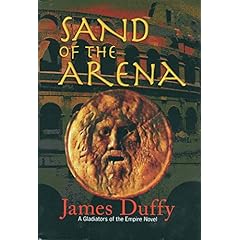
I had the pleasure of meeting author Jim Duffy last Spring at the first North American conference of the Historical Novel Society in Salt Lake City, Utah. Jim was working on the final edits of his book "Sand of the Arena" that will usher in a new series of novels, "Gladiators of the Empire". Jim was kind enough to send me a pre-release galley of his new book and I have enjoyed reading it. Jim has conducted extensive research in the life and training of gladiators and it shows in the depth of detail he has woven into his novel. His action scenes are very well paced and draw the reader quickly forward, rewarding him with a believable and gratifying conclusion to each encounter.
I found the protagonist's Ethiopian friend Lindani's almost miraculous feats of prowess in the beast hunts particularly fascinating and the shipwreck scene graphically realistic and immersive (no pun intended). Duffy's experience in writing for television has given him insight into the entertainment aspect of historical fiction and his tightly written prose provides a literary adrenaline rush that is seldom experienced in a first novel.
I do think as the series progresses, however, he will need to balance the glorification of victory and the rush of audience acclaim with the bittersweet aspects of belonging to a social class that is considered the lowest of the low, and the obstacles that this creates in the pursuit of other objectives.
Book description:
"In 63 AD the long arm of the Roman Empire stretches across the European continent and the gladiatorial games are awash in blood and glory. For Quintus Honorius Romanus, son of one of the richest men in Rome, everything is as it should be--as long as he can sneak off to the amphitheater for a little entertainment. Things go drastically wrong, however, when Quintus loses his family, his social standing, and his name to an imposter. Faced with a life of menial slavery, Quintus joins a gladiatorial school instead and begins a game of unimaginably high stakes, as he vows to bring down the usurper who stole his life. But first he must survive his training. Together with the deadly African hunter Lindani and the lethal gladiatrix Amazonia, Quintus learns the hard way what it means to live--and die--in the arena.
Rough-and-tumble, fast-paced, and unrelenting, Sand of the Arena brings the Roman Empire to life and sheds light on its most controversial form of entertainment. Quintus, Lindani, and Amazonia face the ultimate test of courage and skill inside the arena--and out. For the Gladiators of the Empire, the goal is simply to survive!"
Thursday, November 17, 2005
Lest Darkness Falls

I was up on Amazon yesterday looking for bargains on non-fiction books about the Roman Empire and stumbled across a recommendation for a time-travel story in which a 1940s era man travels back in time to the 6th century and subsequently tries to prevent the fall of the Roman Empire. Of course, I dearly love time travel stories and stories that deal with time traveling to the ancient world most of all. So I couldn't resist checking reviews of it and finally ordering it for myself.
Last night I got a call from my son, a sci-fi writer and officiando, and mentioned the book to him. He told me that Sprague De Camp and his wife Catherine, who were contemporaries of Isaac Asimov and Robert Heinlein, gained more recognition for his series about Conan the Barbarian than some of his more classic works like this title. Apparently they recently passed away which led their publisher to rerelease some of their earlier works. Judging from Harry Turtledove's glowing recommendation below, I'm glad they did.
"Lest Darkness Fall is the best Connecticut Yankee in King Arthur's Court-type story ever written, with the possible--by no means certain--exception of the Connecticut Yankee itself. The tale of a modern man struggling to introduce technology in sixth-century Italy--where theology and war dominated affairs, and concern for knowledge was a tiny afterthought at best, with best not coming along very often--grips from the first page. Like any of de Camp's heroes, Martin Padway has no easy time of it, having to cope with the ignorance and foibles of a great many people, himself emphatically included. It's no wonder that Lest Darkness Fall, which first appeared in abridged form in the December 1939 issue of Unknown and was published at full length in 1941, has been in print almost continuously ever since, and no wonder that Baen Books has chosen to put it in print once more.
The plot of Lest Darkness Fall was not the only thing about it that grabbed me. I also found fascinating the world of sixth-century Italy that de Camp depicted with such loving attention to detail--including a lot of the unpleasant, smelly details that often get omitted from fiction dealing with the past. At the time, I knew nothing about such things, and had no real notion of how much of the background of Lest Darkness Fall was real and how much de Camp was making up. I started trying to find out, and soon discovered that, except for the introduction of Martin Padway, de Camp was making up next to nothing. He had done his homework, and done it well."
Subscribe to:
Posts (Atom)