Monday, January 21, 2008

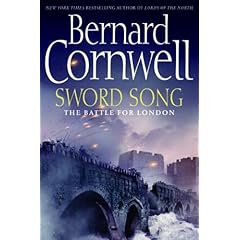
Sword Song by Bernard Cornwell


"The year is 885, and England is at peace, divided between the Danish kingdom to the north and the Saxon kingdom of Wessex in the south. Uhtred, the dispossessed son of a Northumbrian lord—warrior by instinct, Viking by nature—has finally settled down. He has land, a wife, and two children, and a duty given to him by King Alfred to hold the frontier on the Thames. But then trouble stirs: a dead man has risen, and new Vikings have arrived to occupy the decayed Roman city of London. Their dream is to conquer Wessex, and to do it they need Uhtred's help.

Alfred has other ideas. He wants Uhtred to expel the Viking raiders from London. Uhtred must weigh his oath to the king against the dangerous turning tide of shifting allegiances and deadly power struggles. And other storm clouds are gathering: Ætheleflæd—Alfred's daughter—is newly married, but by a cruel twist of fate, her very existence now threatens Alfred's kingdom. It is Uhtred—half Saxon, half Dane—whose uncertain loyalties must now decide England's future.

A gripping story of love, deceit, and violence, Sword Song is set in an England of tremendous turmoil and strife—yet one galvanized by the hope that Alfred may prove an enduring force. Uhtred, his lord of war and greatest warrior, has become his sword—a man feared and respected the length and breadth of Britain."

Sunday, January 13, 2008

Bulgarian author shares love of her country and its ancient history in new time travel novel


I'm so excited to see that a woman from Bulgaria with a love of her country's ancient history has written a time travel novel that whisks readers back in time to 5th century BCE Thrace. I've been fascinated by all of the reports of such beautiful artifacts that have been peppering the news these past few years and have yearned to learn more about the history of ancient Thrace Now I can do this in a book that also gives me a time travel adventure as well.

Thracian Princess by Bistra Johnson, (nee Tangarova), explores the world of Thrace when its tribes were unified by the Odrysians and ruled by their leader Teres in the 5th century BCE.

"The 144-page book itself tells the story of Veronica, a young English woman whose parents bought a house in Stara Zagora and moved to Bulgaria. In somewhat of a period of transition herself, she goes to visit them, meets a handsome neighbour (an architect, at that) and starts to learn about the country.

Then, the reader is as surprised as is Veronica – suddenly she is in ancient Thrace (called Trakiya in Bulgarian), and the beloved new wife of the king.

Through this experience, the reader, like Veronica, learns first-hand about a world that is probably unknown to most.

Bistra says that her facts came from a variety of sources and lots of research. A comprehensive glossary at the back substantiates and further explains many of the characters and terms. For example, the town where the novel is set has been known under eight names: Beroe (meaning “iron”, a Thracian settlement), Augusta Trajana (Roman era), Beroia/Vereia, Irinopolis (in honour of Empress Irina, in the Byzantine era), Boruy (during the First Bulgarian Kingdom), Eskizagra (Turkish for “behind the mountain”), Zheleznik (Slavic for “iron”), and now, finally, Stara Zagora (meaning “the old one behind the mountain”)."

Thracian Princess is available from Lulu.com in both English and Bulgarian.

Tuesday, December 25, 2007

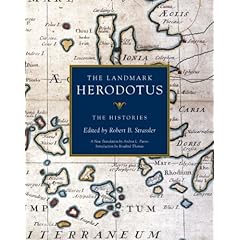
Strassler's The Landmark Herodotus released by Pantheon Press


Robert Strassler, the 70-year-old president of Riverside Capital Management Corp., a private investment firm, is a Harvard graduate who describes himself as a historian of the ancient Mediterranean. Back in 1996, he edited "The Landmark Thucydides: A Comprehensive Guide to The Peloponnesian War," that was published by CBS Corp.'s Free Press. This book received excellent reviews and sold over 24,000 copies. It has taken 10 years for a sequel "The Landmark Herodotus" is now available from Pantheon with 20,000 copies in print.

When Wall Street Journal columnist, Jeffrey Trachtenberg asked Strassler why it took so long to write this sequel, Strassler says, "Thucydides is more narrowly focused. He was interested only in military and political history. Herodotus is interested in everything. He wants to know what people wear, what gods they worship, what crops they grow. I needed 11 appendices for Thucydides to provide context, but we have 21 for Herodotus, and we could have done another five to 10."

When asked about the reliability of Herodotus' chronicles, Strassler replies, "There are a lot of questions. He does tend to write about fables, things that aren't real. His job was to tell you what he heard. He's critical, but there are anecdotes where you don't know if he's pulling your leg, or his leg is being pulled. For example, he said he saw a sign on one of the Pyramids. He asked his Egyptian guide about it and says he was told that the sign listed the amount of garlic, leeks and onions consumed by the workmen over the 20 years it took to build the pyramid. Do you think he believed it? But he put it in his book. You can't always be sure. And he wasn't an eyewitness to everything. But this book has survived for 2,500 years, and it offers a huge panorama of his world."

If you wish to learn even more about Herodotus, I would highly recommend an audio course offered through the Teaching Company, Herodotus: Father of History presented by Professor Elizabeth Vandiver of Whitman College.