Showing posts with label novel. Show all posts

Thursday, July 08, 2010

Review: Persona Non Grata by Ruth Downie

Persona Non Grata: A Novel of the Roman Empire (Roman Empire Series)As senior surgeon for the 20th legion in Britain, Gaius Petreus Ruso has had to deal with everything from murdered bar maids to mystical stag men.   But when he returns home to his family's villa in southern Gaul after receiving a cryptic request marked "urgent", he's hardly prepared for what he finds there.  His sister has fallen in love with a gladiator, his brother is about to be sued by the swindling agent of the local senator, and the brother of his sister-in-law has gone missing in a suspicious shipping mishap.  To make matters worse, the the senator's agent drops dead of apparent poisoning in Ruso's study and Ruso himself quickly becomes the prime suspect.  What's a well-meaning but financially strapped medicus to do?

Although the scoundrel's last utterance points to Ruso's social climbing ex-wife who had married the man not realizing he did not own the sumptuous villa where he resided, the rascal appears to have also had contentious encounters with Ruso's step mother, sister, and even the voluptuous widow next door who is almost singlehandedly running an amphora manufacturing business.  Ruso's not even sure he can safely discount the man's grief-stricken sister. Furthermore, Ruso learns that the agent arranged for the worm-riddled vessel that his sister-in-law's brother disappeared in so he wonders if his brother's wife, the seemingly loving mother of his five rambunctious nieces and nephews, could have slipped something into the cool drink she offered the man when he came to the farm looking for Ruso.  

Fortunately, Ruso brought along his British housekeeper/lover Tilla, whose unassuming way of looking at events with the innocence of child, helps Ruso resolve his latest gaggle of delimmas without alienating his family or landing in the arena as the afternoon snack for the beastkeeper's bear.  Once again Ruth Downie has conjured up late 1st century CE Roman life and peopled it with characters that provide a panoply of suspects along with plot twists to keep readers guessing until the gratifying climax.

The ending leaves you wondering, though, if Ruso is going to give up the army life, settle down in Gaul and make an honest woman of Tilla.  I hope not.  I prefer the setting of a military infirmary or outpost in the wilds of Roman Britain to the more Romanized society of southern Gaul, although this book was certainly enjoyable.   Another aspect of the book that made me nervous was the introduction of the local cult of Christos and Tilla's involvement with it.  Fortunately, Downie invested the experience with humor created by Tilla's naivete about other religions and her effort to compare the new religion with those she is more familiar with.  I just didn't want the series to become a platform for idealizing early Christianity and promoting one religion of the period over others that were fervently and, in many cases, reverently practiced at the time.

I look forward to sharing Ruso and Tilla's next adventure.  Fortunately, a quick check on Amazon shows Downie will be releasing the next installment, entitled "Caveat Emptor", in December 2010.  The book description confirms that Ruso and Tilla do return to Britannia to investigate the disappearance of a local tax collector.  I see he's going to be in Veralamium, the Roman settlement that became St. Alban's.  I've actually been to the ruins of Veralamium so it should be great fun to read a story with that setting.  
  

Caveat Emptor: A Novel of the Roman Empire   Terra Incognita: A Novel of the Roman Empire   Medicus: A Novel of the Roman Empire

Thursday, March 25, 2010

Review: Fire in the East: Warrior of Rome by Harry Sidebottom

Fire in the East: Book One of Warrior of RomeA ballista is a fearsome Roman siege weapon that uses torsion springs made of twisted animal sinew to hurl stone projectiles or bolts over 500 yards.  Ballistae were used for both prosecuting a siege as well as to defend a besieged city from attacking forces employing siege engines themselves. A man who knew how to most effectively deploy such weapons was certainly worth the military title of Dux Ripea, a rank roughly equivalent to a regional commander and just one step below that of provincial governor. An officer who had earned the cognomen of Ballista must be extraordinary indeed - at least so thought the people of Arete, a Roman outpost on the fringes of the Syrian desert. But this tall, pale-eyed barbarian with flowing blond locks was not at all what they were expecting.

Ballista may not have been what the scheming merchants, priests and caravan lords were hoping for, but he is exactly what they needed to defend the bustling center of trade against a looming horde of Sassanid Persians led by Shapur I himself, King of Kings.

And so, the story of the siege of Arete unfolds from classical scholar Harry Sidebottom. I found myself captivated by not only the depth of knowledge of ancient siege craft conveyed through the observations and decisions of this unusual Roman commander but by Sidebottom's complex characterizations of not only Ballista but his unlikely household as well.

Ballista, himself, is a Germanic political hostage that has been raised and educated in an imperial court, where in just one year alone six men claimed the emperor's crown only to be slaughtered by mutinous soldiers, lynched by their own bodyguards or beaten and dragged naked through the streets of Rome.  In the year of Ballista's birth, the vainglorious boy emperor Elagabalus is murdered by his own Praetorian guard in a latrine and this brutal act seems to presage the tumult Ballista will face in the years ahead.

Civil war and repeated barbarian incursions have also forced embattled emperors to recruit Germans, Sarmatians, Arabs, Armenians, and Moors from the far reaches of the empire.  So, the opportunity to learn the art of war presents itself early to the young nobleman, who, at the age of just 16 finds himself in the forces of the brutal, gargantuan, soldier-emperor Maximinus Thrax besieging the city of Aquileia.  It would prove to be just one of many sieges in his military career that would provide him with the special knowledge later needed by the Emperors Valerian and Gallienus to deal with a fresh Persian incursion into Roman Syria as well as a solid understanding of how to relate to and motivate a fighting force.

But Ballista is more than the quintessential commander, he is still a warrior of northern traditions in an unfamiliar landscape who struggles with who he is as a man while trying to perform his sworn duty to the empire.  He is aided in this task by a diverse "familia".

Maximus, his Celtic bodyguard, has fought side by side with Ballista so many times they move almost as one man.  But, where Ballista is contemplative, Maximus relies on instinct which controls not only his combat maneuvers but his over sized libido as well. 

A crusty old Caledonian slave that has taken care of Ballista since he was a child serves as his steward but relates to the Dux Ripea almost like a querulous old uncle.  Their relationship reminded me of the contentious relationship between the slave Posca and Julius Caesar in the HBO miniseries "Rome". 

A shy Greek slave, Demetrius, serves as Ballista's secretary but frequently quotes epic poetry and uses examples in Greek mythology to try to guide his master in difficult decisions.  Bagoaz, a Persian slave boy, was purchased to teach Ballista the Persian language and advises him (and through Ballista, the reader) about Persian customs and battle tactics. 

By using the narrative device of these various characters, each possessing special knowledge about the different cultures of the period, Sidebottom is able to relate a lot of knowledge about the period couched in the natural flow of the story and character relationships.  Sidebottom's solid grasp of storytelling enables him to truly immerse the reader in the tumultuous world of the third century.  Fire in the East: Warrior of Rome serves as a vivid example of the best in historical fiction, where the genre serves to not only accurately inform its readers about the complexities of life and relationships between diverse cultures but imbues them with a passion to learn even more.

Rome and Persia in Late Antiquity: Neighbours and Rivals   Between Rome and Persia: The Middle Euphrates, Mesopotamia and Palmyra Under Roman Control (Routledge Monographs in Classical Studies)      The Catastrophic Era:: Rome Versus Persia in the Third Century      Fire in the East: Book One of Warrior of Rome
Enhanced by Zemanta

Saturday, January 23, 2010

Review: The Jupiter Myth by Lindsey Davis

The Jupiter Myth (Marcus Didius Falco Mysteries)Davis' Roman super-sleuth Marcus Didus Falco returns to Britain in this tale and must investigate the death of  a roguish courtier of King Togidubnus who ends up head first down a tavern well in a rather primitive Londonium.  The town, still scarred by fires and devastation wrought by Queen Boudicca in the Iceni Revolt a little over a decade before, holds no pleasant memories for Falco, who served there with the Second Augusta.  The Second Augusta Legion, under Petillius Cerialis, met Boudicca's eighty to one-hundred thousand rebels near Verulamium (modern St. Alban's ) with only two thousand Roman troops. Needless to say, few of the legion survived although Falco and his old friend Petro were among them.

Now, it seems gangsters from Rome have decided to exploit the new province. Falco discovers their hired muscle leaning on bakers, tavern keepers and even the local familia gladiatorix.  Davis does a good job of conjuring up the rough and tumble world of this colonial village on the Thames but I found passages to be exasperating as Falco would discover important information that should have been reported to the governor right away but instead, Falco decides he's too tired and figures it can wait until the next day which, of course, is too late.  The showdown between the imported thugs and the women gladiators seems more contrived than exciting and the villain's escape borders on the ridiculous.

I listened to the unabridged audio version of this book while I was exercising alone on my exercise bike and it's a good thing since I found myself blurting out derisive comments about Falco's contrived missteps.

Davis also has Petro acting remote and brooding for no particular reason and when the reason is finally revealed it doesn't really make any sense since Petro acknowledges he figured Falco would be watching his back.  I also found it pretty implausible that Helena Justina would be wandering the seamier neighborhoods of this grimy little backwater with her young children in tow and no escort. 

The frustrations I felt while reading this book were roughly equivalent to my generally negative reactions to "Last Act in Palmyra" and "See Delphi and Die".  Each time I read one of the Falco mysteries, I am hoping to catch a glimpse of the solid writing and plot development I experienced reading "The Course of Honor", "Silver Pigs", and "The Iron Hand of Mars".  Perhaps my biggest problem is that I don't really enjoy reading about a man who has such a negative view of life in general.  I guess some people consider Falco an interesting curmudgeon but I've had enough interactions with negative personalities in the real world that I prefer not to spend my fantasy world with them.

 Roman Myths (The Legendary Past)  The Course of Honour    The Iron Hand of Mars: A Marcus Didius Falco Mystery  

Wednesday, April 22, 2009

Review: Agincourt by Bernard Cornwell


Peering from his hiding place in a corpse-strewn alley of 15th century Soissons, young Nicholas Hook watched in horror as his fellow English archers, surrendered by a treacherous nobleman for a pouch of coins then disarmed, are set upon by their French captors. First, their bow fingers are sliced off, something Hook had heard stories about in the short time he had spent with his company. But then they were grabbed by the hair, their heads wrenched back, and their eyes gouged from their sockets. Still the Frenchmen’s bloodlust was not sated. Drawing their daggers, the French men-at-arms castrated the screaming, blinded men and left them to bleed to death, writhing on the cobblestones of the square in front of the little church where they had sought refuge.

This scene (I have condensed it) reflects the sheer brutality of warfare during the Hundred Years War. I have read many books in which conquering armies sack cities but I have never experienced the savagery as explicitly as I did reading Cornwell’s description of the fall of Soissons in 1415.

There, men not only hacked each other to pieces with poleax, mace, and sword, but the victors used their own bodies to violate and rend dazed women and hollow-eyed children. Even priests and nuns were raped or disemboweled. The shockwaves of this massacre of mostly French citizens by French soldiers rocked all of Christendom. In fact, this transgression was pointed to as the reason the French were so resoundingly defeated at Agincourt a year later, October 25, 1415, on the feast day of St. Crispin and St. Crispian, the patron saints of the town of Soissons.

Nicholas Hook escapes the carnage, along with a young novice, Melisande, the bastard daughter of a wealthy French nobleman. The couple flee to Calais where Nicholas relates all he has seen to the English commander there. As one of the few survivors of the butchery at Soissons, Nicholas is then summoned to London to repeat his story to King Henry V. Afterwards, the king assigns him to the company of Sir John Cornewaille (sometimes spelled Cornwall).

Sir John Cornewaille was born in 1364 to a noble family. His father, also Sir John Cornewaille, had been in service to the Duke of Brittany. His mother was, purportedly, the niece of the Duke. Sir John (the younger) served Richard II in Scotland. Then, he fought for the Duke of Lancaster in Brittany and, later, King Henry IV. Sir John was made a Knight of The Garter in 1410 for his numerous acts of courage on the battlefield. King Henry IV even gave him Elizabeth Plantagenet, the Duchess of Exeter, daughter of the third surviving son of King Edward III , in marriage.

But, although he was a celebrated tournament champion as well as decorated soldier, Sir John was not the romanticized warrior that people often think of when the subject of knights and chivalry arise. His training speech, as related by Cornwell, would make a U.S. Marine drill sergeant proud:

“ …you rip their bellies open, shove blades in their eyes, slice their throats, cut off their bollocks, drive swords up their arses, tear out their gullets, gouge their livers, skewer their kidneys, I don’t care how you do it, so long as you kill them!”

Now English archers were lethal and Nicholas Hook was an exceptional archer. Hook could punch a fletched shaft through the throat of a crossbowman at a distance considered out-of-range by the average archer. But Sir John taught him to kill with poleax and dagger as well. As it turned out he would need all of these skills to survive the killing fields of Agincourt.

But first, Hook had to endure the withering siege of Harfleur, a small port on the coast of Normandy. There, Henry V’s army not only faced a defiant French garrison supported by determined townsfolk, but, as the siege dragged on and on, devastating disease and dysentery.

Again Cornwell’s gritty narrative engulfs you in the grinding depravations of the victims of the besieged town as well as the squalid existence of the archers and men-at-arms clamoring outside the crumbling walls.

Cornwell also introduces us to a quintessential villain, not a menacing Frenchman, but a stringy-haired English priest who uses his office to force himself on women and now casts a lecherous eye on Melisande. Each time this priest appeared, I would picture the balding priest with bulging, lascivious eyes who is groping a cackling, bulbous-breasted prostitute in the History Channel series, “The History of Sex”. This character was so well drawn, like all of Cornwell’s characters, that he actually made my skin crawl.

Of course the climax of the novel is the battle of Agincourt. The battle itself lasted for about three hours and Cornwell’s account of the slaughter that occurred in those three hours left me as emotionally drained as those unarmored archers who, after exhausting their supply of bodkins, struggled in the knee deep mud of that sodden wheat field to fight off French knights wielding shortened lances and spiked maces.

I had always heard that the English won the battle of Agincourt because of their archers with their famous long bows. But, actually, the archers depleted their arrow supply on the first French battle charge. The second wave was repulsed in hand to hand fighting along the entire English line, with archers discarding their bows and resorting to secondary weapons like poleaxes and mallets.

I must confess, now, although I have seen probably all of the Sharpe’s Rifles television series and have over a dozen of Bernard Cornwell’s books in my “to be read” stack, Agincourt: A Novel
is the first book by Cornwell that I have actually read. I have read hundreds of other novels featuring accounts of many of the ancient world’s most famous battles - some, like Cannae, with much higher death tolls than Agincourt. But I have never read a fictionalized account of battle more immersive than the struggle described by Cornwell in this novel.

For interesting videos about the story behind the book, check out my earlier post.

Friday, April 03, 2009

Review: Of Merchants and Heroes by Paul Waters


The young Roman protagonist of classicst Paul Waters' first novel, "Of Merchants and Heroes", seeks to find his own identity in a society in the midst of redefining itself, as the traditionally conservative Roman culture begins to embrace, albeit uncertainly, Greek Hellenism at the end of the second Punic War. Born of a landed but impoverished family on a farm in the centuries old city of Praeneste, young Marcus' life takes a dramatic turn when he and his father, along with other travelers, are captured by pirates, led by a ruthless but charismatic rogue named Dicaearchus (Dicearchus, or Diceärch - d.196 BC), an Aetolain rogue (and real historical figure) employed by Philip V of Macedon to raid the Cyclades and Rhodian ships after the second Punic War.

Marcus, alone, escapes and flees to the house of his uncle, a prosperous merchant who has capitalized on the war with Hannibal. Forced to become his uncle's adopted son, Marcus accompanies his uncle to Tarentum where his uncle has obtained a contract to oversee properties seized from Tarentines who supported Hannibal in the recent war. There, he saves the life of the father of Titus Quinctius Flamininus, a man who would play a prominant role in the future of Greco-Roman relationships and command the allied forces of Rome and Greece in the defining battle of Cynoscephalae in 197 BCE.

Titus, like many young elite Romans of the period, had selectively embraced a number of Greek customs while living in Tarentum, a city originally founded by a group of exiled Spartans in the 8th century BCE. Since its founding, Tarentum had become a thriving trading center and bustling seaport where many nations of the ancient Mediterranean co-mingled, sharing ideas and lifestyles. At one of Titus' dinner parties, Marcus encounters his first hetaira, a lady he grows to respect as they encounter each other a number of times throughout the story. Pacifae personifies the skilled courtesan described by Lucian in his Dialogues of the Courtesans:

"In the first place, she dresses attractively and looks neat; she's gay with all the men, without being so ready to cackle as you are, but smiles in a sweet bewitching way; later on, she's very clever when they're together, never cheats a visitor or an escort, and never throws herself at the men. If ever she takes a fee for going out to dinner, she doesn't drink too much--that's ridiculous, and men hate women who do--she doesn't gorge herself--that's ill-bred, my dear--but picks up the food with her finger-tips, eating quietly and not stuffing both cheeks full, and, when she drinks, she doesn't gulp, but sips slowly from time to time....Also, she doesn't talk too much or make fun of any of the company, and has eyes only for her customer. These are the things that make her popular with the men."

But love does not bloom for the young man until he visits the gymnasium and meets Menexanos, a young Athenian athlete. Bisexuality was accepted openly in the ancient world although in Roman society any Roman male engaging in such relationships was expected to take the dominant role. Waters does not examine that aspect of the relationship but rather presents the relationship as a communion of souls who strive to serve their respective homelands and infuse their lives with meaning while cultivating courage and lending support the each other in their quest for achievement and honor. This approach most closely resembles the treatment of bisexual relationships in Mary Renault’s classic “The Last of the Wine”.

Both young men end up as combatants in the famous battle of Cynoscephalae – Menexanos as an Athenian hoplite and Marcus as a Roman tribune – in the climax of the novel.

The thing that struck me as particularly unique about this novel was the development of the character of King Philip V of Macedon. He is usually mentioned only in passing in many books focusing on this period, presumably because Hannibal is such a charismatic figure he steals the show, so to speak. But King Philip V is presented by Waters as quite a dashing, if a bit roguish, commander of note in his own right who mounted a serious threat to Roman dominance in the Aegean. True to his ancestors, he was a master of subterfuge and seemed to have a formidable grasp of both siege and naval warfare. He was an intelligent and perceptive leader who could have easily turned the tables on the Romans if the confrontation at Cynoscephalae had occurred on ground more suited to phalanx tactics than to maneuvers of small Roman maniple units. As it is, the battlefield apparently was not specifically selected by Flamininus, just a fortunate coincidence although I’m sure Flamininus was aware of the phalanx’s maneuvering vulnerabilities. It seemed to be more of a case of Fortuna smiling on the Romans that day rather than a victory resulting from a carefully sprung trap.

I enjoyed this novel immensely and highly recommend it. I think it ranks as one of the best “first” novels I have read and I look forward with anticipation to Waters next effort.

Note: This novel was recently released in the U.S. under the title "The Republic of Vengeance."

Tuesday, December 16, 2008

Agincourt - Where History Became Legend!


I see that Bernard Cornwell has shifted his historical focus once again from the Viking era to the reign of Henry V in his newest novel, Agincourt:

Young Nicholas Hook is dogged by a cursed past—haunted by what he has failed to do and banished for what he has done. A wanted man in England, he is driven to fight as a mercenary archer in France, where he finds two things he can love: his instincts as a fighting man, and a girl in trouble. Together they survive the notorious massacre at Soissons, an event that shocks all Christendom. With no options left, Hook heads home to England, where his capture means certain death. Instead he is discovered by the young King of England—Henry V himself—and by royal command he takes up the longbow again and dons the cross of Saint George. Hook returns to France as part of the superb army Henry leads in his quest to claim the French crown. But after the English campaign suffers devastating early losses, it becomes clear that Hook and his fellow archers are their king's last resort in a desperate fight against an enemy more daunting than they could ever have imagined.

One of the most dramatic victories in British history, the battle of Agincourt—immortalized by Shakespeare in Henry V—pitted undermanned and overwhelmed English forces against a French army determined to keep their crown out of Henry's hands. Here Bernard Cornwell resurrects the legend of the battle and the "band of brothers" who fought it on October 25, 1415. An epic of redemption, Agincourt follows a commoner, a king, and a nation's entire army on an improbable mission to test the will of God and reclaim what is rightfully theirs. From the disasters at the siege of Harfleur to the horrors of the field of Agincourt, this exhilarating story of survival and slaughter is at once a brilliant work of history and a triumph of imagination. - Harper/Collins Publishers


Bernard Cornwell discusses the history behind Agincourt.


Agincourt is slated for release January 20, 2009.

I had the pleasure of meeting Mr. Cornwell at the Historical Novel Society Conference in Albany, New York a couple of years ago. The conference is held every two years and is scheduled this year from June 12 -14 in Schaumburg, Illinois. My son lives in Schaumburg so I called him up and said "Guess who gets to come stay with you in June?" My son is also a writer and said if the guests were interesting he might join me. I'm excited to see that Margaret George is one of the featured speakers this year. Her "Autobiography of Henry VIII" is one of my all time favorites!

Friday, November 07, 2008

Conn Iggulden delivers riveting tale in Genghis: Birth of an Empire

A history resource article by  © 2015


I knew very little about the Mongol people before reading this novel. But Conn Iggulden brought the culture to life in a riveting narrative that kept me exercising way beyond my required minutes each day (I listened to the unabridged audible version). Iggulden's incarnation of "Timujin" is that of a warrior of admirable strength and skill as well as a man of vision and deep conviction. Some may also perceive him as ruthless although he appears to have demonstrated more restraint than other men spawned in such an environment. The tribal society Iggulden depicts on the unforgiving steppes is that of a hard people struggling just to survive in a land where the dispossessed (or just unfortunate) were often prey to any passing group desirous of their meager belongings, even if the spoils were just an old worn deel (coat) and a small pouch of rancid mutton. Yet, it was from these very wanderers that Genghis Khan forged a nation.

Mongolian Eagle Master Khairat Khan by Glenn Lewis.  Reproduced by permission CC by nc-nd 2.0
Hunting with eagles is a traditional form of falconry found throughout the Eurasian steppe,  Under Mongol rule, the Kyrgyz preserved their nomadic culture as well as eagle falconry tradition until the 1990s
I appreciated the author's notes at the end that pointed out where his tale diverged from actual events. I had heard that Iggulden had took such liberty with history in his Emperor series about Julius Caesar that some reviewers had said it resembled fantasy rather than historical fiction so I was a little apprehensive about believing too much of what I "learned" about the Mongol culture by reading this work. But, after hearing his explanations about which parts of the story veered from the actual events, I thought Iggulden had done an admirable job of crafting an intensely interesting story that, for the most part, followed the trajectory of Genghis Khan's early life closely enough in most areas that mattered.

Saturday, October 18, 2008

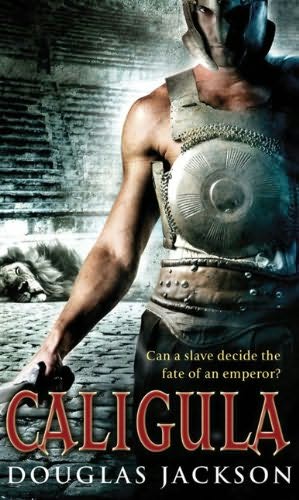
Caligula: The Tyranny of Rome by Douglas Jackson


Gaius Julius Caesar Augustus Germanicus, the third Roman Emperor, is better known by another name: Caligula, a name synonymous with decadence, cruelty and madness. His reign was marked by excess, huge building projects, the largest gladiatorial battles Rome was ever to see - men and animals killed in their hundreds - conspiracies, assassination attempts and sexual scandal. Rufus as a young slave grows up far from the corruption of the imperial court. His master is a trainer of animals for the gladiatorial arena. Rufus discovers that he has a natural ability with animals, a talent for controlling and schooling them. It is at the arenas that Rufus meets his great friend Cupido, one of Rome's greatest gladiators. It is his growing reputation as an animal trainer and his friendship with Cupido that attracts the cruel gaze of the Emperor.Caligula wants a keeper for the imperial elephant and Rufus is bought from his master and taken to the imperial palace. Life here is dictated by Caligula's ever shifting moods. Caligula is as generous as he is cruel, he is a megalomaniac who declares himself a living god and simultaneously lives in constant fear of the plots against his life.Technorati Tags: , , , , , ,

Sunday, June 01, 2008

Review: Nox Dormienda by Kelli Stanley


A history resource article by  © 2008

"The morning staggered by, still looking for a party. Saturnalia was officially over two days ago - unofficially there were still cockfights and dice throws, more wine-soaked quickies and the odor of vomit filling every alley."

Welcome to Kelli Stanley's world of Roman noir.

I have enjoyed "detectives in togas" for a number of years - particularly a late Roman Republican sleuth named Gordianus the Finder penned from the imagination of Steven Saylor. But I am not familiar with the private eyes that populate the books by Stanley's favorite author Raymond Chandler. Perhaps the closest I have come to this genre is reading James Lee Burke's Dave Robicheaux novels. Likewise, I have not shared my son's passion for noir genre films, although Bogart's Casablanca deserves its reputation as a classic. So I wasn't quite sure what to expect when Stanley sent me a copy of her book "Nox Dormienda", the first of a planned series of mystery novels featuring a crime-solving medicus in Agricola's Roman Britain promoted as a new genre, Roman noir.

For a child of the 50s and 60s raised on a diet of traditional historical epics, I found the "snappy-tough" noir-style dialogue jarring at first as I struggled to lose myself in the gritty reality of life in early Londonium. I felt like I had bought a ticket to see "Gladiator" but made a wrong turn inside the cineplex and stumbled into Tarrentino's "Pulp Fiction". But as the novel progressed and I got to know the interesting cast of characters, especially the quirky half-Roman, half-Britain medicus who could be gently caressing a puppy one minute and groping in the abdomen of a nearly eviscerated legionary the next, I succumbed to this author's efforts to conjure up a unique view of ancient Rome and began to enjoy the bumpy ride as Stanley's protagonist tugged me through Londonium's back streets, down into a mithraeum, up the back stairs of a seedy brothel, then into the provincial governor's palace where a weary Agricola, one of Domitian's most successful and honored generals, brooded over rumors of his pending dismissal as he realized his old soldier's boots may not be the best footwear to navigate the tightrope of imperial politics. I think what I enjoyed most was becoming an invisible member of the raucous household of Julius Alpinus Classicianus Favonianus (that's Arcturus to you natives or Ardur to any rheumy-eyed Trinovantean females) whose members so eagerly attempted to assist the Dominus in his investigations.

As a member of the senatorial class, Arcturus does not lead the hand-to-mouth solo existence of Lindsey Davis' Didius Falco. His extended family includes a cook, Venutius, who tries to win Arcturus over with cullinery experiments that often go awry, Draco, a hulking bodyguard with a legendary appetite who must be barely out of his teens as he's still growing out of his tunics, a steward, Brutius, who tries to keep Arcturus' adoring public at bay, Coire, a slave girl who would like to perform in the bedroom but is relegated to the examination room, and a love-struck freedman, Bilicho, who serves as assistant surgeon/gumshoe. As the story progresses, the seductive Gywnna, daughter of an aging Trinovantean auxiliary commander moves in along with her 10-year-old brother Hefin. Then, Bilicho drags home Stricta, his Egyptian girlfriend and one-time prostitute who also happens to be a witness to the murder Arcturus is attempting to solve. Add to this a faithful and much loved dog, Pyxis, her puppies, a cat, and a smattering of chickens and you definitely experience the "urbanity" of Roman life.

The only plot development that struck a sour note with me was introduction of an insane Christian legionary. Stanley seemed compelled to offer insanity as an excuse for his dichotomous behavior. Early Christians were not necessarily the pious, submissive victims of "The Robe", though. The violence of a soldier's profession would not have been viewed as incongruous with Christian teachings. This attitutde is clearly demonstrated several centuries later by the first so-called Christian emperor Constantine. Furthermore, a soldier who zealously berated his bunkmates for their embrace of other relgions of the period, like Mithrascism, would be doubtful in the inclusive polytheism of Roman culture. Acting like a near-zombie, chanting religious mantras with eyes glazed over, would have netted a man a quiet but violent fate in some back alley. The Roman army was still a well-oiled machine at this time and its members would not have tolerated such gum in the works for very long. That is not to say that there weren't any Christian legionaries. I just don't think the behavior exhibited by this character was needed to validate that portion of the plot.

Inevidentably, people who have read my review of Ruth Downie's "Medicus" will ask me how I would compare the two, since both not only feature a Roman medicus as primary protagonist but both set the stage for action in Roman Britain, albeit different time periods. Downie's Ruso is a regular army medicus recently transferred to the XX Legion in the remote port of Deva (now Chester). He is starting over after a ruinous divorce from a socialite wife that has left him almost penniless. His father has also died leaving a mountain of unpaid bills to Ruso and his brother struggling to scratch a living from a small farm in Gaul. Ruso's sense of "dignitas" drives him to not only attempt to reverse his family's financial misfortunes by writing a medical treatise, but to become a reluctant sleuth when a serial killer surfaces in the seedier part of town and no one else seems to view the lives of the unfortunate prostitute victims as worth the trouble. Ruso is a healer first and foremost and only consequentially an investigator. Arcturus, on the other hand, seems to eagerly embrace the opportunity to discover "who done it", welcoming the diversion from the humdrum of the normal practice of the governor's medicus. Both men, though, seem to be equally gifted with the healing arts.

Ruso's world is also decidedly different that than of Arcturus and, with the exception of Ruso serendipitously saving the life of the emperor Trajan in an earthquake, did not include encounters with the famous. But that is not to say that Ruso did not interact with equally intriguing characters. Downie's dilapidated military outpost teemed with vibrantly-drawn people thriving in the cauldron of a remote Roman frontier where two cultures attempted to co-exist. Arcturus' Londonium is nearly as primitive, since it is decades earlier. But, Arcturus' lineage from a native mother married to a Roman centurion provides Arcturus with an internal conflict in which his two halves attempt to co-exist in a single body. So, I would say both novels offer a unique perspective on the Roman experience in Britain and I look forward to the next installment in both of these series.

One last note - I truly appreciate the writing device Kelli Stanley uses to acquaint the reader with common latin references. Each time she uses a latin word, she places it in italics and includes it in a gloassary at the end of the book. Since I have read a number of novels and nonfiction works about the Roman Empire, I was familiar with many of the terms without looking them up. However, I welcomed the opportunity to expand my latin vocabulary. I was particularly pleased to learn that posca was a cheap alcoholic drink made from vinegar and herbs. I had to smile when I read that since it made me think of the personality of Julius Caesar's wannabe-strategist-slave, Posca, in the HBO miniseries, "Rome". I think a blend of vinegar and herbs aptly described him!