Showing posts with label Persia. Show all posts

Saturday, January 08, 2011

Review: King of Kings: Warrior of Rome Book 2 by Harry Sidebottom

King of Kings: Book Two of Warrior of RomeMarcus Claudius Ballista, a warrior of Rome despite his origins in the wilds of Germania, returns to the court of the Emperor Valerian after a valiant but futile defense of the (fictional) Syrian stronghold of Arete in the second installment of Harry Sidebottom's Warrior of Rome series, "King of Kings'.  Unfortunately, the fragile old emperor Valerian, who knowingly sent Ballista on what amounted to a suicide mission, is neither grateful for Ballista's courageous stand or even appreciative that he returned alive.  The feeble emperor has fallen under the sway of an unscrupulous courtier who has his eyes on the purple and is plotting to use a war with the Sassanid Persians to eliminate the old man and seize the throne for his two sons. 

But Ballista, with his battle experience and knowledge of eastern customs and battle strategies represents a threat to the conspiracy.  So, the wily Macrianus the Lame engineers another near suicide mission to save another besieged town. But, when Ballista manages to best the Sassanids once again, Macrianus sidelines Ballista to an administrative post in Ephesus where he has been given a mandate to persecute the new religious sect known as Christians.  Since Christians betrayed Ballista at the siege of Arete, he has no qualms, initially, to oversee the trials of arrested believers.  But as the brutality of the persecution promoted by a zealous local magistrate becomes painfully clear, Ballista devises a plan to use the law itself to halt the distasteful purge. 

But Macrianus had intended for Ballista to fail and uses the opportunity to replace Ballista with Macrianus' own ruthless son, Quietus, to gain even more favor with Valerian.  Once again Ballista finds himself back in Antioch and more out-of-favor than ever.  Treated as a pariah by most of the powerful at the imperial court, Ballista whiles away his time hunting with one of his few friends, the future emperor Aurelian.  Finally, Ballista is asked to serve as a lowly baggage train officer in the army the emperor has assembled to confront Shapur I, the King of Kings.  This fateful battle, that eventually results in the capture of Valerian, takes place near
The triumph of Shapur I over the Roman Emperor...Image via Wikipedia
Rock relief at Naqsh-e Rostam showing the Roman
Emperor Valerian kneeling before Persian King Shapur I
Edessa.

Macrianus has conveniently been left safely in Samosata with the imperial treasury while Quietus continues to pour honey in the ear of the old emperor convincing him to rely on the services of a turncoat, despite the fact that it is apparent to everyone else, particularly Ballista, that the army is being led into a trap.  At the last moment, the guide disappears and Quietus convinces Valerian to send Quietus back to Samosata for help (and safely out of harm's way), leaving Ballista to face the tightening Persian encirclement.  
The Humiliation of Emperor Valerian by Shapur,...Image via Wikipedia
The Humiliation of Emperor Valerian by Shapur,
King of Persia by Hans Holbein the Younger.


When I wrote my review of "Fire In the East: Warrior of Rome Book 1", I didn't realize Ballista was a real Roman commander of the period.  I had searched in vain for a real city named Arete that underwent a siege at about the time period covered by the novel and when I didn't find one, I assumed that the entire book was fictional (except for references to the emperor Valerian and the Persian king Shapur I.  Now, researching my review for Book 2, "King of Kings", I found references to a praetorian prefectus named Ballista who served in various capacities under Valerian. 

He was a notable man, skilled in administering the commonwealth, vehement in counsel, winning fame in campaigns, without an equal in providing for rations, and so highly esteemed by Valerian that in a certain letter he honoured him with the following testimony:

 "From Valerian to Ragonius Clarus, prefect of Illyricum and the provinces of Gaul. If you are a man of good judgement, my kinsman Clarus, as I know that you are, you will carry out the arrangements of Ballista. Model your government on them. Do you see how he refrains from burdening the provincials, how he keeps the horses in places where there is fodder and exacts the rations for his soldiers in places where there is grain, how he never compels the provincials or the land-holders to furnish grain where they have no supply, or horses where they have no pasture? There is no arrangement better than to exact in each place what is there produced, so that the commonwealth may not be burdened by transport or other expenses. Galatia is rich in grain, Thrace is well stocked, and Illyricum is filled with it; so let the foot-soldiers be quartered in these regions, although in Thrace cavalry, too, can winter without damage to the provincials, since plenty of hay can be had from the fields. As for wine and bacon and other forms of food, let them be handed out in those places in which they abound in plenty. All this is the policy of Ballista, who gave orders that any province should furnish only one form of food, namely that in which it abounded, and that from it the soldiers should be kept away. This, in fact, has been officially decreed." - Historia Augusta, Vol III p. 111-113

The villains of the story, Macrianus the Lame and his two sons Macrianus the Younger and Quietus, are also real persons. The ancient sources during this tumultuous period are fragmentary at best but most sources refer to The Macriani as usurpers although I could not find any outright accusations of treachery against Valerian as portrayed in the novel.

"Being now engaged in the war with the Persians, Conscript Fathers, I have entrusted all public affairs, and even those which concern the war, to Macrianus. He is faithful to you, loyal to me, and both beloved and feared by the soldiers. He with his army will act as the case shall demand. And in this, Conscript Fathers, there is nothing new or unexpected by us. For while a boy in Italy, while a youth in Gaul, while a mature man in Africa, and, finally, while well advanced in years in Illyricum and Dalmatia, his valour has been well proved, for in divers battles he has done brave deeds which may serve as a pattern to others." - Valerian, Historia Augusta, Vol. III p. 100. 

However, despite Valerian's implicit trust in Macrianus, like Sidebottom, I find it curious that somehow Macrianus managed to separate himself from Valerian's ill-fated expedition and safely ensconce himself in Samosata with the imperial treasure. It also seems conveniently fortuitous that neither of Macrianus' sons, so lauded by Valerian for their bravery, were captured by the Persians on the expedition in which Valerian himself was seized. 

Some scholars speculate that Ballista was actually a supporter of the Macriani even though in Sidebottom's novel, the Macriani are Ballista's worst enemies. The first mention of Ballista in the Historia Augusta is rather vague about the relationship between these two men.

"So then, when Gallienus and Volusianus were consuls, Macrianus and Ballista met together, called in the remains of the army, and, since the Roman power in the East was tottering, sought someone to appoint as emperor. For Gallienus was showing himself so careless of public affairs that his name was not even mentioned to the soldiers.  It was then finally decided to choose Macrianus and his sons as emperors and to undertake the defence of the state. And so the imperial power was offered to Macrianus.  Now the reasons why Macrianus and his sons should be chosen to rule were these: First of all, no one of the generals of that time was held to be wiser, and none more suited to govern the state; in the second place, he was the richest, and could by his private fortune make good the public losses.  In addition to this, his sons, most valiant young men, rushed with all spirit into the war, ready to serve as an example to the legions in all the duties of soldiers. - Historia Augusta Vol. III p. 19-20

Although Ballista did apparently meet with Macrianus after Valerian was captured, this passage of the Augusta Historia does not say Ballista supported Macrianus as the new emperor.  It sounds to me like Macrianus, as possessor of the imperial treasury, merely used gold to secure the position.

A later section of the Augusta Historia claims Ballista actively supported Macrianus and his sons but this passage was supposedly related by one Maeonius Astyanax, considered a "bogus authority" by such modern scholars as Ronald Syme in his work "Ammianus and the Historia Augusta". 

Enmity between Ballista and Macrianus and/or his sons, however, would certainly explain a later passage relating that Ballista instigated the murder of Macrianus' son, Quietus.

But those who were with Macrianus' son — whose name was Quietus — taking sides with Odaenathus, by the instigation of Ballista, Macrianus' prefect, killed the young man, and, casting his body over the wall, they all in large numbers surrendered to Odaenathus.  And so Odaenathus was made emperor over almost the whole East, while Aureolus held Illyricum and Gallienus Rome. This same Ballista murdered, in addition to Quietus and the guardian of his treasures, many of the people of Emesa, to whom Macrianus' soldiers had fled, with the result that this city was nearly destroyed. - Historia Augusta Vol. III, pp 19-23


If Ballista had supported the Macriani, why would he switch his support to Odenathus and murder Quietus?  There are no reports anywhere else in the Historia Augusta that Ballista was a man with imperial aspirations or of a duplicitous nature. So Sidebottom's scenario seems much more plausible than the conflicting information provided by the rather exasperating "historical" source of the Historia Augusta that repeatedly contradicts itself .
The Roman Emperor Aurelian

So, the real Ballista's role in the imperial succession after the capture of Valerian seems to be somewhat unclear but he is recorded as later defeating Shapur I in Asia Minor at the battle of Corycus.  These events apparently form the foundation of Sidebottom's third installment in the series, Lion of the Sun.  As I am now totally intrigued with Ballista, I look forward to reading the next book in the series.  I see on Sidebottom's website that he is presently working on a fourth novel entitled "The Caspian Gates".  I'm hoping Sidebottom ignores spurious  reports about Ballista meeting his end prematurely and will provide us with even more adventures in which Ballista serves with his friend Aurelian.  I find Aurelian fascinating and would love to learn more about his reconquest of the empire and reasons for his betrayal.


King of Kings: Book Two of Warrior of Rome  Valerian Emperor  Aurelian and the Third Century (Roman Imperial Biographies)   Restorer of the World: The Emperor Aurelian   Corycus   Ancient Warfare: A Very Short Introduction (Very Short Introductions)
Enhanced by Zemanta

Thursday, March 25, 2010

Review: Fire in the East: Warrior of Rome by Harry Sidebottom

Fire in the East: Book One of Warrior of RomeA ballista is a fearsome Roman siege weapon that uses torsion springs made of twisted animal sinew to hurl stone projectiles or bolts over 500 yards.  Ballistae were used for both prosecuting a siege as well as to defend a besieged city from attacking forces employing siege engines themselves. A man who knew how to most effectively deploy such weapons was certainly worth the military title of Dux Ripea, a rank roughly equivalent to a regional commander and just one step below that of provincial governor. An officer who had earned the cognomen of Ballista must be extraordinary indeed - at least so thought the people of Arete, a Roman outpost on the fringes of the Syrian desert. But this tall, pale-eyed barbarian with flowing blond locks was not at all what they were expecting.

Ballista may not have been what the scheming merchants, priests and caravan lords were hoping for, but he is exactly what they needed to defend the bustling center of trade against a looming horde of Sassanid Persians led by Shapur I himself, King of Kings.

And so, the story of the siege of Arete unfolds from classical scholar Harry Sidebottom. I found myself captivated by not only the depth of knowledge of ancient siege craft conveyed through the observations and decisions of this unusual Roman commander but by Sidebottom's complex characterizations of not only Ballista but his unlikely household as well.

Ballista, himself, is a Germanic political hostage that has been raised and educated in an imperial court, where in just one year alone six men claimed the emperor's crown only to be slaughtered by mutinous soldiers, lynched by their own bodyguards or beaten and dragged naked through the streets of Rome.  In the year of Ballista's birth, the vainglorious boy emperor Elagabalus is murdered by his own Praetorian guard in a latrine and this brutal act seems to presage the tumult Ballista will face in the years ahead.

Civil war and repeated barbarian incursions have also forced embattled emperors to recruit Germans, Sarmatians, Arabs, Armenians, and Moors from the far reaches of the empire.  So, the opportunity to learn the art of war presents itself early to the young nobleman, who, at the age of just 16 finds himself in the forces of the brutal, gargantuan, soldier-emperor Maximinus Thrax besieging the city of Aquileia.  It would prove to be just one of many sieges in his military career that would provide him with the special knowledge later needed by the Emperors Valerian and Gallienus to deal with a fresh Persian incursion into Roman Syria as well as a solid understanding of how to relate to and motivate a fighting force.

But Ballista is more than the quintessential commander, he is still a warrior of northern traditions in an unfamiliar landscape who struggles with who he is as a man while trying to perform his sworn duty to the empire.  He is aided in this task by a diverse "familia".

Maximus, his Celtic bodyguard, has fought side by side with Ballista so many times they move almost as one man.  But, where Ballista is contemplative, Maximus relies on instinct which controls not only his combat maneuvers but his over sized libido as well. 

A crusty old Caledonian slave that has taken care of Ballista since he was a child serves as his steward but relates to the Dux Ripea almost like a querulous old uncle.  Their relationship reminded me of the contentious relationship between the slave Posca and Julius Caesar in the HBO miniseries "Rome". 

A shy Greek slave, Demetrius, serves as Ballista's secretary but frequently quotes epic poetry and uses examples in Greek mythology to try to guide his master in difficult decisions.  Bagoaz, a Persian slave boy, was purchased to teach Ballista the Persian language and advises him (and through Ballista, the reader) about Persian customs and battle tactics. 

By using the narrative device of these various characters, each possessing special knowledge about the different cultures of the period, Sidebottom is able to relate a lot of knowledge about the period couched in the natural flow of the story and character relationships.  Sidebottom's solid grasp of storytelling enables him to truly immerse the reader in the tumultuous world of the third century.  Fire in the East: Warrior of Rome serves as a vivid example of the best in historical fiction, where the genre serves to not only accurately inform its readers about the complexities of life and relationships between diverse cultures but imbues them with a passion to learn even more.

Rome and Persia in Late Antiquity: Neighbours and Rivals   Between Rome and Persia: The Middle Euphrates, Mesopotamia and Palmyra Under Roman Control (Routledge Monographs in Classical Studies)      The Catastrophic Era:: Rome Versus Persia in the Third Century      Fire in the East: Book One of Warrior of Rome
Enhanced by Zemanta

Tuesday, February 10, 2009

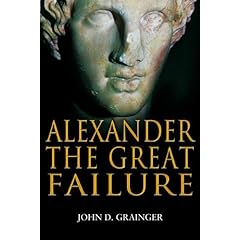
Alexander the Great Failure


This new book about the failures of Alexander the Great looks like it will stir up a little scholarly controversy. Alexander may have been a formidable warrior and military genius, but Grainger points out that Alexander's administrative failures were directly responsible for the collapse of the empire he fought so hard to create. Grainger also corrects the common misconception (as a result of the west's somewhat restricted diet of Greek versions of history from this period) of Persia, not as the discordant mélange of peoples depicted in classical Greek accounts, but as the political and economic center of the civilized world.

"In this authoritative book John Grainger explores the foundations of Alexander's empire and why it did not survive after his untimely death in 323 BC. Alexander the Great's empire stretched across three continents and his achievements changed the nature of the ancient world. But for all his military prowess and success as a conqueror, John Grainger argues that he was one of history's great failures. Alexander's arrogance was largely responsible for his own premature death and he was personally culpable for the failure of his imperial enterprise. For Alexander was king of a society where the ruler was absolutely central to the well-being of society as a whole. When the king failed, the Macedonian kingdom imploded, something which had happened every generation for two centuries before him and happened again when he died. For the good of his people, Alexander needed an adult successor, but he refused to provide one while also killing any man who could be seen as one. The consequence was fifty years of warfare after his death and the destruction of his empire."
This book is scheduled for release in August, 2009.

Thursday, October 30, 2008

Shadows In the Desert by Dr. Kaveh Farrokh

Shadows in the Desert: Ancient Persia at War (General Military)The ruins of Persepolis evoke the best-known events of ancient Persia's history: Alexander the Great's defeat of Darius III, his conquest of the Achaemenid empire, and the burning of the great palace complex at Persepolis. However, most of the history of ancient Persia remains as mysterious today as it was to contemporary Western scholars. Compared to the world-famous Alexander, the many wars won by the Achaemenid, Parthian, and Sassanian empires, and their revolutionary military technology, have been almost forgotten in the sands of the East.

In its day, Persia was a superpower to rival Greece and Rome, and conflict between them spanned over a millennium. Through these wars, and trade, these foes learnt from each other, not only adopting elements of military technology, but influences in the arts, architecture, religion, technology and learning. In this beautifully illustrated book, Dr Kaveh Farrokh narrates the history of Persia from before the first empires, through their wars with East and West to the fall of the Sassanians. He also delves into the forgotten cultural heritage of the Persians, spread across the world through war and conquest, which, even after the fall of the Sassanians, continued to impact upon the Western world.

The author was awarded the 2008 Persia Golden Lioness Award for outstanding literature for this work.

Technorati Tags: , , , , , , , ,

Monday, June 23, 2008

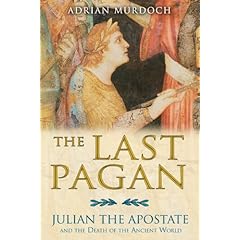
The Last Pagan: Julian The Apostate and the Death of the Ancient World


"Since his death on a Persian battlefield in AD 363, the violent end of the Emperor Julian (Flavius Claudius Julianus, 332-363_ has become synonymous with the death of paganism. Vilified throughout history as the `Apostate', the young philosopher-warrior was the last and arguably the most potent threat to Christianity.
The Last Pagan examines Julian's emergence as the sole survivor of a political dynasty soaked in blood. It traces his journey from an aristocratic Christian Childhood to his initiation into pagan cults and his mission to establish paganism as the dominant faith of the Roman world."

I've been interested in Julian ever since I read Michael Curtis Ford's novel "Gods and Legions". It, too, was a sympathetic portrait of the last pagan Roman emperor. So, when I was researching Adrian Murdoch's work, "The Last Roman:
Romulus Augustulus and the Decline of the West' and noticed he had also written about Julian the Apostate, I couldn't help but order it to have a look. I also got a great buy up at the David Brown Book Company - only $6.98!

I found a very interesting "Meet the Author" interview up at OxBow Books. An excerpt:

"
Constantine’s reign is usually heralded as a golden age and is celebrated as the beginning of the Christian era. The Last Pagan adopts a different approach, mourning the death of antiquity. Is this how you feel?

Very much so. The Emperor Julian has often been portrayed as an anomaly and regarded with slight embarrassment. It’s useful I think to change historical perspective. Instead of seeing Julian as the young man who came along and upset a Christian empire, he stood at the end of a line of Roman emperors.

At the same time, one of the premises with which I started the book is that while Constantine is conventionally heralded as the great hero and saviour of the empire, as a person he’s always appeared to me as a cynical and ruthless political operative. A deeply unpleasant man. It was natural, I suppose, to make Julian’s actions and values stand in contrast to those of Christian relatives.

Julian died aged only 31. Do you think that he had the qualities as a ruler to have shaped history if he had lived longer?

Arguably the largest problem for any biographer is that you have the benefit of hindsight – you know how the story ends. The challenge is to remember this and to stop seeing your subject’s fate as preordained. It’s too easy to see portents of doom wherever you look. This is especially true of Julian as all of the contemporaries tripped over themselves to editorialise his fate: his supporters painted him as a tragic hero and his opponents saw him as doomed from the moment of his apostasy.

If I’m being honest, even had Julian survived the war he might not have survived the peace. Religion has always attracted extremists, and it’s unlikely that Julian and his Christian opponents could have found any kind of middle ground. Plots to murder the emperor were uncovered before his death and so impassioned was the opposition to Julian’s religious reforms that I suspect one assassination attempt would have succeeded before too long.

The Last Pagan remembers a time when conflict over religion was rife, coming to a head on a battlefield in present-day Iraq. Did these parallels with recent events inspire you to choose Julian the Apostate as your subject?

Although I’d originally planned to draw parallels with the First Gulf War, the chapters on Julian’s invasion of Persia were written to a background of the build-up to the current conflict in Iraq. As Western governments began their build-up to what was obviously going to be an invasion last year, the parallels with Julian’s campaign made for distinctly uncomfortable writing – a foreign policy dictated by domestic necessity; support for the invasion from what is now Israel and the Gulf Arabs; debates about an illegal arms trade with Persia – swords of mass destruction if you will; a media campaign to encourage popular support for the war; even the fact that one of the most vocal opponents to the war was the administrator of Gaul. With Julian’s fate in mind (and the fact that his opponent outlasted his rule by some sixteen years) it is hard not to be discouraged about what the future holds.

Do you think that Roman paganism has any relevance for everyday life in the 21st century?

It’s more that the big questions that dominated Julian reign – the search for belief and the question of religious tolerance – are centre stage once more in the modern world. It’s easy to see similarities between Julian’s lack of comprehension of Christianity and the West’s frequent blindness to the Islamic world. It remains a historical irony that where Christianity was once the persecuted minority, it is now all-too often perceived as the aggressor.

At the same time, Julian’s search for his own faith as a young man mirrors the disillusionment and confusion that many today have with organised religion and the search for alternative forms of worship – a case in point is the startling growth in the interest in paganism over the past few years." - More

I'm not a big fan of Constantine either so I found Mr. Murdoch's comments quite interesting.

I also got "The Last Roman" since I wanted to read more about this era that essentially marked the formal end of the Roman Empire, especially after reading my friend, Boris Raymond's historical novel, "The Phoenix Circle" in which Orestes and Odovacar (Odacer) play major roles.