Showing posts with label Roman. Show all posts

Saturday, January 23, 2010

Review: Give Me Back My Legions by Harry Turtledove

Give Me Back My Legions!The Roman Emperor Augustus' anguished cry, "Publius Quinctilius Varus, Give Me Back My Legions!", is probably one of the most famous quotations that has come down to us from the ancient world.  So, I was naturally drawn to a novel with that title, hoping I could explore at least one person's interpretation of the events of that fatal confrontation and insight into the motivations of the men who met their destiny there.

"Give Me Back My Legions" is the first book I have ever read by Harry Turtledove although I have several of his books, either written alone or as a co-author with someone else, in my "to-be-read" stack.  Since the novel, centered around the events leading up to the massacre of three Roman legions in the Teutoburg Forest, was released in unabridged audio format, it gave me the opportunity to listen to it while I exercise each morning so received my attention much sooner than my other hard copy volumes.

Turtledove did a good job of characterization, neither overtly villifying either one side or the other in the conflict between occupying Roman forces and the tribal cultures of Germania.  The only problem with this approach, of course, is that there appears to be no clear protagonist or antagonist so the author sacrifices tension to some extent in the telling of the story.  Publius Quinctillus Varus is portrayed as a typical middle-aged Roman administrator who has married well (the emperor's Augustus' grandniece) but who is really ready for a gradual slide into retirement and longing for a less stressful life in Rome and the companionship of his son, who is currently studying in Greece.  When he is assigned the task of turning Germania into a proper Roman province paying proper Roman taxes, he is less than enthusiastic about the job.  But, who in the entire Roman Empire, would dare to refuse Augustus' request?

Arminius is an auxiliary officer with the Roman legions fighting a revolt in Pannonia.  He demonstrates courage and a strategic understanding of guerilla warfare, but privately harbors fears that his own people will eventually become victims of the Roman war machine if something isn't done soon in his native Germania.  When he receives word that the father of his betrothed, an overt Roman supporter, has decided to break the engagement and wed his daughter to another man with a political attitude more like his own, Arminius asks for permission to return home and straighten out this point of honor.

After Arminius resolves the matter by whisking away his betrothed and deflowering her to prevent any other man of his tribe from wanting her, Arminius turns his attention to finding a way to drive the Romans out of his homeland.  He knows that his countrymen's style of personal combat would be disastrous in a pitched battle with the disciplined Romans so he decides his only option is to somehow deceive them into venturing out of their encampment through territory more advantageous to an ambush.  He begins his plan by overtly trying to impress Varus.  Varus, in turn, sees something of his own son in the young, brash Arminius and despite numerous warnings from his own officers as well as Arminius' suspicious father-in-law, Segestes, Varus warms to the young man.

 Arminius watches as year after year the Romans build up then tear down their settlement at Mindinum and struggle back through the mud to their winter quarters on the other side of the Rhine. It occurs to him that if he suggests to Varus that he knows an easier route back to the base camp, he could lure Varus out onto a winding track through the forest where Arminius and his followers could construct an ambush.  So, although Arminius lives within the Roman camp and sups frequently with Varus during the spring and summer, he travels around Germania recruiting followers for his planned attack during the winter months.  I can understand the need for duplicity but when the time finally arrives and the ambush is accomplished, I was bothered by Arminius' eagerness to capture Varus alive so Varus could be brutally butchered as a sacrifice to the Germanic gods.  I found it hard to imagine that the kindness shown by Varus towards Arminius could be so totally dismissed.  In the novel, Arminius is quite aware that Varus misses his own son and views Varus as a kind of temporary substitute.  Although Varus must levy taxes as a requirement of provincial administration, he is not depicted as cruel or unjust (or at least he is not portrayed as such by Turtledove).  Therefore, the viciousness of Arminius' plans to brutalize him are repugnant and not really justified by the portrayal of a relatively benign Varus in the story.

In actual history, however, Varus may not have been quite so harmless.  While governing Syria, Varus, in command of four legions, put down a Jewish revolt that erupted after the death of the Roman client king Herod the Great in 4 BCE and crucified 2,000 Jewish rebels.  Although Josephus tries to point out the judiciousness of Varus' actions, there are references in the ancient sources to mass protests as a result of Varus' cruelty.  Turtledove's sympathetic portrayal of the man may have been a little misleading.

But, nevertheless, the retelling of the ambush and subsequent massacre was riveting.  Something that really stuck in my mind as I read the passage was how Arminius pondered the meaning of his countrymen's willingness to attack the Romans and the realization that most of the tribal warriors were only interested in plundering the Roman baggage train for loot.  Arminius concludes that they had no real overarching vision of independence or dream of establishing a united kingdom of their own.  I think Turtledove hit the hammer right on the head with that observation.  The other aspect of Arminius that I found disquieting was his immediate plans to not only throw the Romans out of Germania but follow it up by ravaging Gaul and taking it away from the people living there.  The victim had no qualms about becoming a brutal conqueror himself which seemed to diminish Arminius' nobility, at least in my eyes.

I realize Arminius is celebrated as an historical hero in Germany but I, like some other scholars, wonder if the victory he won in the Teutoburg forest was not ultimately a setback to cultural development.  A people's independence is always held up as the ultimate achievement but living in a society without a law code where the strong routinely exploit their weaker neighbor could hardly be viewed as an ideal way of life. Much was made in the novel about the Germans' hatred of Roman taxes but the taxes assessed at the time were not particularly exorbitant or arbitrary.  The Romans were apparently trying to base the taxes on the prosperity of the individual steadings.  Taxes are ultimately necessary to fund projects that provide services to a large group of people and are too expensive for any one individual to undertake.  Sadly, the Germanic tribes had not reached that level of understanding yet so still clung to their "mine" vs. "yours" view of the world. Some scholars have gone so far as to suggest that if the massacre in the Teutoburg forest had not happened and Germania had been successfully Romanized, we would have never had WWI and WWII.  I, too, wonder..

 Rome's Greatest Defeat: Massacre in the Teutoburg Forest   Terror in Teutoburg Forest   The Battle That Stopped Rome: Emperor Augustus, Arminius, and the Slaughter of the Legions in the Teutoburg Forest

Friday, November 13, 2009

Roman Iberia: Economy, Society and Culture by Benedict Lowe


This is the first book to examine the economic impact of external cultures - the Phoenicians, Greeks and Romans - upon the Iberian peninsula throughout the first millennium BC. Benedict Lowe provides a synthesis of recent archaeological work to place Spain in the broader context of debates about Romanisation during the Republic and Early Imperial period. He adopts a chronological approach, focusing on the processes of integration and regionalism in the economy of the Iberian peninsula.

The book begins with an introduction to the kingdom of Tartessos and the impact of the Phoenician and Greek colonists upon the economy of the peninsula, setting the scene for Rome's conquest. Succeeding chapters explore the growing Roman presence, culminating in the 1st century AD.

Combining literary and archaeological evidence, Roman Iberia provides an in-depth analysis of the Romanisation of Iberia in economic terms: villas, urbanism, pottery and trade and the interaction of Roman and native populations.


Benedict Lowe is Associate Professor of History, Western Oregon University.

The Essentials of Greek and Roman Law by Russ VerSteeg


Countless books detail the development of Roman law and explain the laws of the ancient Romans. Similarly, many scholars have traced the law of ancient Athens. Written for both students and educated lay readers, the chapters dealing with ancient Greece focus primarily on the law of ancient Athens in the 5th and 4th centuries B.C.E.

But material relating to other Greek colonies and city states also plays a significant role in the development of ancient Greek law. The Roman law chapters explore both law and legal institutions and emphasize the growth and expansion of legal principles. Roman law still serves as the foundation for the civil laws of many nations today. And given the importance of globalization, Roman law is likely to continue to influence the modern word for the foreseeable future.

Russ VerSteeg is a professor of law at the New England School of Law and a former teacher of classics.

A Companion to Roman Rhetoric by William Dominik and Jon hall


In this authoritative Companion of specially commissioned studies, 31 scholars from nine countries have combined to produce a survey of Roman rhetoric that explores its wide-ranging cultural importance. The contributors include not only internationally recognized figures with established reputations in the field of Roman rhetoric but also emerging scholars with fresh perspectives on the discipline. Among the topics covered by A Companion to Roman Rhetoric are the evolution of Roman rhetoric from its origins to the Renaissance; rhetoricrsquo;s role in the education and acculturation of the elite; the seminal importance of rhetoric in statesmanship and politics; the relationship between rhetoric and social identity; the philosophical and theoretical underpinnings of rhetoric; the dynamics of oratorical performance; and rhetoricrsquo;s interaction with the major genres and figures of Roman literature. --This text refers to the Hardcover edition.
This authoritative Companion of specially commissioned studies, 31 scholars from nine countries have combined to produce a survey of Roman rhetoric that explores its wide-ranging cultural importance. The contributors include not only internationally recognized figures with established reputations in the field of Roman rhetoric but also emerging scholars with fresh perspectives on the discipline.

Among the topics covered by A Companion to Roman Rhetoric are the evolution of Roman rhetoric from its origins to the Renaissance; rhetoric’s role in education and acculturation; the seminal importance of rhetoric in statesmanship and politics; the relationship between rhetoric and social identity; the philosophical and theoretical underpinnings of rhetoric; the dynamics of rhetoric performance; and rhetoric’s interaction with the major genres and figures of Roman literature.

This Companion will be valuable to a wide readership including undergraduates, graduate students, and scholars in Roman culture, as well as scholars in adjacent disciplines seeking an accessible introduction to Roman rhetoric. All Greek and Latin passages are translated. The volume complements A Companion to Greek Rhetoric published in the Blackwell Companions to the Ancient World series.
William Dominik is Professor of Classics at the University of Otago. He is a contributor to A Companion to Ancient Epic (2005) and A Companion to the Classical Tradition (2006). He has also published numerous books, chapters, and articles on Roman literature and other topics.

Jon Hall is Senior Lecturer in Classics at the University of Otago. He is the author of numerous articles and chapters on Cicero’s oratory and rhetorical treatises. He has also completed a book on Cicero’s correspondence.

Friday, April 03, 2009

Ten Books That Illustrate Why Romans Were Great Lovers


While I was browsing new ancient-themed books on Amazon I saw this interesting list by Mary Beard of ten books that illustrate why Romans were great lovers. I definitely agree with item 9. When I visited the Museo Archaeologico in Naples a couple of years ago and ventured into the "Secret Room" I did not find the semi-erotic paintings particularly shocking, as did the first female Victorian visitors, but found the heaps of phallic-shaped votive offerings and explicit terracotta lamps a little unnerving. They still make me blush and I haven't gotten my nerve up enough to upload my photographs of them to Flickr even yet. When I do so I will flag them as "may offend" so they will be filtered. I don't want any teachers angry with me for including such graphic sexual images in collections I promote for classroom use.


1. Staying power
Roman lovers could keep going all night (at least if we take their word for it). Ovid – the first-century-BC’s man about town – claims that he could perform nine times in a single night. Read all about it in his ‘Love Poems” (Book 3, number 7). Read: Ovid, The Erotic Poems (Penguin Classics)
, translated by Peter Green.

2. Sweet talk
Roman men could make you feel so good. Mark Antony and Julius Caesar both talked their way into the heart of feisty Cleopatra. The chat-up lines of Rome’s founding father Aeneas drove Queen Dido senseless. Read: Virgil, The Aeneid (Penguin Classics Deluxe Edition)
, translated by Robert Fagles. (Go straight to Book 4)

3. Body beautiful
There was no flab or beer belly on these six-pack hunks. All that gym and exercise kept Greeks and Romans bronzed and trim. Read: Nigel Spivey, The Ancient Olympics: A History
.

4. Inventiveness

Sexual positions became (literally) an art-form for the Romans--two-somes, three-somes and more. You’d better stay supple though, or those more testing acrobatics will be beyond you. Read: John Clarke, Looking at Lovemaking: Constructions of Sexuality in Roman Art, 100 B.C. - A.D. 250
.

5. Romantic agony
Roman men could do anguish better than any others. “I hate and I love . . . and it hurts” as the poet Catullus succinctly wrote to his fickle mistress. Don’t expect to escape a Roman affair without tears. Read: Catullus,The Poems of Catullus: A Bilingual Edition
, translated by Peter Green.

6. Great pick-up lines
Romans knew they had to work hard at the first impressions. Ovid, in a lover’s manual, gives the beginner plenty of advice on how to break the ice. Stand right next to her at a procession, and when some elaborate display goes past explain to her what it is. It doesn’t matter, says Ovid, if you don’t really know – make it sound plausible, to impress. Read: Ovid, Ovid: The Art of Love and Other Poems (Loeb Classical Library No. 232)
, translated by J. H. Mozley.

7. Open minds
Not many Romans were prudes. Most men were happy to contemplate sex with women, men, or if it came to it, animals – just so long as they were the active, not the passive partner. Read: Apuleius, The Golden Ass (Penguin Classics)
, translated by E. J. Kenney.

8. Rough-trade

Roman women went for the rough, tough sporting heroes of the ancient world. Successful gladiators became the heart-throbs of the Roman girls. Read: Catharine Edwards, The Politics of Immorality in Ancient Rome
.

9. In touch with their inner-selves
The anxiety of Roman men was one of their more endearing features. Images of the phallus were everywhere in Roman towns – but so too were images of castration and mutilation. The ancient man never took his prowess for granted. Carlin A. Barton,The Sorrows of the Ancient Romans
.

10. Not afraid to say 'I love you'


The walls of the buried city of Pompeii are covered with written messages from satisfied (and a few unsatisfied) men. ‘Oh Chloe, I had a wonderful time, twice over in this very spot, I love you. . . .’
Read: Antonio Varone, Eroticism in Pompeii
. And, in case you are looking for the woman’s point of view, try Marilyn B. Skinner, Sexuality in Greek and Roman Culture (Ancient Cultures)
.

Wednesday, December 31, 2008

The Gladiators from Capua: A Review

by Mary Harrsch

I just finished listening to Caroline Lawrence's novel for young adults (grades 5-8) "The Gladiators from Capua" and found it both exciting and illustrative of both the Roman cultural attitudes towards bloodsport and the daily life of those involved in the production of Roman games and entertainments. The story's young heroes and heroines, each an interesting individual, acted maturely and, despite my own age, I felt like I was a companion to them as they searched the dank recesses of the Flavian amphitheater searching for a friend hiding among the ranks of the gladiators to escape execution as an arsonist. I found their youthful enthusiasm refreshing compared to the often bellicose and cyncial Marcus Didius Falco featured in adult mysteries by Lindsey Davis.

Inspired by Martial's accounts of Roman spectacles, Lawrence pulled no punches in depicting the brutality of theatrically presented executions and the bleak life of those condemned to serve as slaves in the squalor of the hypogeum. But she also revealed the glamorous life of successful gladiators so the readers could understand why men would choose to become professional fighters and members of a gladiatorial familia.

Lawrence presented the lives of the privileged sharply contrasted with the lives of the lowest classes in Roman society and even mixed in a touch of political intrigue and the social machinations that concerned the emperor Titus as he tries to govern the sometimes fickle Roman mob and thwart the power plays of his brother Domitian. The resulting story kept me as enthralled as many adult novels and provided an insightful slice of Roman life in the Flavian period that I think would encourage any child (or adult) to want to learn more about the classical world.

Seattle educator B. Goh observes, "The protagonists--all children--adroitly negotiate a morally difficult world where men, womnen and even children are victims of spectacular (and bloodthirsty) games in the Flavian amphitheater. However, the narration is also quite sensitive to the young reader's possible reactions, and sympathetic views are always heard from at least one character. The subject of personal loss and family tragedy is well explored here. I'm not a a mental health professional, but this books feels like the type that might help a child who has had to cope with the loss of a loved one. I've read every book in the series and as an educator in literature, I highly recommend it, and also the other books in the series."

Although this was my first exposure to Lawrence's work, the novel is actually the sixth in her Roman mysteries series. I definitely look forward to reading more adventures of these intrepid young sleuths.

Monday, November 10, 2008

Robert Harris' second novel about Cicero due this month


I noticed with excitement that "Conspirata", Robert Harris' second novel about the career of famous Roman politician Marcus Tullius Cicero is due out this month. I also see that it will be available on audio CD so hopefully I'll be able to get the audio version up on audible.com as well.

All I could find out about the plot was this rather generic blurb up on the Audio Editions website (Amazon, surprisingly, had nothing but a note that it was not yet available):

"Cicero returns to continue his quest for supreme power in the state of Rome. Amid treachery, vengeance, violence, and treason, he finally reaches the summit of all his ambitions: he becomes the world's first professional politician, using his compassion and cunning to overcome all obstacles. By the author of Imperium."

I'll have to be sure to email my son about it. He surprised me recently in a phone call telling me how much he enjoyed "Imperium". He's not normally a fan of historical fiction (he, himself, writes sci-fi) so I'm not quite sure what prompted him to read it except curiousity about what could be prompting his mother's fanatical obsession with the Roman Empire

Friday, August 22, 2008

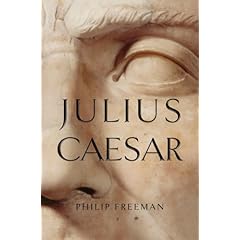
Philip Freeman's "Julius Caesar": A Review


by Mary Harrsch

Philip Freeman's "Julius Caesar" is a comprehensive biography of the Roman conqueror that is as straightforward and readable as the general's own "Gallic Wars". Freeman not only stitches together the various ancient accounts of Caesar's exploits but adds context to his activities by including helpful background information about his various adversaries pulled from a wealth of modern scholarship. He recounts Caesar's conquest of the Celtic tribes of Gaul against a vivid tapestry of the Celtic culture gleaned from such works as Rankin's "Celts and the Classical World, Cunliff's "The Ancient Celts", and Green's "The World of the Druids". I especially found the defeats or near-defeats suffered at the hands of the Celts as fascinating as Caesar's famous victory at Alesia.

The details of a surprise attack by Belgic tribes was particularly intense and sadly ironic because Caesar was essentially saved by his future Civil War opponent, Labienus.

"He [Caesar] had been caught unprepared for a surprise assault of such force and speed. His army would surely have been overwhelmed had it not been for the training and experience they had gained during the past year. There was no time to call his officers together and form a plan , so each organized whatever men were nearest and struck back at the Belgae. With a herculean effort, the Roman troops on the eastern side of the battlefield were able to push the Atrebates and then the Vironmandui back across the river with heavy losses on both sides, but the Nervii on the western end would not yield and pressed the Romans until they fell back in a hopeless struggle to save their camp. The Nervii stormed over the uncompleted walls of the Roman stronghold, killing many of the legionaries and threatening to outflank the Roman forces who had already crossed the river. Caesar had been rushing madly to every corner of the battlefield, but when he saw the dire threat at the camp, he leapt from his horse, grabbed a sword, and joined the fray."

Although Caesar's men rallied with their commander beside them calling them by name, their plight was dire. They managed to stop the encirclement and were presently reinforced by the the arrival of the two legions that had escorted the baggage train. But the real turning point of the battle hinged on the counterattack led by Labienus who, seeing Caesar's desperate struggle, dashed back across the river.

"His arrival brought such hope to the beleaguered men around Caesar that even those who had been seriously wounded propped themselves against their shields for support to continue to fight."

With the tide of battle now turned the Belgic warriors demonstrated their own ferocity and determination to remain an unconquered people.

"As the hours passed, the Romans slowly tightened the circle on them, hacking and killing as each Belgic warrior fought with all his might. In the end, the few Nervii who were left stood on a mound formed by their fallen comrades and - pulling the Roman spears from the dead bodies of their friends - threw them back down at the legions."

These images brought echoes of Thermopylae to mind.

Many critics of Caesar's activities in Gaul have portrayed Caesar and his commanders as ruthless perpetrators of genocide without significant provocation but Freeman, using the details of engagements retold in Caesar's Gallic Wars, recounts numerous incidents of Gallic duplicity after peace agreements were concluded. But Freeman also points out that Caesar did not delude himself with proclamations that he was bringing "civilization" to the Gauls. Instead he said Caesar candidly observed, "Human nature everywhere yearns for freedom and hates submitting to domination by another."

"The Romans never pretended that they were bringing freedom or a better way of life to the peoples they conquered." Freeman states. "They frankly admitted that they were only interested in increasing their own power, wealth, and security through conquest."

I have previously only read isolated passages of accounts of Caesar's Alexandrian Wars so I also found that portion of Freeman's book particularly fascinating. Many books and films about this period seem to omit most references to intervention by Cleopatra's sister Arsinoe and her commander Ganymedes. Many accounts of the confrontation between the Alexandrians and Caesar seem to focus on the activities of the Egyptian general Achillas and the spoiled child-pharaoh Ptolemy XIII. But Freeman recounts how Achillas was actually murdered by Ganymedes and most of the near disasters suffered by Caesar's forces, beseiged in the palace, were masterminded by this militarily astute courtier. Freeman also details the urban warfare that Caesar was forced to conduct in Alexandria that sounded eerily familiar to anyone who watches CNN regularly. I was also surprised to read that the often-portrayed luxurious "honeymoon" cruise up the Nile was a deliberate show of military force since the royal barge was accompanied by over 400 ships crammed with Roman troops. I am now more convinced than ever that Caesar's effort to father a child with Cleopatra was a deliberate act to obtain a client king related by blood to secure Egypt without annexing it and risking its plunder by a corrupt proconsular governor in the future.

Freeman mentioned Caesar's epilepsy only in passing early on in the text. This surprised me since I have long suspected that a head wound Caesar sustained on campaign was actually the cause of the increased frequency of seizures Caesar suffered toward the end of his life and perhaps one of the reasons for the apparent lack of political judgment he exercised at the time of the Africa triumph when he included unpopular tableaus depicting the deaths of Scipio and Cato. Freeman only observed that Caesar showed particularly bad taste in celebrating a triumph over his Roman opponents and how this had upset his normally adoring crowd. There were at least four significant seizures documented by the ancient sources (Plutarch, Suetonius, Appian, and Pliny) that modern experts conclude, according to J. R. Hughes, Department of Neurology, School of Medicine, University of Illinois at Chicago, "were probably complex partial seizures: (1) while listening to an oration by Cicero, (2) in the Senate while being offered the Emperor's Crown, and in military campaigns, (3) near Thapsus (North Africa) and (4) Corduba (Spain)."

Drs. J.G Gomez, J.A. Kotler, and J.B. Long, Division of Neurological Surgery, Holy Cross Hospital, Fort Lauderdale, Florida, conducted a pathological analysis of Caesar's reported symptoms and behavioral changes in 1995 and suggested he may have been suffering from a brain tumor. "The patient had late onset of seizures in the last two years of his life, headaches, personality changes. Upon reexamination of existing Julius Caesar iconography, busts, statues and minted coins no skull deformities have been noted. Identification of a skull deformity as described by Suetonius would have confirmed the suspicion of meningioma involving the convexity of the cerebral hemispheres. Meningioma or slow-growing supratentorial glioma may well have been responsible for this man's illness."

In any event, I think a man who had demonstrated such a superior grasp of Roman politics in the past would not have committed such blunders on purpose or because success had simply "gone to his head".

Freeman included a wonderful compedium at the end of the book that listed his sources for various sections within the text that is a valuable reference for readers wishing to learn more about specific events in Caesar's life. A comprehensive bibliography and index rounded out the text's impressive list of source materials. There were only two things contained in the book that gave me pause. One was a reference to a pilum not being designed as a throwing weapon but rather a thrusting weapon. I think this must have been a lapse in editing as Freeman was comparing Roman weapons with other weapons of the ancient world. Alexander's Macedonians carried sarissas, that, unlike commonly used Greek spears, were not designed for throwing but for thrusting. Likewise, the Roman gladius was designed for thrusting rather than slashing. But a Roman pilum was designed to bend on impact to make it difficult to remove and Freeman pointed this out. So, I would think a weapon so designed was obviously intended primarily for throwing. The other error was the inclusion of an image of a sculptured head of Lucius Cornelius Sulla labeled as Gaius Marius in the photo insert section. It was provided by the Bridgeman Art Library and perhaps the labeling error was theirs. The head is in the permanent collection of the Glyptotek in Munich, Germany as indicated but according to an overwhelming majority of people on the web, including the scholars who maintain Vroma.org, the head belongs to Marius' arch enemy, Sulla. See http://www.vroma.org/~bmcmanus/optimates.html.

Sunday, June 29, 2008

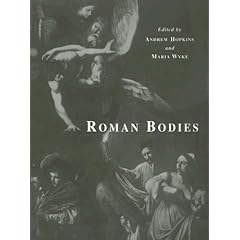
Roman Bodies. Antiquity to the Eighteenth Century


While I was researching other works published by The British School in Rome, I came across a listing for this fascinating-sounding book, Roman Bodies. Antiquity to the Eighteenth Century, edited by Andrew Hopkins and Maria Wyke:

"
The seventeen wide-ranging and interdisciplinary essays explore dramatic changes in Western conceptions of the body. Divided into three sections, ‘Empire’, ‘Church’ and ‘Religion and science’, topics discussed include gender, sexuality, social and political identity, health and sickness, the body in death and after, and corporeal aesthetics.

[1] The body of Rome: introduction, Maria Wyke and Andrew Hopkins; [2] Archetypally Roman? Representing Seneca’s ageing body, Catharine Edwards; [3] Circumcision, de-circumcision and self-image: Celsus’s ‘operation on the penis’, Ralph Jackson; [4] A Roman perspective on circumcision, Pierre Cordier; [5] In the foreskin of your flesh’: the pure male body in late antiquity, Gillian Clark; [6] Headhunters of the Roman army, Nic Fields; [7] Execution in effigy: severed heads and decapitated statues in Imperial Rome, Eric R. Varner; [8] Disabled bodies: the (mis)representation of the lame in antiquity and their reappearance in early Christian and medieval art, Livio Pestilli; [9]Truth, perception and the pagan body in the Roman martyr narratives, Kristina Sessa; [10] The paradoxical body of Saint Agnes, Lucy Grig; [11] The relic translations of Paschal I: transforming city and cult, Caroline Goodson; [12] Majesty and mortality: attitudes towards the corpse in papal funeral ceremonies, Minou Schraven; [13] A theatre of cruelty and forgiveness: dissection, institutions and the moral discourse of anatomy in sixteenth-century Rome, Andrea Carlino; [14] Not torments, but delights: Antonio Gallonio’s Trattato de gli instrumenti di martirio of 1591 and its illustrations, Opher Mansour; [15] Ancient bodies and contested identities in the English College martyrdom cycle, Rome, Richard L. Williams; [16] Secrets of the heart: the role of saintly bodies in the medical discourse of Counter-Reformation Rome, Catrien Santing; [17] Contesting the Sacred Heart of Jesus in late eighteenth-century Rome, Jon L. Seydl."

I thought the sections on executions in effigy and the decapitation of statues in Roman art as well as the discussion of the misrepresentation of the disabled in antiquity sounded particularly interesting.

Monday, June 23, 2008

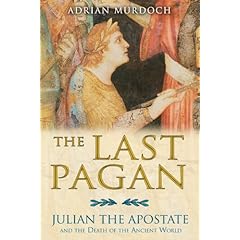
The Last Pagan: Julian The Apostate and the Death of the Ancient World


"Since his death on a Persian battlefield in AD 363, the violent end of the Emperor Julian (Flavius Claudius Julianus, 332-363_ has become synonymous with the death of paganism. Vilified throughout history as the `Apostate', the young philosopher-warrior was the last and arguably the most potent threat to Christianity.
The Last Pagan examines Julian's emergence as the sole survivor of a political dynasty soaked in blood. It traces his journey from an aristocratic Christian Childhood to his initiation into pagan cults and his mission to establish paganism as the dominant faith of the Roman world."

I've been interested in Julian ever since I read Michael Curtis Ford's novel "Gods and Legions". It, too, was a sympathetic portrait of the last pagan Roman emperor. So, when I was researching Adrian Murdoch's work, "The Last Roman:
Romulus Augustulus and the Decline of the West' and noticed he had also written about Julian the Apostate, I couldn't help but order it to have a look. I also got a great buy up at the David Brown Book Company - only $6.98!

I found a very interesting "Meet the Author" interview up at OxBow Books. An excerpt:

"
Constantine’s reign is usually heralded as a golden age and is celebrated as the beginning of the Christian era. The Last Pagan adopts a different approach, mourning the death of antiquity. Is this how you feel?

Very much so. The Emperor Julian has often been portrayed as an anomaly and regarded with slight embarrassment. It’s useful I think to change historical perspective. Instead of seeing Julian as the young man who came along and upset a Christian empire, he stood at the end of a line of Roman emperors.

At the same time, one of the premises with which I started the book is that while Constantine is conventionally heralded as the great hero and saviour of the empire, as a person he’s always appeared to me as a cynical and ruthless political operative. A deeply unpleasant man. It was natural, I suppose, to make Julian’s actions and values stand in contrast to those of Christian relatives.

Julian died aged only 31. Do you think that he had the qualities as a ruler to have shaped history if he had lived longer?

Arguably the largest problem for any biographer is that you have the benefit of hindsight – you know how the story ends. The challenge is to remember this and to stop seeing your subject’s fate as preordained. It’s too easy to see portents of doom wherever you look. This is especially true of Julian as all of the contemporaries tripped over themselves to editorialise his fate: his supporters painted him as a tragic hero and his opponents saw him as doomed from the moment of his apostasy.

If I’m being honest, even had Julian survived the war he might not have survived the peace. Religion has always attracted extremists, and it’s unlikely that Julian and his Christian opponents could have found any kind of middle ground. Plots to murder the emperor were uncovered before his death and so impassioned was the opposition to Julian’s religious reforms that I suspect one assassination attempt would have succeeded before too long.

The Last Pagan remembers a time when conflict over religion was rife, coming to a head on a battlefield in present-day Iraq. Did these parallels with recent events inspire you to choose Julian the Apostate as your subject?

Although I’d originally planned to draw parallels with the First Gulf War, the chapters on Julian’s invasion of Persia were written to a background of the build-up to the current conflict in Iraq. As Western governments began their build-up to what was obviously going to be an invasion last year, the parallels with Julian’s campaign made for distinctly uncomfortable writing – a foreign policy dictated by domestic necessity; support for the invasion from what is now Israel and the Gulf Arabs; debates about an illegal arms trade with Persia – swords of mass destruction if you will; a media campaign to encourage popular support for the war; even the fact that one of the most vocal opponents to the war was the administrator of Gaul. With Julian’s fate in mind (and the fact that his opponent outlasted his rule by some sixteen years) it is hard not to be discouraged about what the future holds.

Do you think that Roman paganism has any relevance for everyday life in the 21st century?

It’s more that the big questions that dominated Julian reign – the search for belief and the question of religious tolerance – are centre stage once more in the modern world. It’s easy to see similarities between Julian’s lack of comprehension of Christianity and the West’s frequent blindness to the Islamic world. It remains a historical irony that where Christianity was once the persecuted minority, it is now all-too often perceived as the aggressor.

At the same time, Julian’s search for his own faith as a young man mirrors the disillusionment and confusion that many today have with organised religion and the search for alternative forms of worship – a case in point is the startling growth in the interest in paganism over the past few years." - More

I'm not a big fan of Constantine either so I found Mr. Murdoch's comments quite interesting.

I also got "The Last Roman" since I wanted to read more about this era that essentially marked the formal end of the Roman Empire, especially after reading my friend, Boris Raymond's historical novel, "The Phoenix Circle" in which Orestes and Odovacar (Odacer) play major roles.

Tuesday, December 25, 2007

The Roman Triumph by Mary Beard


"... for almost every detail of this picture - familiar as it is from sword-and-sandal epics and Asterix books - is, according to Mary Beard, up for grabs. Yes, the triumph was a vivid and central part of Roman culture. In fact, she argues, it was in some ways more central than we have ever realised. Triumphal imagery and triumphal language bled into the Roman games and seeped into the ceremonies that marked the election of a consul or the arrival (or through deification, the departure) of a new emperor. Triumph was inscribed into the architecture of arches, theatres and temples, and also sarcophaguses and tombs. It penetrated epic and erotic poetry and comic drama too. But almost every detail of this great ceremony is maddeningly difficult to seize upon. Everything on which we were agreed turns out to be just that little bit more difficult to demonstrate than anyone ever imagined.

Beard has in her sights three processions. The first is that long historical sequence of actual celebrations. The second is a series of rich and extravagant accounts of triumphs, what she calls "rituals in ink" although they include a mass of images too, such as the Arch of Titus. Third, there is a long procession of classical scholars, who follow Beard's chariot with placards hung around their necks detailing their wild conjectures, hypotheses and claims about what the triumph "really meant".

It would be convenient if each could be examined separately, but the processions keep colliding in the winding, narrow streets of Roman cultural history. The actual triumphs are known to us only through the representations, and these are difficult to disentangle from the dense foliage of scholarly exegesis. Beard prunes ferociously. The evidence for the triumphal route is alarmingly inconsistent. The slave in the chariot whispering to the general is a modern composite, compiled of late testimony, no one piece of which tells exactly this story. The clothes borrowed from the god, the chariot itself are insecure. So is much more.

Once the factoids are swept away we are left with modern attempts to create some sort of general rule-book for triumphs. How many enemies did you need to kill? What sort of general could celebrate? Who decided? Ancient writers made many claims, but their generalisations stand up no better than those of the moderns. It does not help that when a Polybius or a Livy or a Josephus sets out to describe a particular triumph, he focused on what was remarkable, extraordinary, controversial and bizarre. And who was to say what was "normal" and what excessive?"

Tuesday, March 13, 2007

Review: Rome's Gothic Wars by Michael Kulikowski

A history text review by  © 2007- 5 stars

I was recently asked by Cambridge University Press to review "Rome's Gothic Wars: From the Third Century to Alaric (Key Conflicts of Classical Antiquity) by Michael Kulikowski. I finally got a chance to begin reading it and find it clearly written and thankfully devoid of the stilted academic jargon that pervades many history texts. As most
of my studies have focused on the Roman Republic, I am learning all kinds of fascinating things about this later period.

For example, I did not realize that there were reports of cannibalism
inside the city of Rome during Alaric's siege. Kulikowski also postulates that one of the stimuli for the beginning of Gothic invasions of the Empire was in response to Caracalla's granting of citizenship to all free residents of the empire. He felt that this action opened up the possibilities for anyone - not just provincial
elites who had gained senatorial rank - to gain the throne.


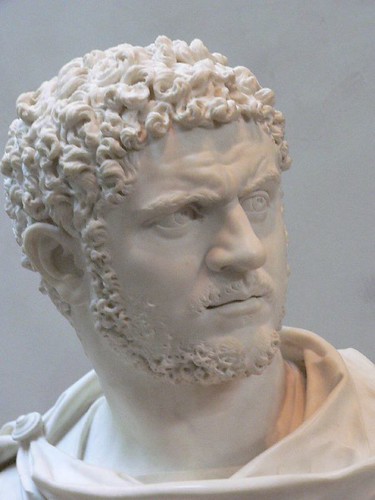
Cavaceppi's 18th century portrait of 2nd
century CE Roman Emperor Caracalla

 photographed at the J. Paul Getty Museum
in Los Angeles, CA
by
© 2005
Evidently, Mr. Kulikowski has another problem with Caracalla. He says in his opinion, much of the civil unrest in Rome itself resulting from the long string of assassinated emperors was triggered unwittingly by Caracalla when he defeated the last Parthian king. This left a power vacuum in the east that was filled by the much more problematic (for the Romans)Sassanids who were not content to control the former Parthian Empire but launched numerous incursions into Roman territory. Less successful responses to these incursions would often result in deposition of the current emperor. Likewise, success would bring a new challenger to the imperial throne.

He also went on to describe the problems created by Roman interference in Barbarian tribal control with Roman subsidy of particular tribal leaders. Although this may have brought temporary loyalty, ultimately it garnered a larger core of support around these subsidized chieftains who would then be in a position to challenge the authority of Rome itself along the frontiers. He pointed out that Decablus was just such an example. The Romans initially subsidized his power base in Dacia.

I found an article that described how this came about:

"In 60 BC, King Burebista of Dacia began a series of expansionistic moves to relieve pressure from nomadic incursions, which eventually threatened Roman Danubian and Black Sea territories. Julius Caesar began to lay plans for a campaign in Dacia and Partha, which came to naught when both Caesear and Burebista were assassinated in 44 BC. Later, during the reign of Nero (54-68 AD), Dacian raids into Roman Moesia became so serious that the Romans engaged the Roxolani to help defend their frontier, thus placing Dacia's sometime Sarmatian allies on their enemies list.
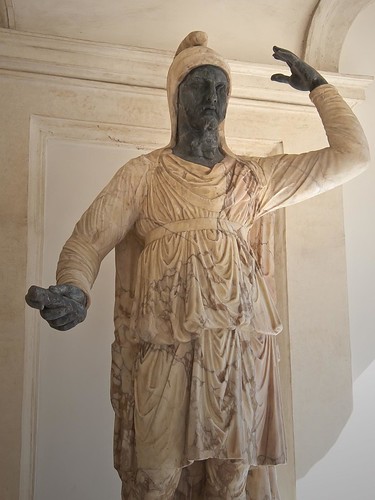
Colossal statue of a Dacian Roman 2nd century CE
photographed at the Palazzo Altemps, Rome, Italy by
 © 2009
In 85 AD, King Decebalus assumed the Dacian throne, adopting a hostile Roman policy that posed a serious challenge to the Emperor Domitian (81-96 AD). A Dacian army raided across the Danube into the Roman province of Moesia, killing the Roman governor and looting the
countryside. This prompted an retaliatory expedition under command of  praetorian prefect Cornelius Fuscus that was wiped out in eastern Dacia (including the loss of Legio V Alaudae) . A second Roman expedition was severely defeated in 87 AD.
Finally, a Roman army under Tettius Julianus defeated the Dacians at Tapae in 88 or 89 A.D. King Decabalus of Dacia was forced to pay tribute and allow Roman armies passage through Dacian territory. Domitian, however, was distracted by Saturninus' Revolt on the Rhine Frontier and uprisings by the Sarmatian Iazyges, Marcomanni and Quaid tribes on Rome's Pannonian frontier. He sought the favor of Decabalus to avoid a Dacian-Sarmatian alliance, offering skilled artisans and hostages to ensure Dacian neutrality while he contended with his other headaches." - DBA Resource, Fanaticus.org 

I couldn't help but think that we certainly didn't learn much from these Roman experiences in political interference since we so recently repeated their mistakes!

Kulikowski, also pointed out something that is important to know if you are reading original historical sources from the period. He says that, even though the Goths contemporaries referred to them as Goths,
historical scholars of the day used the formal designation "Scythians" because the Goths had originated north of the Black Sea in the same region once occupied by the true Scythians recorded by Herodotus.

I also found little controversies pointed out by Michael Kulikowski quite interesting. He appears to be very skeptical of Jordanes narrative of the origin and migration of the Goths from Scandanavia to the Black Sea region ("Getica"). Supposedly, Jordanes sixth century account was based on the lost barbarian histories by Cassiodorus. But Kulikowski maintains that Jordanes work was prepared while attached to the court of
Theodoric so he feels it was meant to provide a glorious history of descent for that monarch and can't be solely relied upon when no other sources are available - much like the skepticism that always surrounds
the narratives by Suetonius.

He went on to say that the connection between the Goths and Scandanavia has been disproved archaeologically but did not elaborate on how. He feels the Goths arose as a result of barbarian
relationships with the Roman army along the frontiers in the third century and that they did not exist as a recognizable cultural group before that time.

Detail of a tapestry by Peter Paul Reubens depicting Constantine's victory over Maxentius at the battle of the Milvian
Bridge in 312 CE
photographed at the Philadelphia Museum of Art in Philadelphia, PA by © 2011

Kulikowski, also observed that Constantine apparently deliberately shifted from the former emperors' claims to be descended from Hercules to claim a descent from Claudius Gothicus. The author seemed to think this was a way to demonstrate a rejection of pagan philosophies. Richard D. Weigel of Western Kentucky University seems to support the observation that any connection with Claudius Gothicus was a fiction:

"M. Aurelius Claudius, known to history as Claudius Gothicus or Claudius II, was born in either Dalmatia or Illyria on May 10, probably in A.D. 213 or 214, " Wiegel says, "Although the most substantive source on Claudius is the biography in the Scriptores Historiae Augustae (SHA), this account is riddled with fabrications and slanted with fawning praise for this particular emperor, who in the fourth century was viewed as an ancestor of Constantine's father and thus of the ruling imperial family. This biography, attributed to one Trebellius Pollio, must be read with extreme caution and supplemented with information from other sources, including Aurelius Victor, the Epitome de Caesaribus, Eutropius, Orosius, Zonaras, and Zosimus, as well as coins and inscriptions." - De Imperatorabus Romanis
The first one of the two twin bronze busts of ...
The first one of the two twin bronze busts of Claudius II "the Gothic" (268/269 d.C.). The gilded bronze portraits, five of Roman emperors and one of an empress, were hidden beneath the Capitoline temple in Brescia, together with other bronze objects, to prevent the consequences of a possible sack of the town in the 4th or 5th century, and unearthed only in 1826. They are now exhibited in the archaeological Santa Giulia Museum, in Brescia, Italy. (Photo credit: Wikipedia)


Although his reign was short, Claudius Gothicus did appear to be an emperor worth emulating:
"The Gothic challenge in 269 CE proved to be the greatest that Claudius II would face. The Goths assembled a large invading force, reportedly amounting to 320,000 men transported on a fleet of at least 2,000 ships, and first attacked coastal cities along the Black Sea in Moesia. After passing into the Aegean the Goths besieged Thessalonica. At this point, in 269, Claudius left Rome to stop the invasion. The Goths then sent the larger segment of their troops on land toward the Danube, while the fleet took the remaining group to continue the naval attack on Aegean coastal cities. Claudius sent Aurelian's cavalry to Macedonia to protect Illyria from attack, while he commanded the forces blocking the route to the Danube. In the area of Doberus and Pelagonia, the Goths lost 3,000 men to Aurelian's cavalry. At Naissus in Moesia, Claudius' force succeeded in killing some 50,000 Goths. There were follow-up operations on both land and sea, but the Gothic War had essentially been won. Staving off the attacks of the Goths was a major contribution to the survival of the Roman Empire. It was a significant step leading to the subsequent success of Aurelian and the resurrection of the Empire under Diocletian and Constantine. When the Goths eventually succeeded in taking parts of the western Empire in the fifth century, their disruption to the course of civilization was likely much less violent than it would have been had they succeeded in the third century.< 
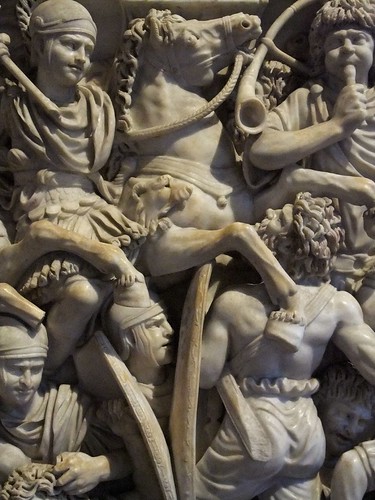
Detail of the Ludovisi sarcophagus thought to depict a
battle between the Romans and the Goths 2nd - 3rd
century CE
photographed at the Palazzo Altemps in
Rome, Italy
by  © 2009
 In addition to bad weather, a lack of supplies, and hunger, plague was a major factor in the defeat of the Goths. Many of the Gothic prisoners were either impressed into Roman military service or settled on farms as coloni. Claudius received the title Gothicus in recognition of his triumph over the Goths. At some point he had also been given the title Parthicus, but the unlikelihood of any conflict with the Parthians in his short reign makes this difficult to explain. Perhaps Damerau was correct in his suggestion that a Parthian unit may have been involved in one of the battles with the Palmyrenes, although on this front there were few achievements to claim. In any case, Claudius' victory over the Goths was short-lived. The emperor himself caught the plague and died at Sirmium early in 270. He was 56 years old  Claudius' brother, Quintillus, became emperor briefly before losing out to Aurelian. Claudius also had another brother, Crispus, and the SHA traces the link to Constantius through Crispus' daughter Claudia. 
The Roman Senate showed its respect for Claudius Gothicus by setting up a gold portrait-shield in the Curia and by approving his deification. He was also honored with a golden statue in front of the great temple of Jupiter Optimus Maximus and a silver statue set on a column on the Rostra." - Wikipedia
All of these issues prompted me to seek out other academic opinions and more information.

Judith Weingarten, who studied classical archaeology at Oxford and is a member of the British School of Athens, disagreed with Kulikowski's suggestion that Caracalla's granting of citizenship to all free residents was a crucial trigger to the Gothic migrations:


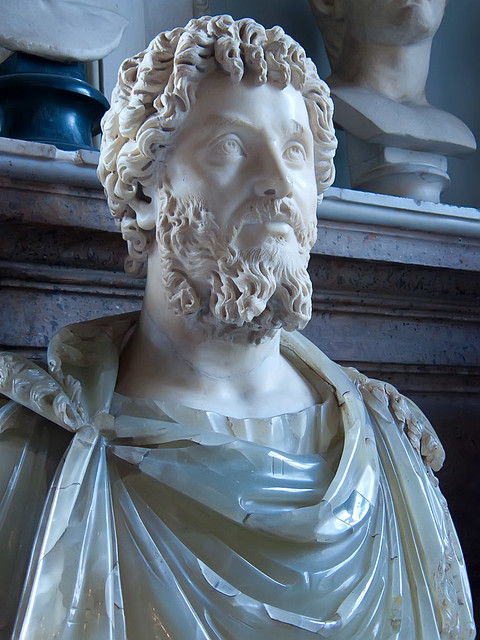
Bust of the Roman emperor Septimius Severus
photographed at the Capitoline Museum in
Rome, Italy
by  © 2009
"Caracalla's father, the Emperor Septimius Severus, had already started the rot," Weingarten exclaims,  "As the first of the Soldier Emperors, he came to power over the bodies of three emperors (all murdered in a single year!) and fought two bloody civil wars against rival generals to boot. He was, however, the last emperor, for a very long time, to die in bed. For the next 60 years, emperor after emperor - and there were many - fell to the assassin’s knife - and that is only to speak of the so-called legitimate emperors, who managed to fight off and kill their rivals - the losers then being called ‘usurpers’ or ‘pretenders’. [An old English jingle makes the point: Treason doth never prosper/ what’s the reason?/ For if it prosper/ none dare call it treason.] Caracalla’s murder, in turn,, did usher in a new age of instability. Legitimacy gave way to force and absolute despotism, in which the losers, their friends and supporters, were slaughtered and their property confiscated."
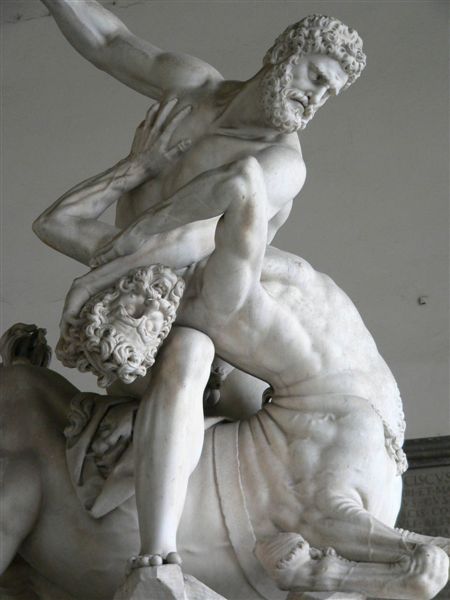
Hercules battling the centaur Nessus by
by Giovanni Bologna 1599 CE
photographed
at the Palazzo Vechio in Florence, Italy by
 © 2005

"In my opinion," she continues, "the true reason for Caracalla granting citizenship to all free men in the Empire, was his need to raise revenue: in return for citizenship, he taxed them. When even that was insufficient, he debased the currency...."

Another historian, Volker Carlton Bach of Denmark, took issue with the speculation that Constantine's rejection of the emperor's traditional descent from Hercules was a demonstration of rejection of pagan philosophy.

"I think this is based on a misunderstanding," Bach states, "The descent of the Herculian Emperors (not the Jovian ones) from Hercules was purely a notional, cultic (for want of a better word) concept. The closest we have today, I think, is the link between the popes and St Peter - not an arogation of genetic descent, but a claim of spiritual successorship and close association. The Romans knew that Maximian and his successors were not the great-great-great-repeat ad nauseam-grandsons of the heros Hercules. After all, they had real mothers and fathers, and in some cases even knew both with a degree of certainty. The descent claim from Claudius Gothicus, on the other hand, *is* a 'real' paternity claim, similar to the adoption of Antonine nomenclature by third-century emperors. So Constantine doesn't really replace one claim with another. The Herculian designation was unnecessary simply because with Constantine's victories, as it had been used to distinguish junior colleagues from senior (Jovian) ones. Constantine was *the* emperor, so that was that. Claudius Gothicus, on the other hand, was a very attractive ancestor to claim, a successful and legendary warrior and, unlike Aurelian or Diocletian, without anti-Christian baggage."

Any book that can generate this type of quality discussion is a worthy addition to any history enthusiast's collection. I notice it is one of a series of introductory-level texts exploring the key conflicts of classical antiquity. I look forward to reading others in this series.

Related articles
Enhanced by Zemanta