Showing posts with label strategy. Show all posts

Saturday, January 23, 2010

Review: Give Me Back My Legions by Harry Turtledove

Give Me Back My Legions!The Roman Emperor Augustus' anguished cry, "Publius Quinctilius Varus, Give Me Back My Legions!", is probably one of the most famous quotations that has come down to us from the ancient world.  So, I was naturally drawn to a novel with that title, hoping I could explore at least one person's interpretation of the events of that fatal confrontation and insight into the motivations of the men who met their destiny there.

"Give Me Back My Legions" is the first book I have ever read by Harry Turtledove although I have several of his books, either written alone or as a co-author with someone else, in my "to-be-read" stack.  Since the novel, centered around the events leading up to the massacre of three Roman legions in the Teutoburg Forest, was released in unabridged audio format, it gave me the opportunity to listen to it while I exercise each morning so received my attention much sooner than my other hard copy volumes.

Turtledove did a good job of characterization, neither overtly villifying either one side or the other in the conflict between occupying Roman forces and the tribal cultures of Germania.  The only problem with this approach, of course, is that there appears to be no clear protagonist or antagonist so the author sacrifices tension to some extent in the telling of the story.  Publius Quinctillus Varus is portrayed as a typical middle-aged Roman administrator who has married well (the emperor's Augustus' grandniece) but who is really ready for a gradual slide into retirement and longing for a less stressful life in Rome and the companionship of his son, who is currently studying in Greece.  When he is assigned the task of turning Germania into a proper Roman province paying proper Roman taxes, he is less than enthusiastic about the job.  But, who in the entire Roman Empire, would dare to refuse Augustus' request?

Arminius is an auxiliary officer with the Roman legions fighting a revolt in Pannonia.  He demonstrates courage and a strategic understanding of guerilla warfare, but privately harbors fears that his own people will eventually become victims of the Roman war machine if something isn't done soon in his native Germania.  When he receives word that the father of his betrothed, an overt Roman supporter, has decided to break the engagement and wed his daughter to another man with a political attitude more like his own, Arminius asks for permission to return home and straighten out this point of honor.

After Arminius resolves the matter by whisking away his betrothed and deflowering her to prevent any other man of his tribe from wanting her, Arminius turns his attention to finding a way to drive the Romans out of his homeland.  He knows that his countrymen's style of personal combat would be disastrous in a pitched battle with the disciplined Romans so he decides his only option is to somehow deceive them into venturing out of their encampment through territory more advantageous to an ambush.  He begins his plan by overtly trying to impress Varus.  Varus, in turn, sees something of his own son in the young, brash Arminius and despite numerous warnings from his own officers as well as Arminius' suspicious father-in-law, Segestes, Varus warms to the young man.

 Arminius watches as year after year the Romans build up then tear down their settlement at Mindinum and struggle back through the mud to their winter quarters on the other side of the Rhine. It occurs to him that if he suggests to Varus that he knows an easier route back to the base camp, he could lure Varus out onto a winding track through the forest where Arminius and his followers could construct an ambush.  So, although Arminius lives within the Roman camp and sups frequently with Varus during the spring and summer, he travels around Germania recruiting followers for his planned attack during the winter months.  I can understand the need for duplicity but when the time finally arrives and the ambush is accomplished, I was bothered by Arminius' eagerness to capture Varus alive so Varus could be brutally butchered as a sacrifice to the Germanic gods.  I found it hard to imagine that the kindness shown by Varus towards Arminius could be so totally dismissed.  In the novel, Arminius is quite aware that Varus misses his own son and views Varus as a kind of temporary substitute.  Although Varus must levy taxes as a requirement of provincial administration, he is not depicted as cruel or unjust (or at least he is not portrayed as such by Turtledove).  Therefore, the viciousness of Arminius' plans to brutalize him are repugnant and not really justified by the portrayal of a relatively benign Varus in the story.

In actual history, however, Varus may not have been quite so harmless.  While governing Syria, Varus, in command of four legions, put down a Jewish revolt that erupted after the death of the Roman client king Herod the Great in 4 BCE and crucified 2,000 Jewish rebels.  Although Josephus tries to point out the judiciousness of Varus' actions, there are references in the ancient sources to mass protests as a result of Varus' cruelty.  Turtledove's sympathetic portrayal of the man may have been a little misleading.

But, nevertheless, the retelling of the ambush and subsequent massacre was riveting.  Something that really stuck in my mind as I read the passage was how Arminius pondered the meaning of his countrymen's willingness to attack the Romans and the realization that most of the tribal warriors were only interested in plundering the Roman baggage train for loot.  Arminius concludes that they had no real overarching vision of independence or dream of establishing a united kingdom of their own.  I think Turtledove hit the hammer right on the head with that observation.  The other aspect of Arminius that I found disquieting was his immediate plans to not only throw the Romans out of Germania but follow it up by ravaging Gaul and taking it away from the people living there.  The victim had no qualms about becoming a brutal conqueror himself which seemed to diminish Arminius' nobility, at least in my eyes.

I realize Arminius is celebrated as an historical hero in Germany but I, like some other scholars, wonder if the victory he won in the Teutoburg forest was not ultimately a setback to cultural development.  A people's independence is always held up as the ultimate achievement but living in a society without a law code where the strong routinely exploit their weaker neighbor could hardly be viewed as an ideal way of life. Much was made in the novel about the Germans' hatred of Roman taxes but the taxes assessed at the time were not particularly exorbitant or arbitrary.  The Romans were apparently trying to base the taxes on the prosperity of the individual steadings.  Taxes are ultimately necessary to fund projects that provide services to a large group of people and are too expensive for any one individual to undertake.  Sadly, the Germanic tribes had not reached that level of understanding yet so still clung to their "mine" vs. "yours" view of the world. Some scholars have gone so far as to suggest that if the massacre in the Teutoburg forest had not happened and Germania had been successfully Romanized, we would have never had WWI and WWII.  I, too, wonder..

 Rome's Greatest Defeat: Massacre in the Teutoburg Forest   Terror in Teutoburg Forest   The Battle That Stopped Rome: Emperor Augustus, Arminius, and the Slaughter of the Legions in the Teutoburg Forest

Friday, August 22, 2008

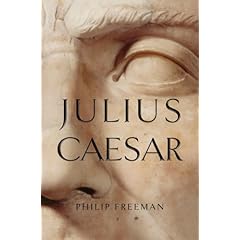
Philip Freeman's "Julius Caesar": A Review


by Mary Harrsch

Philip Freeman's "Julius Caesar" is a comprehensive biography of the Roman conqueror that is as straightforward and readable as the general's own "Gallic Wars". Freeman not only stitches together the various ancient accounts of Caesar's exploits but adds context to his activities by including helpful background information about his various adversaries pulled from a wealth of modern scholarship. He recounts Caesar's conquest of the Celtic tribes of Gaul against a vivid tapestry of the Celtic culture gleaned from such works as Rankin's "Celts and the Classical World, Cunliff's "The Ancient Celts", and Green's "The World of the Druids". I especially found the defeats or near-defeats suffered at the hands of the Celts as fascinating as Caesar's famous victory at Alesia.

The details of a surprise attack by Belgic tribes was particularly intense and sadly ironic because Caesar was essentially saved by his future Civil War opponent, Labienus.

"He [Caesar] had been caught unprepared for a surprise assault of such force and speed. His army would surely have been overwhelmed had it not been for the training and experience they had gained during the past year. There was no time to call his officers together and form a plan , so each organized whatever men were nearest and struck back at the Belgae. With a herculean effort, the Roman troops on the eastern side of the battlefield were able to push the Atrebates and then the Vironmandui back across the river with heavy losses on both sides, but the Nervii on the western end would not yield and pressed the Romans until they fell back in a hopeless struggle to save their camp. The Nervii stormed over the uncompleted walls of the Roman stronghold, killing many of the legionaries and threatening to outflank the Roman forces who had already crossed the river. Caesar had been rushing madly to every corner of the battlefield, but when he saw the dire threat at the camp, he leapt from his horse, grabbed a sword, and joined the fray."

Although Caesar's men rallied with their commander beside them calling them by name, their plight was dire. They managed to stop the encirclement and were presently reinforced by the the arrival of the two legions that had escorted the baggage train. But the real turning point of the battle hinged on the counterattack led by Labienus who, seeing Caesar's desperate struggle, dashed back across the river.

"His arrival brought such hope to the beleaguered men around Caesar that even those who had been seriously wounded propped themselves against their shields for support to continue to fight."

With the tide of battle now turned the Belgic warriors demonstrated their own ferocity and determination to remain an unconquered people.

"As the hours passed, the Romans slowly tightened the circle on them, hacking and killing as each Belgic warrior fought with all his might. In the end, the few Nervii who were left stood on a mound formed by their fallen comrades and - pulling the Roman spears from the dead bodies of their friends - threw them back down at the legions."

These images brought echoes of Thermopylae to mind.

Many critics of Caesar's activities in Gaul have portrayed Caesar and his commanders as ruthless perpetrators of genocide without significant provocation but Freeman, using the details of engagements retold in Caesar's Gallic Wars, recounts numerous incidents of Gallic duplicity after peace agreements were concluded. But Freeman also points out that Caesar did not delude himself with proclamations that he was bringing "civilization" to the Gauls. Instead he said Caesar candidly observed, "Human nature everywhere yearns for freedom and hates submitting to domination by another."

"The Romans never pretended that they were bringing freedom or a better way of life to the peoples they conquered." Freeman states. "They frankly admitted that they were only interested in increasing their own power, wealth, and security through conquest."

I have previously only read isolated passages of accounts of Caesar's Alexandrian Wars so I also found that portion of Freeman's book particularly fascinating. Many books and films about this period seem to omit most references to intervention by Cleopatra's sister Arsinoe and her commander Ganymedes. Many accounts of the confrontation between the Alexandrians and Caesar seem to focus on the activities of the Egyptian general Achillas and the spoiled child-pharaoh Ptolemy XIII. But Freeman recounts how Achillas was actually murdered by Ganymedes and most of the near disasters suffered by Caesar's forces, beseiged in the palace, were masterminded by this militarily astute courtier. Freeman also details the urban warfare that Caesar was forced to conduct in Alexandria that sounded eerily familiar to anyone who watches CNN regularly. I was also surprised to read that the often-portrayed luxurious "honeymoon" cruise up the Nile was a deliberate show of military force since the royal barge was accompanied by over 400 ships crammed with Roman troops. I am now more convinced than ever that Caesar's effort to father a child with Cleopatra was a deliberate act to obtain a client king related by blood to secure Egypt without annexing it and risking its plunder by a corrupt proconsular governor in the future.

Freeman mentioned Caesar's epilepsy only in passing early on in the text. This surprised me since I have long suspected that a head wound Caesar sustained on campaign was actually the cause of the increased frequency of seizures Caesar suffered toward the end of his life and perhaps one of the reasons for the apparent lack of political judgment he exercised at the time of the Africa triumph when he included unpopular tableaus depicting the deaths of Scipio and Cato. Freeman only observed that Caesar showed particularly bad taste in celebrating a triumph over his Roman opponents and how this had upset his normally adoring crowd. There were at least four significant seizures documented by the ancient sources (Plutarch, Suetonius, Appian, and Pliny) that modern experts conclude, according to J. R. Hughes, Department of Neurology, School of Medicine, University of Illinois at Chicago, "were probably complex partial seizures: (1) while listening to an oration by Cicero, (2) in the Senate while being offered the Emperor's Crown, and in military campaigns, (3) near Thapsus (North Africa) and (4) Corduba (Spain)."

Drs. J.G Gomez, J.A. Kotler, and J.B. Long, Division of Neurological Surgery, Holy Cross Hospital, Fort Lauderdale, Florida, conducted a pathological analysis of Caesar's reported symptoms and behavioral changes in 1995 and suggested he may have been suffering from a brain tumor. "The patient had late onset of seizures in the last two years of his life, headaches, personality changes. Upon reexamination of existing Julius Caesar iconography, busts, statues and minted coins no skull deformities have been noted. Identification of a skull deformity as described by Suetonius would have confirmed the suspicion of meningioma involving the convexity of the cerebral hemispheres. Meningioma or slow-growing supratentorial glioma may well have been responsible for this man's illness."

In any event, I think a man who had demonstrated such a superior grasp of Roman politics in the past would not have committed such blunders on purpose or because success had simply "gone to his head".

Freeman included a wonderful compedium at the end of the book that listed his sources for various sections within the text that is a valuable reference for readers wishing to learn more about specific events in Caesar's life. A comprehensive bibliography and index rounded out the text's impressive list of source materials. There were only two things contained in the book that gave me pause. One was a reference to a pilum not being designed as a throwing weapon but rather a thrusting weapon. I think this must have been a lapse in editing as Freeman was comparing Roman weapons with other weapons of the ancient world. Alexander's Macedonians carried sarissas, that, unlike commonly used Greek spears, were not designed for throwing but for thrusting. Likewise, the Roman gladius was designed for thrusting rather than slashing. But a Roman pilum was designed to bend on impact to make it difficult to remove and Freeman pointed this out. So, I would think a weapon so designed was obviously intended primarily for throwing. The other error was the inclusion of an image of a sculptured head of Lucius Cornelius Sulla labeled as Gaius Marius in the photo insert section. It was provided by the Bridgeman Art Library and perhaps the labeling error was theirs. The head is in the permanent collection of the Glyptotek in Munich, Germany as indicated but according to an overwhelming majority of people on the web, including the scholars who maintain Vroma.org, the head belongs to Marius' arch enemy, Sulla. See http://www.vroma.org/~bmcmanus/optimates.html.