Showing posts with label Roman Empire. Show all posts

Sunday, February 27, 2011

Review: Roman Games by Bruce MacBain

Roman Games: A Plinius Secundus MysterySextus Ingentius Verpa, imperial informant to the vicious emperor Domitian, was a real piece of work, having clawed his way to imperial favor by turning in even the emperor's cousin, Clemens, for atheism.  Now, the disgusting thug lay tangled in his bedsheets in a pool of blood, gripping his "member virilus" and clutching his throat.

But, just as in life, Verpa's death sends terror through his household as troopers of the city prefect round up the household slaves and herd them into a small windowless chamber where they will await the foregone conclusion of the official investigation before being executed in a most hideous manner in the arena.

After all, Roman law was clear.  If any slave should murder his master, all slaves, considered complicit because the murder was not prevented, are deemed equally guilty.

But, this time, the outcome was not going to be as predetermined as in cases in Rome's past.  The city prefect has appointed Gaius Plinius Caecilius Secundus, temporary vice-prefect, to investigate, and the thriving young lawyer, known to history as Pliny the Younger, will not be content to simply go through the motions.
As the case begins to unravel, we find Pliny snared in not only a complicated murder investigation but an assassination plot woven about the imperial throne as well.

Mosaic of a Charioteer at the Palazzo Massimo
Photographed by Mary Harrsch
Bruce MacBain, with a PhD in ancient history, does an excellent job of conjuring daily life in Rome of the late first century CE.  I did not detect a single misstep in his descriptions of Roman housing and decor, Roman law, religion, social obligations, leisure pursuits or entertainments.  He even got the numbers and colors of chariot teams correct for the period,  the whites, blues, greens, reds, purples and golds.   Thankfully, I had just finished the Teaching Company course, The Visual Exploration of Rome: Antiquity's Greatest Empire by Dr. Steven Tuck in which Dr. Tuck explained that throughout most of the imperial period there were four official chariot team colors. But, Domitian introduced two more colors, the purples and the golds.  So, I was gratified when Dr. MacBain mentioned the purples and golds in his novel when Pliny attends the races one day!

Although I was only slightly familiar with the historical Pliny the Younger from my study of Pompeii and the Vesuvian disaster that claimed his uncle, Pliny the Elder, I found Pliny to be an interesting man in his own right and plan to read more of his letters as time permits.  From what I found in my research, Dr. MacBain's portrayal of Pliny closely follows his real persona as discovered in the study of his own writings, the Epistulae (Letters), a series of personal missives directed to his friends and associates that were published in Pliny's own lifetime.

Pliny the Younger's descriptions of the eruption
 of Vesuvius have been invaluable to modern volcanologists
From the Discovery Channel's ''Pompeii'', courtesy of Crew Creative, Ltd 
"We know more about Pliny as a person than we do about most figures from antiquity," MacBain obeserves, "because he was a great letter writer. Through his letters we see many facets of the man. He was a Roman senator and a lawyer with a successful, if not brilliant, career in the imperial administration. He was a landowner with a beautiful villa on the Italian coast. He was a literary dilettante. He was rather vain, rather fussy. At the same time, conscientious and honest. He was curious about the natural—and supernatural—world. He was a very social animal, he had hundreds of friends. His most endearing qualities are his love for his young wife, Calpurnia; his generosity—he endowed a scholarship fund for the boys and girls of his home town; and his humanity towards his slaves and freedmen in an age when that was not common."

Calpurnia was actually Pliny's third wife.  Childbirth was a hazardous undertaking in the 1st century CE and Pliny had already been widowed by it earlier in his life.  So, we can certainly understand his worry over his young wife's advanced pregnancy as the story progresses.

MacBain also introduces us to the flamboyant poet Martial.  This hairsute Spaniard is a pungent blend of crude comedy mixed with sudden, unexpected flashes of introspection.  Although he was known for his ribald epigrams he could also pen verses that encouraged reflection on what was really important in life.
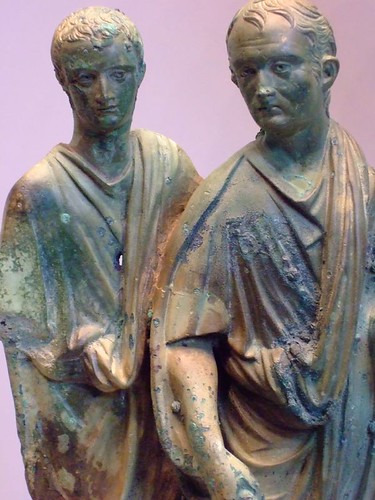
Bronze applique depicting two togate men.
Roman 50 - 75 CE. Photographed at the Getty Villa by Mary Harrsch
An example:

"This is that toga much celebrated in my little books, that toga so well known and loved by my readers. It was a present from Parthenius; a memorable present to his poet long ago; in it, while it was new, while it shone brilliantly with glistening wool, and while it was worthy the name of its giver, I walked proudly conspicuous as a Roman knight. Now it is grown old, and is scarce worth the acceptance of shivering poverty; and you may well call it snowy. What does not time in the course of years destroy? this toga is no longer Parthenius's; it is mine." - Martial, On a Toga Given Him by Parthenius, Book IX,  XLIX.  

We meet Parthenius, a portly and scheming chamberlain of Domitian who acted as gatekeeper to the emperor as the story progresses and learn that even he has joined the inner circle of conspirators plotting Domitian's death.  The chambelain was probably the recipient of many gestures offered to secure a position in the imperial court and someone who an aspiring poet would have had to flatter with verse if he sought to have a copy of his work reach the eyes of the emperor.  Parthenius may have reciprocated with the gift of a toga that could have been worn by the poet to disguise his rather common upbringing and tout his court favor.  But life takes a toll on togas as well as men and Martial confides at the end of the passage that now the toga is more worn and threadbare, it is much more suitable for the real man it now covers.

Martial actually was a friend of Pliny the Younger, who, like many young aristocrats, dabbled in poetry himself and enjoyed  socializing with literary celebrities.  I appreciate the inclusion of  this aspect of Pliny's nature in MacBain's portrayal of Pliny and the opportunity to gain insight into the life of one of Rome's celebrated grammarians living on the precarious edge of imperial patronage.

Bust of the Roman Emperor Domitian 1st century...Image by mharrsch via Flickr
Bust of Domitian 1st century CE

Of course, we also get to meet one of Rome's most sinister emperors, Domitian.  Our first encounter occurs when Pliny is invited to a strange dinner party where the guests are first ushered deep into the bowels of the palace and a bizarre charade takes place where an encounter with Hades himself is reenacted without the guests being forewarned, in an effort to elicit damning confessions from them.  This scene is very reminiscent of a similar audience with Domitian described by Steven Saylor in his novel "Empire".

Domitian's pleasure derived from tormenting Rome's social elite is chilling.  I know Professor Tuck related that he felt many of Domitian's more "transgressive" activities reflected the emperor's efforts to redefine Roman virtus but I can't help but assign a proclivity to sadism to Domitian's psychological profile.

At one point in the novel, Pliny watches as Domitian squashes flies in a prelude to a petulant diatribe against first, Pliny, then Roman society as a whole.  As Domitian veers wildly from condemnation to bestowing  favor upon his hapless visitors and demanding kisses, we can easily understand the fear that must have  permeated Domitian's inner circle.  We also gain sympathy for Domitian's wife, one of the co-conpirators, who is described as bruised so severely even heavy makeup cannot conceal her condition.
Understandably, Pliny  offers to resign his position but the prefect and emperor make it clear that is not an option.  So, he plows ahead, investigating as best he can,  at one point searching through piles of scrolls that comprise his uncle's Naturalis Historia for clues (a respectful nod to the prodigious scholarship of Pliny the Elder).

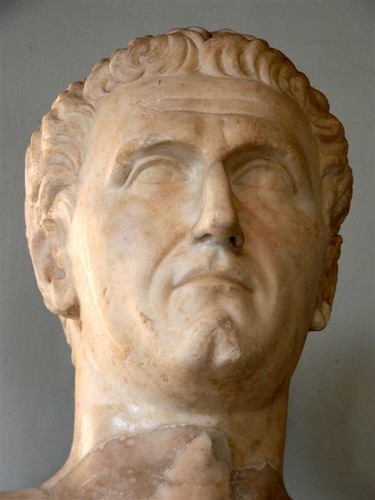
The emperor Nerva photographed at the
Capitoline Museum by Mary Harrsch
The plot takes many twists and turns as Pliny gets closer to the truth. Will Pliny as an upright officer of the court denounce the killer and expose the imperial treachery even though it may mean the deaths of family friends and some of the most conscientious people in Roman society?  Will the emperor's death ignite a civil war with the emperor's loyal legions in Germania who Pliny fears will swoop down on the eternal city  and wreak revenge on its citizens?  What will happen to Pliny under the rule of someone like Nerva, the conspirators' less than enthusiastic designate?

Nerva was Domitian's immediate successor and he is portrayed in the book much as he was thought to have been in life - a reluctant Caesar who other conspirators selected mainly because of his age, with the thought that he could be a placeholder for a short time until someone more suitable could be found.  But there was more to Nerva than the conspirators may have realized.  If we examine another passage from Martial, we see that the poet, experienced in assessing the motivations of others, lends insight into this "man who would be king":

"He who ventures to send verses to the eloquent Nerva, will present common perfumes to Cosmus, violets and privet to the inhabitant of Paestum, and Corsican honey to the bees of Hybla. Yet there is some attraction in even a humble muse; the cheap olive is relished even when costly daintiest are on the table. Be not surprised, however, that, conscious of the mediocrity of her poet, my Muse fears your judgment. Nero himself is said to have dreaded your criticism, when, in his youth, he read to you his sportive effusions." - Martial, To Nerva, Book IX, XXVI.
Martial, at least, has more than just a little trepidation about Nerva's accession and, as the novel concludes, Pliny soon discovers himself that the new emperor has an edge of ruthlessness about him that Pliny will be unable to deflect.

So we leave Pliny, sobered by his new reality, and must say goodbye to Martial as he leaves for his childhood home in Hispania.  Although Pliny has more adventures ahead of him, Martial will no longer share them and, historically, dies within a few years of his return to Spain.

I look forward to Pliny's next adventure as we fast forward ten years and Pliny embarks on a new career as governor of the province of Bithynia-Pontus in Asia Minor.  I see that his new side-kick will be that salacious gossip-monger Suetonius so I'm sure that will make for a wild ride!

Roman Games: A Plinius Secundus Mystery  Complete Letters (Oxford World's Classics)  Ashen Sky: The Letters of Pliny The Younger on the Eruption of Vesuvius Domitian: Tragic Tyrant 


Enhanced by Zemanta

Friday, February 25, 2011

Review: The Green Bronze Mirror by Lynne Ellison (Young Adult)

  The Green Bronze MirrorThis time travel tale by a 14-year-old author was sent to me quite some time ago and I read it but got so swamped with other committments, I never got around to writing my review of it.  My apologies to CnPosner Books who were kind enough to send me a review copy.

Karen is a young British girl, about the same age as the author, with a talent for art. One day she is swept back in time to the age of the Roman Empire under the reign of Nero when she finds an old bronze mirror on a deserted beach and gazes into its corroded surface.  She is discovered by a Roman patrol whose Centurion takes her for a runaway slave and places her temporarily in his household until inquiries can be made.

When no one claims the girl, she is sold to a slaver and placed aboard a ship destined for Rome.  There, she befriends other young slaves and wonders what will happen to her once they reach their destination.
Roman coin bank depicting a beggar girl. 25-50 CE.
Photographed at the Getty Villa by Mary Harrsch.

In Rome, she is purchased by a wealthy Roman family and is charged with the care of the family's children.  When the mistress of the house later discovers Karen's talent for art, she orders Karen to paint murals on the walls of the villa in addition to her child care duties.   Karen enjoys her work so doesn't seem to mind her role in ancient society and befriends some of the other household slaves, discovering one of them is a member of the new Christian cult.  She asks to attend some of their meetings and she is welcomed into the group.  She then falls in love with one of the other young Christian slaves named Kleon.

One day a fire erupts in the city and soon many of the buildings surrounding the villa where Karen lives are threatened by flames.  Karen, remembering her Roman history, is terrified because she knows the Christians will be blamed for the fire and brutally persecuted.

She warns her friends that they will be blamed for the conflagration but, as slaves, they fear severe punishment if they are caught trying to flee.  Finally, she convinces them to flee to the catacombs.  But an angry mob discovers the entrance to the catacombs and begins searching its dank recesses looking for the "arsonists".
Will Karen escape persecution and find her way back to Britain and her own time?

Reading this book, I was impressed with this young author's skilled handling of dialogue.  She also seemed to have a good grasp of Roman culture and seemed to know quite a bit about the layout of ancient Rome, too, as evidenced by references to particular gates of the ancient city.

Her primary shortcoming, as an author, was her naivete about the brutality of daily life for slaves and other members of the lower classes in Roman society.  Her heroine was actually considered a fully mature woman at that point in time and it would be quite a stretch to believe that she could be found by a group of Roman legionaries and deposited untouched into the care of her new master's household slaves.  Furthermore, she manages to remain chaste despite her sale to a slaver, a long sea voyage, and purchase by a Roman master, seemingly content with the attentions of his own wife.
Bronze Bust of a Gallo-Roman Youth 
wearing a hairstyle fashioned after the 
emperor Nero 60-70 CE.  Photographed
at the Getty Villa by Mary Harrsch.

But, I can vaguely remember being 14-years-old myself and innocent about gender relations at that age, so I can certainly understand this aspect of the story.

The "Ben-Hur" approach to ancient Christianity is also understandable since this book was written in 1966 by an imaginative young girl who was probably as enthralled with Charlton Heston's portrayal of the Judean prince at that time as I was.

She also unknowingly compressed historical events surrounding the Great Fire.  The Christians were not immediately blamed for the disaster.  They were eventually selected as probable perpetrators after the populace began voicing their suspicions that Nero himself started the fire to clear out the center of Rome for his new Golden House.

Still, I think young Lynne Ellison could have blossomed into a very good author with more experience.  Sadly, I understand this was her one and only published effort.

I would recommend to the publisher, however, that more care be taken with proofing future releases.  The copy I received, although a commercial release complete with cover and illustrations, was filled with typos and even missing words and phrases.  It was as if an old manuscript was simply scanned, OCRed and sent to press without any human intervention.  Even young authors deserve a publisher's respect for quality in the output of the final product.

The Green Bronze Mirror  A. D. 62: Pompeii  The Gladiators from Capua (Roman Mysteries) The Thieves of Ostia (The Roman Mysteries)   The Secrets of Vesuvius (The Roman Mysteries)                
Enhanced by Zemanta

Saturday, January 08, 2011

Review: King of Kings: Warrior of Rome Book 2 by Harry Sidebottom

King of Kings: Book Two of Warrior of RomeMarcus Claudius Ballista, a warrior of Rome despite his origins in the wilds of Germania, returns to the court of the Emperor Valerian after a valiant but futile defense of the (fictional) Syrian stronghold of Arete in the second installment of Harry Sidebottom's Warrior of Rome series, "King of Kings'.  Unfortunately, the fragile old emperor Valerian, who knowingly sent Ballista on what amounted to a suicide mission, is neither grateful for Ballista's courageous stand or even appreciative that he returned alive.  The feeble emperor has fallen under the sway of an unscrupulous courtier who has his eyes on the purple and is plotting to use a war with the Sassanid Persians to eliminate the old man and seize the throne for his two sons. 

But Ballista, with his battle experience and knowledge of eastern customs and battle strategies represents a threat to the conspiracy.  So, the wily Macrianus the Lame engineers another near suicide mission to save another besieged town. But, when Ballista manages to best the Sassanids once again, Macrianus sidelines Ballista to an administrative post in Ephesus where he has been given a mandate to persecute the new religious sect known as Christians.  Since Christians betrayed Ballista at the siege of Arete, he has no qualms, initially, to oversee the trials of arrested believers.  But as the brutality of the persecution promoted by a zealous local magistrate becomes painfully clear, Ballista devises a plan to use the law itself to halt the distasteful purge. 

But Macrianus had intended for Ballista to fail and uses the opportunity to replace Ballista with Macrianus' own ruthless son, Quietus, to gain even more favor with Valerian.  Once again Ballista finds himself back in Antioch and more out-of-favor than ever.  Treated as a pariah by most of the powerful at the imperial court, Ballista whiles away his time hunting with one of his few friends, the future emperor Aurelian.  Finally, Ballista is asked to serve as a lowly baggage train officer in the army the emperor has assembled to confront Shapur I, the King of Kings.  This fateful battle, that eventually results in the capture of Valerian, takes place near
The triumph of Shapur I over the Roman Emperor...Image via Wikipedia
Rock relief at Naqsh-e Rostam showing the Roman
Emperor Valerian kneeling before Persian King Shapur I
Edessa.

Macrianus has conveniently been left safely in Samosata with the imperial treasury while Quietus continues to pour honey in the ear of the old emperor convincing him to rely on the services of a turncoat, despite the fact that it is apparent to everyone else, particularly Ballista, that the army is being led into a trap.  At the last moment, the guide disappears and Quietus convinces Valerian to send Quietus back to Samosata for help (and safely out of harm's way), leaving Ballista to face the tightening Persian encirclement.  
The Humiliation of Emperor Valerian by Shapur,...Image via Wikipedia
The Humiliation of Emperor Valerian by Shapur,
King of Persia by Hans Holbein the Younger.


When I wrote my review of "Fire In the East: Warrior of Rome Book 1", I didn't realize Ballista was a real Roman commander of the period.  I had searched in vain for a real city named Arete that underwent a siege at about the time period covered by the novel and when I didn't find one, I assumed that the entire book was fictional (except for references to the emperor Valerian and the Persian king Shapur I.  Now, researching my review for Book 2, "King of Kings", I found references to a praetorian prefectus named Ballista who served in various capacities under Valerian. 

He was a notable man, skilled in administering the commonwealth, vehement in counsel, winning fame in campaigns, without an equal in providing for rations, and so highly esteemed by Valerian that in a certain letter he honoured him with the following testimony:

 "From Valerian to Ragonius Clarus, prefect of Illyricum and the provinces of Gaul. If you are a man of good judgement, my kinsman Clarus, as I know that you are, you will carry out the arrangements of Ballista. Model your government on them. Do you see how he refrains from burdening the provincials, how he keeps the horses in places where there is fodder and exacts the rations for his soldiers in places where there is grain, how he never compels the provincials or the land-holders to furnish grain where they have no supply, or horses where they have no pasture? There is no arrangement better than to exact in each place what is there produced, so that the commonwealth may not be burdened by transport or other expenses. Galatia is rich in grain, Thrace is well stocked, and Illyricum is filled with it; so let the foot-soldiers be quartered in these regions, although in Thrace cavalry, too, can winter without damage to the provincials, since plenty of hay can be had from the fields. As for wine and bacon and other forms of food, let them be handed out in those places in which they abound in plenty. All this is the policy of Ballista, who gave orders that any province should furnish only one form of food, namely that in which it abounded, and that from it the soldiers should be kept away. This, in fact, has been officially decreed." - Historia Augusta, Vol III p. 111-113

The villains of the story, Macrianus the Lame and his two sons Macrianus the Younger and Quietus, are also real persons. The ancient sources during this tumultuous period are fragmentary at best but most sources refer to The Macriani as usurpers although I could not find any outright accusations of treachery against Valerian as portrayed in the novel.

"Being now engaged in the war with the Persians, Conscript Fathers, I have entrusted all public affairs, and even those which concern the war, to Macrianus. He is faithful to you, loyal to me, and both beloved and feared by the soldiers. He with his army will act as the case shall demand. And in this, Conscript Fathers, there is nothing new or unexpected by us. For while a boy in Italy, while a youth in Gaul, while a mature man in Africa, and, finally, while well advanced in years in Illyricum and Dalmatia, his valour has been well proved, for in divers battles he has done brave deeds which may serve as a pattern to others." - Valerian, Historia Augusta, Vol. III p. 100. 

However, despite Valerian's implicit trust in Macrianus, like Sidebottom, I find it curious that somehow Macrianus managed to separate himself from Valerian's ill-fated expedition and safely ensconce himself in Samosata with the imperial treasure. It also seems conveniently fortuitous that neither of Macrianus' sons, so lauded by Valerian for their bravery, were captured by the Persians on the expedition in which Valerian himself was seized. 

Some scholars speculate that Ballista was actually a supporter of the Macriani even though in Sidebottom's novel, the Macriani are Ballista's worst enemies. The first mention of Ballista in the Historia Augusta is rather vague about the relationship between these two men.

"So then, when Gallienus and Volusianus were consuls, Macrianus and Ballista met together, called in the remains of the army, and, since the Roman power in the East was tottering, sought someone to appoint as emperor. For Gallienus was showing himself so careless of public affairs that his name was not even mentioned to the soldiers.  It was then finally decided to choose Macrianus and his sons as emperors and to undertake the defence of the state. And so the imperial power was offered to Macrianus.  Now the reasons why Macrianus and his sons should be chosen to rule were these: First of all, no one of the generals of that time was held to be wiser, and none more suited to govern the state; in the second place, he was the richest, and could by his private fortune make good the public losses.  In addition to this, his sons, most valiant young men, rushed with all spirit into the war, ready to serve as an example to the legions in all the duties of soldiers. - Historia Augusta Vol. III p. 19-20

Although Ballista did apparently meet with Macrianus after Valerian was captured, this passage of the Augusta Historia does not say Ballista supported Macrianus as the new emperor.  It sounds to me like Macrianus, as possessor of the imperial treasury, merely used gold to secure the position.

A later section of the Augusta Historia claims Ballista actively supported Macrianus and his sons but this passage was supposedly related by one Maeonius Astyanax, considered a "bogus authority" by such modern scholars as Ronald Syme in his work "Ammianus and the Historia Augusta". 

Enmity between Ballista and Macrianus and/or his sons, however, would certainly explain a later passage relating that Ballista instigated the murder of Macrianus' son, Quietus.

But those who were with Macrianus' son — whose name was Quietus — taking sides with Odaenathus, by the instigation of Ballista, Macrianus' prefect, killed the young man, and, casting his body over the wall, they all in large numbers surrendered to Odaenathus.  And so Odaenathus was made emperor over almost the whole East, while Aureolus held Illyricum and Gallienus Rome. This same Ballista murdered, in addition to Quietus and the guardian of his treasures, many of the people of Emesa, to whom Macrianus' soldiers had fled, with the result that this city was nearly destroyed. - Historia Augusta Vol. III, pp 19-23


If Ballista had supported the Macriani, why would he switch his support to Odenathus and murder Quietus?  There are no reports anywhere else in the Historia Augusta that Ballista was a man with imperial aspirations or of a duplicitous nature. So Sidebottom's scenario seems much more plausible than the conflicting information provided by the rather exasperating "historical" source of the Historia Augusta that repeatedly contradicts itself .
The Roman Emperor Aurelian

So, the real Ballista's role in the imperial succession after the capture of Valerian seems to be somewhat unclear but he is recorded as later defeating Shapur I in Asia Minor at the battle of Corycus.  These events apparently form the foundation of Sidebottom's third installment in the series, Lion of the Sun.  As I am now totally intrigued with Ballista, I look forward to reading the next book in the series.  I see on Sidebottom's website that he is presently working on a fourth novel entitled "The Caspian Gates".  I'm hoping Sidebottom ignores spurious  reports about Ballista meeting his end prematurely and will provide us with even more adventures in which Ballista serves with his friend Aurelian.  I find Aurelian fascinating and would love to learn more about his reconquest of the empire and reasons for his betrayal.


King of Kings: Book Two of Warrior of Rome  Valerian Emperor  Aurelian and the Third Century (Roman Imperial Biographies)   Restorer of the World: The Emperor Aurelian   Corycus   Ancient Warfare: A Very Short Introduction (Very Short Introductions)
Enhanced by Zemanta