Showing posts with label mystery. Show all posts

Sunday, February 27, 2011

Review: Roman Games by Bruce MacBain

Roman Games: A Plinius Secundus MysterySextus Ingentius Verpa, imperial informant to the vicious emperor Domitian, was a real piece of work, having clawed his way to imperial favor by turning in even the emperor's cousin, Clemens, for atheism.  Now, the disgusting thug lay tangled in his bedsheets in a pool of blood, gripping his "member virilus" and clutching his throat.

But, just as in life, Verpa's death sends terror through his household as troopers of the city prefect round up the household slaves and herd them into a small windowless chamber where they will await the foregone conclusion of the official investigation before being executed in a most hideous manner in the arena.

After all, Roman law was clear.  If any slave should murder his master, all slaves, considered complicit because the murder was not prevented, are deemed equally guilty.

But, this time, the outcome was not going to be as predetermined as in cases in Rome's past.  The city prefect has appointed Gaius Plinius Caecilius Secundus, temporary vice-prefect, to investigate, and the thriving young lawyer, known to history as Pliny the Younger, will not be content to simply go through the motions.
As the case begins to unravel, we find Pliny snared in not only a complicated murder investigation but an assassination plot woven about the imperial throne as well.

Mosaic of a Charioteer at the Palazzo Massimo
Photographed by Mary Harrsch
Bruce MacBain, with a PhD in ancient history, does an excellent job of conjuring daily life in Rome of the late first century CE.  I did not detect a single misstep in his descriptions of Roman housing and decor, Roman law, religion, social obligations, leisure pursuits or entertainments.  He even got the numbers and colors of chariot teams correct for the period,  the whites, blues, greens, reds, purples and golds.   Thankfully, I had just finished the Teaching Company course, The Visual Exploration of Rome: Antiquity's Greatest Empire by Dr. Steven Tuck in which Dr. Tuck explained that throughout most of the imperial period there were four official chariot team colors. But, Domitian introduced two more colors, the purples and the golds.  So, I was gratified when Dr. MacBain mentioned the purples and golds in his novel when Pliny attends the races one day!

Although I was only slightly familiar with the historical Pliny the Younger from my study of Pompeii and the Vesuvian disaster that claimed his uncle, Pliny the Elder, I found Pliny to be an interesting man in his own right and plan to read more of his letters as time permits.  From what I found in my research, Dr. MacBain's portrayal of Pliny closely follows his real persona as discovered in the study of his own writings, the Epistulae (Letters), a series of personal missives directed to his friends and associates that were published in Pliny's own lifetime.

Pliny the Younger's descriptions of the eruption
 of Vesuvius have been invaluable to modern volcanologists
From the Discovery Channel's ''Pompeii'', courtesy of Crew Creative, Ltd 
"We know more about Pliny as a person than we do about most figures from antiquity," MacBain obeserves, "because he was a great letter writer. Through his letters we see many facets of the man. He was a Roman senator and a lawyer with a successful, if not brilliant, career in the imperial administration. He was a landowner with a beautiful villa on the Italian coast. He was a literary dilettante. He was rather vain, rather fussy. At the same time, conscientious and honest. He was curious about the natural—and supernatural—world. He was a very social animal, he had hundreds of friends. His most endearing qualities are his love for his young wife, Calpurnia; his generosity—he endowed a scholarship fund for the boys and girls of his home town; and his humanity towards his slaves and freedmen in an age when that was not common."

Calpurnia was actually Pliny's third wife.  Childbirth was a hazardous undertaking in the 1st century CE and Pliny had already been widowed by it earlier in his life.  So, we can certainly understand his worry over his young wife's advanced pregnancy as the story progresses.

MacBain also introduces us to the flamboyant poet Martial.  This hairsute Spaniard is a pungent blend of crude comedy mixed with sudden, unexpected flashes of introspection.  Although he was known for his ribald epigrams he could also pen verses that encouraged reflection on what was really important in life.
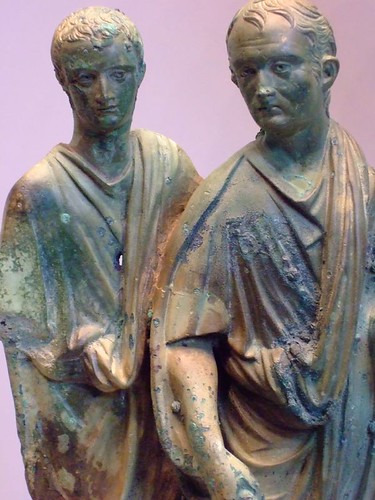
Bronze applique depicting two togate men.
Roman 50 - 75 CE. Photographed at the Getty Villa by Mary Harrsch
An example:

"This is that toga much celebrated in my little books, that toga so well known and loved by my readers. It was a present from Parthenius; a memorable present to his poet long ago; in it, while it was new, while it shone brilliantly with glistening wool, and while it was worthy the name of its giver, I walked proudly conspicuous as a Roman knight. Now it is grown old, and is scarce worth the acceptance of shivering poverty; and you may well call it snowy. What does not time in the course of years destroy? this toga is no longer Parthenius's; it is mine." - Martial, On a Toga Given Him by Parthenius, Book IX,  XLIX.  

We meet Parthenius, a portly and scheming chamberlain of Domitian who acted as gatekeeper to the emperor as the story progresses and learn that even he has joined the inner circle of conspirators plotting Domitian's death.  The chambelain was probably the recipient of many gestures offered to secure a position in the imperial court and someone who an aspiring poet would have had to flatter with verse if he sought to have a copy of his work reach the eyes of the emperor.  Parthenius may have reciprocated with the gift of a toga that could have been worn by the poet to disguise his rather common upbringing and tout his court favor.  But life takes a toll on togas as well as men and Martial confides at the end of the passage that now the toga is more worn and threadbare, it is much more suitable for the real man it now covers.

Martial actually was a friend of Pliny the Younger, who, like many young aristocrats, dabbled in poetry himself and enjoyed  socializing with literary celebrities.  I appreciate the inclusion of  this aspect of Pliny's nature in MacBain's portrayal of Pliny and the opportunity to gain insight into the life of one of Rome's celebrated grammarians living on the precarious edge of imperial patronage.

Bust of the Roman Emperor Domitian 1st century...Image by mharrsch via Flickr
Bust of Domitian 1st century CE

Of course, we also get to meet one of Rome's most sinister emperors, Domitian.  Our first encounter occurs when Pliny is invited to a strange dinner party where the guests are first ushered deep into the bowels of the palace and a bizarre charade takes place where an encounter with Hades himself is reenacted without the guests being forewarned, in an effort to elicit damning confessions from them.  This scene is very reminiscent of a similar audience with Domitian described by Steven Saylor in his novel "Empire".

Domitian's pleasure derived from tormenting Rome's social elite is chilling.  I know Professor Tuck related that he felt many of Domitian's more "transgressive" activities reflected the emperor's efforts to redefine Roman virtus but I can't help but assign a proclivity to sadism to Domitian's psychological profile.

At one point in the novel, Pliny watches as Domitian squashes flies in a prelude to a petulant diatribe against first, Pliny, then Roman society as a whole.  As Domitian veers wildly from condemnation to bestowing  favor upon his hapless visitors and demanding kisses, we can easily understand the fear that must have  permeated Domitian's inner circle.  We also gain sympathy for Domitian's wife, one of the co-conpirators, who is described as bruised so severely even heavy makeup cannot conceal her condition.
Understandably, Pliny  offers to resign his position but the prefect and emperor make it clear that is not an option.  So, he plows ahead, investigating as best he can,  at one point searching through piles of scrolls that comprise his uncle's Naturalis Historia for clues (a respectful nod to the prodigious scholarship of Pliny the Elder).

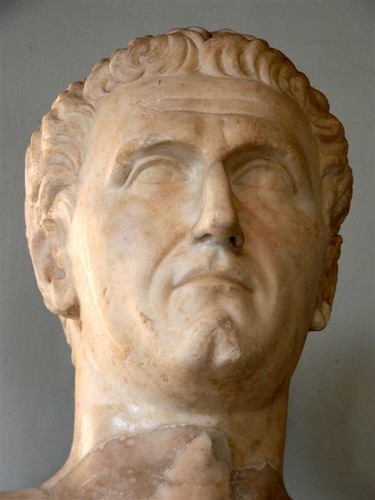
The emperor Nerva photographed at the
Capitoline Museum by Mary Harrsch
The plot takes many twists and turns as Pliny gets closer to the truth. Will Pliny as an upright officer of the court denounce the killer and expose the imperial treachery even though it may mean the deaths of family friends and some of the most conscientious people in Roman society?  Will the emperor's death ignite a civil war with the emperor's loyal legions in Germania who Pliny fears will swoop down on the eternal city  and wreak revenge on its citizens?  What will happen to Pliny under the rule of someone like Nerva, the conspirators' less than enthusiastic designate?

Nerva was Domitian's immediate successor and he is portrayed in the book much as he was thought to have been in life - a reluctant Caesar who other conspirators selected mainly because of his age, with the thought that he could be a placeholder for a short time until someone more suitable could be found.  But there was more to Nerva than the conspirators may have realized.  If we examine another passage from Martial, we see that the poet, experienced in assessing the motivations of others, lends insight into this "man who would be king":

"He who ventures to send verses to the eloquent Nerva, will present common perfumes to Cosmus, violets and privet to the inhabitant of Paestum, and Corsican honey to the bees of Hybla. Yet there is some attraction in even a humble muse; the cheap olive is relished even when costly daintiest are on the table. Be not surprised, however, that, conscious of the mediocrity of her poet, my Muse fears your judgment. Nero himself is said to have dreaded your criticism, when, in his youth, he read to you his sportive effusions." - Martial, To Nerva, Book IX, XXVI.
Martial, at least, has more than just a little trepidation about Nerva's accession and, as the novel concludes, Pliny soon discovers himself that the new emperor has an edge of ruthlessness about him that Pliny will be unable to deflect.

So we leave Pliny, sobered by his new reality, and must say goodbye to Martial as he leaves for his childhood home in Hispania.  Although Pliny has more adventures ahead of him, Martial will no longer share them and, historically, dies within a few years of his return to Spain.

I look forward to Pliny's next adventure as we fast forward ten years and Pliny embarks on a new career as governor of the province of Bithynia-Pontus in Asia Minor.  I see that his new side-kick will be that salacious gossip-monger Suetonius so I'm sure that will make for a wild ride!

Roman Games: A Plinius Secundus Mystery  Complete Letters (Oxford World's Classics)  Ashen Sky: The Letters of Pliny The Younger on the Eruption of Vesuvius Domitian: Tragic Tyrant 


Enhanced by Zemanta

Thursday, July 08, 2010

Review: Persona Non Grata by Ruth Downie

Persona Non Grata: A Novel of the Roman Empire (Roman Empire Series)As senior surgeon for the 20th legion in Britain, Gaius Petreus Ruso has had to deal with everything from murdered bar maids to mystical stag men.   But when he returns home to his family's villa in southern Gaul after receiving a cryptic request marked "urgent", he's hardly prepared for what he finds there.  His sister has fallen in love with a gladiator, his brother is about to be sued by the swindling agent of the local senator, and the brother of his sister-in-law has gone missing in a suspicious shipping mishap.  To make matters worse, the the senator's agent drops dead of apparent poisoning in Ruso's study and Ruso himself quickly becomes the prime suspect.  What's a well-meaning but financially strapped medicus to do?

Although the scoundrel's last utterance points to Ruso's social climbing ex-wife who had married the man not realizing he did not own the sumptuous villa where he resided, the rascal appears to have also had contentious encounters with Ruso's step mother, sister, and even the voluptuous widow next door who is almost singlehandedly running an amphora manufacturing business.  Ruso's not even sure he can safely discount the man's grief-stricken sister. Furthermore, Ruso learns that the agent arranged for the worm-riddled vessel that his sister-in-law's brother disappeared in so he wonders if his brother's wife, the seemingly loving mother of his five rambunctious nieces and nephews, could have slipped something into the cool drink she offered the man when he came to the farm looking for Ruso.  

Fortunately, Ruso brought along his British housekeeper/lover Tilla, whose unassuming way of looking at events with the innocence of child, helps Ruso resolve his latest gaggle of delimmas without alienating his family or landing in the arena as the afternoon snack for the beastkeeper's bear.  Once again Ruth Downie has conjured up late 1st century CE Roman life and peopled it with characters that provide a panoply of suspects along with plot twists to keep readers guessing until the gratifying climax.

The ending leaves you wondering, though, if Ruso is going to give up the army life, settle down in Gaul and make an honest woman of Tilla.  I hope not.  I prefer the setting of a military infirmary or outpost in the wilds of Roman Britain to the more Romanized society of southern Gaul, although this book was certainly enjoyable.   Another aspect of the book that made me nervous was the introduction of the local cult of Christos and Tilla's involvement with it.  Fortunately, Downie invested the experience with humor created by Tilla's naivete about other religions and her effort to compare the new religion with those she is more familiar with.  I just didn't want the series to become a platform for idealizing early Christianity and promoting one religion of the period over others that were fervently and, in many cases, reverently practiced at the time.

I look forward to sharing Ruso and Tilla's next adventure.  Fortunately, a quick check on Amazon shows Downie will be releasing the next installment, entitled "Caveat Emptor", in December 2010.  The book description confirms that Ruso and Tilla do return to Britannia to investigate the disappearance of a local tax collector.  I see he's going to be in Veralamium, the Roman settlement that became St. Alban's.  I've actually been to the ruins of Veralamium so it should be great fun to read a story with that setting.  
  

Caveat Emptor: A Novel of the Roman Empire   Terra Incognita: A Novel of the Roman Empire   Medicus: A Novel of the Roman Empire

Wednesday, May 26, 2010

Review: The Triumph of Caesar by Steven Saylor

The Triumph of Caesar: A Novel of Ancient Rome (Roma Sub Rosa)I first "met" Gordianus the Finder in 72 BCE investigating the murder of a cousin of Marcus Licinius Crassus in "Arms of Nemesis".  Although "Arms" was not the first of Gordianus' adventures written by author Steven Saylor, it was the first of Saylor's Roma Sub Rosa series of mystery novels that I found in audiobook form among the offerings of a local book seller.  My sister had just turned me onto the pleasure of listening to books on my daily commute so I was constantly on the lookout for audiobooks about the ancient world when I made the discovery.
I enjoyed "Arms of Nemesis" so much I immediately elevated Steven Saylor to the top of my favorite authors list and thereafter searched diligently for more of his work.  Over the years I managed to "read" all of his books detailing Gordianus' sleuthing activities in the late Roman Republic, or at least thought I had until I noticed the publication date of "The Triumph of Caesar".  I had confused it with "The Judgment of Caesar" so thought I had already read it until I took the time to read a synopsis of the plot and realized it was the most recent release in the series that had escaped me.

Like Gordianus, I, too, have grown gray over the years and identified with his desire in this latest episode to finally retire and simply enjoy reading in the quiet of his peristyle garden.  But, the rich and famous are still jockeying for positions of power as the Roman Republic crumbles around them and no one is safe, even the mighty Caesar, who has finally emerged victorious from the Civil War with Pompey the Great and the optimates, placed Cleopatra on the throne of Egypt after defeating her brother and his generals and quelled an uprising in the east led by the King of Pontus. 

As Caesar prepares to celebrate an unprecedented four triumphs, his wife Calpurnia has been told by her Etruscan haruspex (soothsayer) that there is yet another plot afoot to kill her husband.  So, she summons Gordianus to discover the latest villain before the assassin can succeed and throw the Republic back into bloody turmoil.

Little is known about Calpurnia other than the fact that she was the daughter of  Lucius Calpurnius Piso Caesoninus, a wealthy patrician who is thought to have owned the sprawling complex of the Villa dei Papiri in Herculaneum.  Saylor portrays her as a politically savvy woman at the center of a huge web of spies who keep her informed about anything that could threaten her husband and thereby her position as the First Lady of Rome.  If we look at the political machinations of her father, this portrayal seems to be quite probable rather than the image of a modest Roman matron painted by what few sketchy references we have in the ancient sources.

In 58 BC, when the consul, he [Piso] and his colleague, Aulus Gabinius, entered into a compact with Publius Clodius, with the object of getting Marcus Tullius Cicero out of the way. Piso's reward was the province of Macedonia, which he administered from 57 BC to the beginning of 55 BC, when he was recalled. Piso's recall was perhaps in consequence of the violent attack made upon him by Cicero in the Senate in his speech, De provinciis consularibus.

On his return, Piso addressed the Senate in his defence, and Cicero replied with the coarse and exaggerated invective known as In Pisonem. Piso issued a pamphlet by way of rejoinder, and there the matter ended. Cicero may have been afraid to bring the father-in-law of Julius Caesar to trial. At the outbreak of the civil war, Piso offered his services as mediator. However, when Caesar marched upon Rome, he left the city by way of protest. Piso did not openly declare for Gnaeus Pompeius Magnus but remained neutral and did not forfeit the respect of Caesar.

After the murder of Caesar, Piso insisted on the provisions of Caesar's will being strictly carried out and, for a time, he opposed Marcus Antonius. Subsequently, he became one of Anthony's supporters and is mentioned as taking part in an embassy to Antony's camp at Mutina with the object of bringing about a reconciliation with Gaius Julius Caesar Octavianus. - NationMaster
The maxim "fiat justitia, ruat coelum" ("Let justice be done, though the heavens fall") is attributed to Piso.

Piso clearly engaged in power brokering at the highest levels and his daughter would surely have learned many valuable lessons about politics growing up in his household. 

We also know from the ancient sources that Calpurnia believed in prophetic dreams so it would not be surprising if Calpurnia clandestinely relied on the services of an Etruscan haruspex. 

Although haruspicy was considered by the Romans so important at one time, that the senate decreed that a certain number of young Etruscans, belonging to the principal families in the state, should always be instructed in it, by the late Republic the art had fallen into disrepute.

In de Divinatione, "Cicero (de Div. II.24) relates a saying of Cato, that he wondered that one haruspex did not laugh when he saw another." - Haruspices by William Smith, D.C.L., LL.D.:
A Dictionary of Greek and Roman Antiquities, John Murray, London, 1875.
But Calpurnia was not about to reject any tool at her disposal.  Furthermore, the Pisones are thought to have had Etruscan origins themselves.  Scholars think this explains their military service in Etruria during the Hannibalic War and consequent introduction into Roman political life.

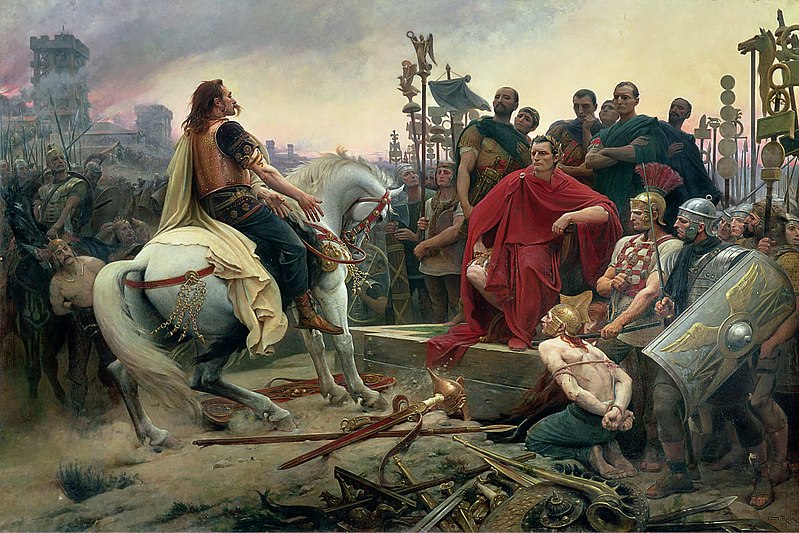
Vercingetorix Throws Down his Arms at the Feet of
Julius Caesar (1899) by Lionel-Noël Royer
She also would not be intimidated by the opinions of pompous men.  Years ago I remember finding an article about Calpurnia that pointed out she resisted the efforts of her domineering father to remarry after Caesar's assassination and actually became a successful businesswoman, much like Caesar's mother Aurelia, evidenced by a grave marker of a young man referring to Calpurnia's business patronage that was recently discovered . 

Although Gordianus does not want to become enmeshed in any more political intrigue, he is convinced to take on the case because he learns that Calpurnia had previously hired his old friend from Massilia, Hieronymous, who now lays dead from a single knife thrust to the chest in Caesar's study.  So, for the sake of his friend, Gordianus accepts the commission.

As Gordianus retraces his friend's steps, we get the opportunity to meet more people whose names crop up in the history of the period.  One of Gordianus' first appointments is to meet with Vercingetorix.  Whenever I read about Vercingetorix, I can't help but envision the noble warrior with flowing hair and mustach depicted in one of my favorite paintings, Vercingetorix Throws Down his Arms at the Feet of Julius Caesar (1899) by Lionel-Noël Royer.  But Gordianus finds a wretched man with matted hair, sunken cheeks and hollow eyes cowering in the depths of the notorious Tullianum, the prison that may have derived its name from the archaic Latin tullius "a jet of water" because the prison, constructed around 640-616 BC, by Ancus Marcius, was originally created as a cistern for a spring in the floor of the structure's lower level. (the prison consisted of two levels - the second of which contained prisoners lowered there through the floor of the upper room).  Eventually a passage between the cistern drain and the Cloaca Maxima was constructed, to not only carry away the waste from prisoners but their bodies as well after their ritual strangulation.
Drain to the Cloaca Maxima in the Tullianum
Drain  the Cloaca Maxima in the Tullianum,
renamed Mamertine Prison in medieval times

I have actually visited the chamber that modern Romans think served as the Tullianum and peered into the hole opening into the Cloaca Maxima.  I shudder to think what it would have been like to languish in that dank cavity awaiting execution.

Goridanus also visits the "House of the Beaks", the former home of Pompey the Great adorned with the ramming beaks of pirate ships captured in Pompey's campaigns.  There, he finds an embittered Antony sodden with wine and consoling himself with a female actress.  Antony is smarting from a public reprimand by Caesar for mismanaging Rome in Caesar's absence and has been placed on notice that Caesar expects him to auction Pompey's house and possessions since they were apparently not formally awarded to Antony for his services during the Civil War.  Pouting like a child, Antony refuses to participate in the upcoming triumphs, despite his own significant contribution to the victory at Alesia, and petulantly plans to hold a rummage sale of Pompey's old mismatched cast offs to give the appearance of complying with Caesar's auction order. I think this passage really nailed the impetuous personality of Antony and his almost child-like contrariness. It was definitely a sharp contrast with Cleopatra's calculated worldliness.

Gordianus also mused about the possibility that Cleopatra herself may be plotting against Caesar.  She certainly could have thought there was a possibility to wrest Egypt away from Roman domination if Caesar's death triggered yet another civil war.  Caesar and Cleopatra were obviously at odds over Caesar's refusal to acknowledge Caesarion as his son although Caesar himself did not seem to have made his mind up yet about what role Cleopatra would play in the future.  Like Gordianus, I too find it odd that he installed her statue in his new Temple of Venus.

Gordianus also interviews Cleopatra's sister, Arsinoe.  Knowing her eventual fate at the hands of Antony's assassins in the sanctuary of Artemis in Ephesus, I couldn't help but find her a tragic figure.  I have been particularly curious about Arsinoe after reading about the possibility that her remains may have been found in an Egyptian style tomb shaped like the Pharos lighthouse in Ephesus.  Although the age of the young woman found in the tomb seems a little too young to me (15 - 18 years of age), I still think the possibility that the skeleton could be Arsinoe is exciting.  (See my original blogpost about the discovery).

 I also felt sorry for Arsinoe's tutor, the eunuch, Ganymedes.  In this book he is portrayed as a somewhat effeminate creature although Ganymedes quite ably commanded Egyptian forces against Caesar after the death of the Egyptian general Achillas.  It was Ganymedes who engineered the pollution of Caesar's water supply when Caesar and his troops were surrounded in Alexandria.  Ganymedes marshalled the Egyptian navy to attack Caesar's fleet too.  Although Ganymedes' seamen lost the naval engagement, he fought Caesar's forces to a standstill in a subsequent bombardment.  But the Egyptian populace, like the Roman mob, were a fickle lot and eventually turned against Arsinoe and Ganymedes claiming they were tired of fighting under the leadership of a woman and her tyrant Ganymedes.  Ganymedes fate is not described in Caesar's Alexandrian Wars.  He simply disappears from the narrative after Caesar releases Ptolemy XIII who then took control of the Egyptian forces and was subsequently defeated by Caesar and drowned in the Nile.  It is unlikely Ganymedes survived the return of Ptolemy even though Arsinoe, still a teenager, was surrendered alive to Caesar.  But, it is such circumstances that invite the novelist's imagination so in this story Ganymedes is pitifully paraded in Saylor's version of Caesar's triumph .

I particularly enjoyed Saylor's descriptions of each triumph and the crowd interactions with the triumphator, Caesar.  I could easily envision the mob shouting in unison like unruly sports fans as they sought to implore Caesar to "Spare The Princess" and "Kill the Eunuch!"

Despite all of these high profile suspects, though, Gordianus discovers that Caesar's conquests may actually not be the ultimate motivation for murder.  The Roman Empire was built on centuries-old traditions and family pride was often tightly interwoven with ancestral contributions to historical tradition. Caesar's seemingly benign attempt to correct the Roman calendar appears to have ruffled important feathers too, including some of his own in-laws.

In the late Republic, the Roman calendar was based on a mish mash of solar and lunar calculations ordained by the second king of Rome, a Sabine statesman named Numa Pompilius. 

"In Romulus' time, the calendar had been fixed at 360 days to the year, but the number of days in a month varied from twenty or less to thirty-five or more. Numa estimated the solar year at 365 days and the lunar year at 354 days. He doubled the difference of eleven days and instituted a leap month of 22 days to come between February and March (which was originally the first month). Numa put January as the first month, and may indeed have added the months of January and February to the calendar." - Biography of Numa Pompilius the Second King of Rome, About.com

Unfortunately, in the 700 or so years since King Numa's calendar had replaced the original calendar, even the leap month could not prevent the calendar from slipping out of sync with the actual seasons.  Harvest festivals based on the calendar were being held before the harvest was even gathered.  So Caesar sought to correct the calendar once and for all with the help of Egyptian astronomers. But, the Calpurnii Pisones prided themselves on their descent from King Numa - so much so that their revered ancestor, the Roman annalist L. Calpurnius Piso Frugi who was consul in 133 BCE, censor in 120 BCE and author of the Annales Maximi, is credited with more citations about King Numa in his writings than any other Roman historiographer.1 

So Caesar's tampering with the calendar could be viewed as almost sacriligious by members of his wife's family.  Furthermore, Caesar's opponents, always on the lookout for something to use against him, were sowing unrest by claiming the involvement of Egyptian astronomers made it look like his new Egyptian subjects were superior to average Romans.


Gordianus eventually manages to thwart those that would put an end to Caesar prematurely but we all know destiny cannot be permanently denied.  Caesar would still find his at the end of dagger (or possibly 23 daggers) in the Theater of Pompey on the Ides of March in 44 BCE. I have yet to discover if Gordianus will be called upon to head that investigation!

Footnote 1: Gary Forsythe, The Historian L. Calpurnius Piso Frugi and the Roman Annalistic Tradition. Lanham, MD: University Press of America, 1994. Pp. xi + 552. ISBN 0-8191-9742-4.
 
The Judgment of Caesar: A Novel of Ancient Rome (Novels of Ancient Rome)   The Roman Triumph   Greek and Roman Calendars: Constructions of Time in the Classical World   The Religion of the Etruscans   Caesar's War in Alexandria: Bellum Civile Iii. 102-112 Bellum Alexandrinum 1-33 

Saturday, January 23, 2010

Review: The Jupiter Myth by Lindsey Davis

The Jupiter Myth (Marcus Didius Falco Mysteries)Davis' Roman super-sleuth Marcus Didus Falco returns to Britain in this tale and must investigate the death of  a roguish courtier of King Togidubnus who ends up head first down a tavern well in a rather primitive Londonium.  The town, still scarred by fires and devastation wrought by Queen Boudicca in the Iceni Revolt a little over a decade before, holds no pleasant memories for Falco, who served there with the Second Augusta.  The Second Augusta Legion, under Petillius Cerialis, met Boudicca's eighty to one-hundred thousand rebels near Verulamium (modern St. Alban's ) with only two thousand Roman troops. Needless to say, few of the legion survived although Falco and his old friend Petro were among them.

Now, it seems gangsters from Rome have decided to exploit the new province. Falco discovers their hired muscle leaning on bakers, tavern keepers and even the local familia gladiatorix.  Davis does a good job of conjuring up the rough and tumble world of this colonial village on the Thames but I found passages to be exasperating as Falco would discover important information that should have been reported to the governor right away but instead, Falco decides he's too tired and figures it can wait until the next day which, of course, is too late.  The showdown between the imported thugs and the women gladiators seems more contrived than exciting and the villain's escape borders on the ridiculous.

I listened to the unabridged audio version of this book while I was exercising alone on my exercise bike and it's a good thing since I found myself blurting out derisive comments about Falco's contrived missteps.

Davis also has Petro acting remote and brooding for no particular reason and when the reason is finally revealed it doesn't really make any sense since Petro acknowledges he figured Falco would be watching his back.  I also found it pretty implausible that Helena Justina would be wandering the seamier neighborhoods of this grimy little backwater with her young children in tow and no escort. 

The frustrations I felt while reading this book were roughly equivalent to my generally negative reactions to "Last Act in Palmyra" and "See Delphi and Die".  Each time I read one of the Falco mysteries, I am hoping to catch a glimpse of the solid writing and plot development I experienced reading "The Course of Honor", "Silver Pigs", and "The Iron Hand of Mars".  Perhaps my biggest problem is that I don't really enjoy reading about a man who has such a negative view of life in general.  I guess some people consider Falco an interesting curmudgeon but I've had enough interactions with negative personalities in the real world that I prefer not to spend my fantasy world with them.

 Roman Myths (The Legendary Past)  The Course of Honour    The Iron Hand of Mars: A Marcus Didius Falco Mystery  

Tuesday, May 06, 2008

Nox Dormienda: A Long Night for Sleeping (An Arcturus Mystery)


Saturnalia is almost over, but drunks and gamblers aren't the only denizens of Londinium knocking on the doctor's door. The winter of 836 a.u.c. (83 A.D.) is cold and bitter. The year's final exhale will be colder still.

Arcturus--the half-native, half-Roman doctor and occasional problem-solver--has seen much in his thirty-three years. He's risen--despite not playing the politics game. He is Agricola's doctor. And Agricola's friend. And Agricola is the governor of Britannia.

Now, on a frozen December afternoon, he learns the governor is in trouble. The Emperor Domitian has sent a spy to Britannia--a spy carrying papers demanding Agricola's resignation. It doesn't make Arcturus any warmer to know that the spy, a Syrian named Vibius Maecenas, is betrothed to the woman who brings him the story. The woman--Gwyna--is as unforgettable as her information.

When Arcturus sends his freedman Bilicho to follow her, he finds himself, hours later, in an underground temple, staring at a shapeless hulk on top the altar. It's the trussed, dead body of Maecenas, with a gaping hole in place of a throat.

If Arcturus doesn't find out who murdered him and why, Domitian might think the governor is responsible. The fat, dead Syrian will ignite a civil war, one hot enough to thaw the ice in frozen Britannia.

He has seven days to unravel fact from story, truth from rumor, and motive from murder. He must walk a carnival landscape of fear and uncertainty, strewn with sadistic pimps, drunken whores, well-bred politicians and four more deaths.

Nox Dormienda is a nightmare vision of Roman Britain, a lightning-paced historical mystery that blends hardboiled prose and impeccably researched historical background. It is the first novel of a new series and a new genre of mystery fiction: it is Roman Noir.

Monday, January 21, 2008

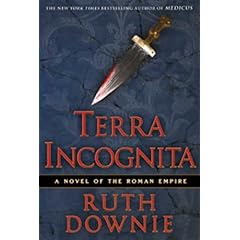
Terra Incognita sequel to Medicus to be released in March


I was thrilled to see that Ruth Downie will be releasing a sequel to her excellent debut novel Medicus in March:

"It is spring in the year 118, and Gaius Petreius Ruso has been stationed in the Roman-occupied province of Britannia for nearly a year. After his long and reluctant investigation of the murders of a handful of local prostitutes, Ruso needs to get away. With that in mind, he has volunteered for a posting with the army in Britannia’s deepest recesses—a calmer place for a tired man.

But the edge of the Roman Empire is a volatile place; the independent tribes of the North dwell near its borders. These hinterlands are the homeland of Ruso’s slave, Tilla, who has scores of her own to settle there: Her tribespeople are fomenting a rebellion against Roman control, and her former lover is implicated in the grisly murder of a soldier. Ruso, filling in for the demented local doctor, is appalled to find that Tilla is still spending time with the prime suspect. Worse, he is honor-bound to try to prove the man innocent—and the army wrong—by finding another culprit. Soon both Ruso’s and Tilla’s lives are in
jeopardy, as is the future of their burgeoning romance.

Terra Incognita shines light on a remote corner of the ancient world, where Ruso’s luck is running short—again."

The Voyage of the Short Serpent by Bernard du Bucheron


Abstract from review by Robert Zaretsky of the Houston Chronicle:

"...The time is the Middle Ages, the place Greenland. In prose as spare as the frozen landscape, we learn that I. Montanus, "inquisitor ordinary and extraordinary" based in Nidaros (the present-day Norwegian city of Trondheim), has been assigned to reclaim the lost colony of New Thule for the Catholic faith.

Perched on the top of the world, New Thule has strayed from the straight and narrow. Sodomy and bigamy, Montanus learns, are widespread. But so are they at any Club Med. More problematic, for modern readers, is the practice of incest and cannibalism.

Montanus seems equal to this monumental task. A learned theologian, he has already shown his mettle in Spain by battling the Moors and hounding the Marranos. At the same time, he is a soft touch for the widows and orphans of those he has condemned to die, enfolding them in the faith rejected by their husbands and fathers. And there is one last flourish to his résumé: He knows the French language and manners. As his archbishop archly notes, Montanus has "learned to enjoy fare other than the barley soup and salted herring so dear to our flock." As he soon discovers, however, even salted herring is a delicacy in New Thule.

The novel opens with a letter from Montanus' superior listing the challenges that await him and his handpicked crew. Ice floes and icebergs, frozen and endless arctic nights, long and pestiferous summer days are the least of it. The spiritual wastes are even greater. As a result, Montanus' mission, should he decide to accept it, is to be "as pitiless in castigating sin as you are generous in recognizing virtue."

Montanus is thus authorized to employ the gamut of inquisitorial punishments, ranging from the stake and head vise to boiling oil and stoning. He is, however, discouraged from using the "beer funnel": This medieval form of waterboarding is "a waste of a scarce commodity and abases the executioner to the vile office of a common inn keeper."

Setting sail for Greenland, Montanus' ship is quickly beset by ice storms that batter and ensnare it. With the onset of frostbite, the crew's arms and legs become as immobilized as the ship. But there is an upside: For the starving men, their numbed appendages are transformed into frozen dinners. As one of Montanus' men argues, "the season was not Lent, and proceeded to devour his own toes."

Yet Montanus' unwavering faith and the ship captain's equally impressive competence allow the crew to make landfall at Greenland. The welcome is scarcely encouraging: Inside the lone and mean dwelling they first discover, the voyagers find several corpses. Were it not for the freshly slit throats of the men, women and children, one might have surmised from their emaciated frames and suppurating lesions that they had been overcome by disease. Completing the nightmarish tableau is the mangled corpse of a monkey — an astonishing find, as Montanus dryly notes, "for I knew that its species did not belong in these arctic climes."

No more so than Homo sapiens, it would seem. In the end, the monkey's presence in Greenland is less puzzling than man's. Why would human beings cling to life in such a dismal and godforsaken icescape? What, indeed, are they doing there in the first place? Of course, if I had a good answer to this question, I wouldn't be writing book reviews for a living. But if, on the other hand, I were writing a book, such a situation would serve a practical purpose. It offers a thought experiment, one that allows us to observe our fellow human beings stripped of every social and moral convention we take for granted. The results are not pretty.

Once Montanus reaches New Thule and its wretched residents, we find that nature's harshness is dwarfed by man's own mercilessness. The novel reads as if Cormac McCarthy had channeled Jack London — or, better yet, Dostoevsky. The Grand Inquisitor in Dostoevsky's Brothers Karamazov, or Machiavelli for that matter, could take a refresher course from Montanus.

Thus, shortly after arriving in New Thule, he condemns two locals to the stake. He does so less for their sins, he writes to his superior, than to assert his authority "in being seen to use immediate severity, thereby saving the need for still greater severity later on." Montanus' political calculus is too optimistic, though, for he launches into a series of ever more gruesome executions and punishments.

By the end of his stay, Montanus has reclaimed New Thule for the church, but at a staggering cost to himself and others. He solves the mystery of the monkey and its slaughtered household, but the answer provides more darkness than light. This holds true for the entirety of this taut and powerful book. It destroys one illusion after another: By the novel's end, even our hope that Montanus' self-discipline is matched by self-understanding has been dashed..."