Showing posts with label detective. Show all posts

Thursday, July 08, 2010

Review: Persona Non Grata by Ruth Downie

Persona Non Grata: A Novel of the Roman Empire (Roman Empire Series)As senior surgeon for the 20th legion in Britain, Gaius Petreus Ruso has had to deal with everything from murdered bar maids to mystical stag men.   But when he returns home to his family's villa in southern Gaul after receiving a cryptic request marked "urgent", he's hardly prepared for what he finds there.  His sister has fallen in love with a gladiator, his brother is about to be sued by the swindling agent of the local senator, and the brother of his sister-in-law has gone missing in a suspicious shipping mishap.  To make matters worse, the the senator's agent drops dead of apparent poisoning in Ruso's study and Ruso himself quickly becomes the prime suspect.  What's a well-meaning but financially strapped medicus to do?

Although the scoundrel's last utterance points to Ruso's social climbing ex-wife who had married the man not realizing he did not own the sumptuous villa where he resided, the rascal appears to have also had contentious encounters with Ruso's step mother, sister, and even the voluptuous widow next door who is almost singlehandedly running an amphora manufacturing business.  Ruso's not even sure he can safely discount the man's grief-stricken sister. Furthermore, Ruso learns that the agent arranged for the worm-riddled vessel that his sister-in-law's brother disappeared in so he wonders if his brother's wife, the seemingly loving mother of his five rambunctious nieces and nephews, could have slipped something into the cool drink she offered the man when he came to the farm looking for Ruso.  

Fortunately, Ruso brought along his British housekeeper/lover Tilla, whose unassuming way of looking at events with the innocence of child, helps Ruso resolve his latest gaggle of delimmas without alienating his family or landing in the arena as the afternoon snack for the beastkeeper's bear.  Once again Ruth Downie has conjured up late 1st century CE Roman life and peopled it with characters that provide a panoply of suspects along with plot twists to keep readers guessing until the gratifying climax.

The ending leaves you wondering, though, if Ruso is going to give up the army life, settle down in Gaul and make an honest woman of Tilla.  I hope not.  I prefer the setting of a military infirmary or outpost in the wilds of Roman Britain to the more Romanized society of southern Gaul, although this book was certainly enjoyable.   Another aspect of the book that made me nervous was the introduction of the local cult of Christos and Tilla's involvement with it.  Fortunately, Downie invested the experience with humor created by Tilla's naivete about other religions and her effort to compare the new religion with those she is more familiar with.  I just didn't want the series to become a platform for idealizing early Christianity and promoting one religion of the period over others that were fervently and, in many cases, reverently practiced at the time.

I look forward to sharing Ruso and Tilla's next adventure.  Fortunately, a quick check on Amazon shows Downie will be releasing the next installment, entitled "Caveat Emptor", in December 2010.  The book description confirms that Ruso and Tilla do return to Britannia to investigate the disappearance of a local tax collector.  I see he's going to be in Veralamium, the Roman settlement that became St. Alban's.  I've actually been to the ruins of Veralamium so it should be great fun to read a story with that setting.  
  

Caveat Emptor: A Novel of the Roman Empire   Terra Incognita: A Novel of the Roman Empire   Medicus: A Novel of the Roman Empire

Saturday, January 23, 2010

Review: The Jupiter Myth by Lindsey Davis

The Jupiter Myth (Marcus Didius Falco Mysteries)Davis' Roman super-sleuth Marcus Didus Falco returns to Britain in this tale and must investigate the death of  a roguish courtier of King Togidubnus who ends up head first down a tavern well in a rather primitive Londonium.  The town, still scarred by fires and devastation wrought by Queen Boudicca in the Iceni Revolt a little over a decade before, holds no pleasant memories for Falco, who served there with the Second Augusta.  The Second Augusta Legion, under Petillius Cerialis, met Boudicca's eighty to one-hundred thousand rebels near Verulamium (modern St. Alban's ) with only two thousand Roman troops. Needless to say, few of the legion survived although Falco and his old friend Petro were among them.

Now, it seems gangsters from Rome have decided to exploit the new province. Falco discovers their hired muscle leaning on bakers, tavern keepers and even the local familia gladiatorix.  Davis does a good job of conjuring up the rough and tumble world of this colonial village on the Thames but I found passages to be exasperating as Falco would discover important information that should have been reported to the governor right away but instead, Falco decides he's too tired and figures it can wait until the next day which, of course, is too late.  The showdown between the imported thugs and the women gladiators seems more contrived than exciting and the villain's escape borders on the ridiculous.

I listened to the unabridged audio version of this book while I was exercising alone on my exercise bike and it's a good thing since I found myself blurting out derisive comments about Falco's contrived missteps.

Davis also has Petro acting remote and brooding for no particular reason and when the reason is finally revealed it doesn't really make any sense since Petro acknowledges he figured Falco would be watching his back.  I also found it pretty implausible that Helena Justina would be wandering the seamier neighborhoods of this grimy little backwater with her young children in tow and no escort. 

The frustrations I felt while reading this book were roughly equivalent to my generally negative reactions to "Last Act in Palmyra" and "See Delphi and Die".  Each time I read one of the Falco mysteries, I am hoping to catch a glimpse of the solid writing and plot development I experienced reading "The Course of Honor", "Silver Pigs", and "The Iron Hand of Mars".  Perhaps my biggest problem is that I don't really enjoy reading about a man who has such a negative view of life in general.  I guess some people consider Falco an interesting curmudgeon but I've had enough interactions with negative personalities in the real world that I prefer not to spend my fantasy world with them.

 Roman Myths (The Legendary Past)  The Course of Honour    The Iron Hand of Mars: A Marcus Didius Falco Mystery  

Sunday, June 01, 2008

Review: Nox Dormienda by Kelli Stanley


A history resource article by  © 2008

"The morning staggered by, still looking for a party. Saturnalia was officially over two days ago - unofficially there were still cockfights and dice throws, more wine-soaked quickies and the odor of vomit filling every alley."

Welcome to Kelli Stanley's world of Roman noir.

I have enjoyed "detectives in togas" for a number of years - particularly a late Roman Republican sleuth named Gordianus the Finder penned from the imagination of Steven Saylor. But I am not familiar with the private eyes that populate the books by Stanley's favorite author Raymond Chandler. Perhaps the closest I have come to this genre is reading James Lee Burke's Dave Robicheaux novels. Likewise, I have not shared my son's passion for noir genre films, although Bogart's Casablanca deserves its reputation as a classic. So I wasn't quite sure what to expect when Stanley sent me a copy of her book "Nox Dormienda", the first of a planned series of mystery novels featuring a crime-solving medicus in Agricola's Roman Britain promoted as a new genre, Roman noir.

For a child of the 50s and 60s raised on a diet of traditional historical epics, I found the "snappy-tough" noir-style dialogue jarring at first as I struggled to lose myself in the gritty reality of life in early Londonium. I felt like I had bought a ticket to see "Gladiator" but made a wrong turn inside the cineplex and stumbled into Tarrentino's "Pulp Fiction". But as the novel progressed and I got to know the interesting cast of characters, especially the quirky half-Roman, half-Britain medicus who could be gently caressing a puppy one minute and groping in the abdomen of a nearly eviscerated legionary the next, I succumbed to this author's efforts to conjure up a unique view of ancient Rome and began to enjoy the bumpy ride as Stanley's protagonist tugged me through Londonium's back streets, down into a mithraeum, up the back stairs of a seedy brothel, then into the provincial governor's palace where a weary Agricola, one of Domitian's most successful and honored generals, brooded over rumors of his pending dismissal as he realized his old soldier's boots may not be the best footwear to navigate the tightrope of imperial politics. I think what I enjoyed most was becoming an invisible member of the raucous household of Julius Alpinus Classicianus Favonianus (that's Arcturus to you natives or Ardur to any rheumy-eyed Trinovantean females) whose members so eagerly attempted to assist the Dominus in his investigations.

As a member of the senatorial class, Arcturus does not lead the hand-to-mouth solo existence of Lindsey Davis' Didius Falco. His extended family includes a cook, Venutius, who tries to win Arcturus over with cullinery experiments that often go awry, Draco, a hulking bodyguard with a legendary appetite who must be barely out of his teens as he's still growing out of his tunics, a steward, Brutius, who tries to keep Arcturus' adoring public at bay, Coire, a slave girl who would like to perform in the bedroom but is relegated to the examination room, and a love-struck freedman, Bilicho, who serves as assistant surgeon/gumshoe. As the story progresses, the seductive Gywnna, daughter of an aging Trinovantean auxiliary commander moves in along with her 10-year-old brother Hefin. Then, Bilicho drags home Stricta, his Egyptian girlfriend and one-time prostitute who also happens to be a witness to the murder Arcturus is attempting to solve. Add to this a faithful and much loved dog, Pyxis, her puppies, a cat, and a smattering of chickens and you definitely experience the "urbanity" of Roman life.

The only plot development that struck a sour note with me was introduction of an insane Christian legionary. Stanley seemed compelled to offer insanity as an excuse for his dichotomous behavior. Early Christians were not necessarily the pious, submissive victims of "The Robe", though. The violence of a soldier's profession would not have been viewed as incongruous with Christian teachings. This attitutde is clearly demonstrated several centuries later by the first so-called Christian emperor Constantine. Furthermore, a soldier who zealously berated his bunkmates for their embrace of other relgions of the period, like Mithrascism, would be doubtful in the inclusive polytheism of Roman culture. Acting like a near-zombie, chanting religious mantras with eyes glazed over, would have netted a man a quiet but violent fate in some back alley. The Roman army was still a well-oiled machine at this time and its members would not have tolerated such gum in the works for very long. That is not to say that there weren't any Christian legionaries. I just don't think the behavior exhibited by this character was needed to validate that portion of the plot.

Inevidentably, people who have read my review of Ruth Downie's "Medicus" will ask me how I would compare the two, since both not only feature a Roman medicus as primary protagonist but both set the stage for action in Roman Britain, albeit different time periods. Downie's Ruso is a regular army medicus recently transferred to the XX Legion in the remote port of Deva (now Chester). He is starting over after a ruinous divorce from a socialite wife that has left him almost penniless. His father has also died leaving a mountain of unpaid bills to Ruso and his brother struggling to scratch a living from a small farm in Gaul. Ruso's sense of "dignitas" drives him to not only attempt to reverse his family's financial misfortunes by writing a medical treatise, but to become a reluctant sleuth when a serial killer surfaces in the seedier part of town and no one else seems to view the lives of the unfortunate prostitute victims as worth the trouble. Ruso is a healer first and foremost and only consequentially an investigator. Arcturus, on the other hand, seems to eagerly embrace the opportunity to discover "who done it", welcoming the diversion from the humdrum of the normal practice of the governor's medicus. Both men, though, seem to be equally gifted with the healing arts.

Ruso's world is also decidedly different that than of Arcturus and, with the exception of Ruso serendipitously saving the life of the emperor Trajan in an earthquake, did not include encounters with the famous. But that is not to say that Ruso did not interact with equally intriguing characters. Downie's dilapidated military outpost teemed with vibrantly-drawn people thriving in the cauldron of a remote Roman frontier where two cultures attempted to co-exist. Arcturus' Londonium is nearly as primitive, since it is decades earlier. But, Arcturus' lineage from a native mother married to a Roman centurion provides Arcturus with an internal conflict in which his two halves attempt to co-exist in a single body. So, I would say both novels offer a unique perspective on the Roman experience in Britain and I look forward to the next installment in both of these series.

One last note - I truly appreciate the writing device Kelli Stanley uses to acquaint the reader with common latin references. Each time she uses a latin word, she places it in italics and includes it in a gloassary at the end of the book. Since I have read a number of novels and nonfiction works about the Roman Empire, I was familiar with many of the terms without looking them up. However, I welcomed the opportunity to expand my latin vocabulary. I was particularly pleased to learn that posca was a cheap alcoholic drink made from vinegar and herbs. I had to smile when I read that since it made me think of the personality of Julius Caesar's wannabe-strategist-slave, Posca, in the HBO miniseries, "Rome". I think a blend of vinegar and herbs aptly described him!

Monday, January 21, 2008

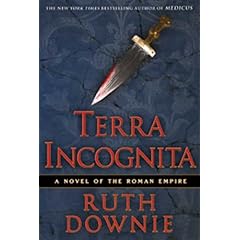
Terra Incognita sequel to Medicus to be released in March


I was thrilled to see that Ruth Downie will be releasing a sequel to her excellent debut novel Medicus in March:

"It is spring in the year 118, and Gaius Petreius Ruso has been stationed in the Roman-occupied province of Britannia for nearly a year. After his long and reluctant investigation of the murders of a handful of local prostitutes, Ruso needs to get away. With that in mind, he has volunteered for a posting with the army in Britannia’s deepest recesses—a calmer place for a tired man.

But the edge of the Roman Empire is a volatile place; the independent tribes of the North dwell near its borders. These hinterlands are the homeland of Ruso’s slave, Tilla, who has scores of her own to settle there: Her tribespeople are fomenting a rebellion against Roman control, and her former lover is implicated in the grisly murder of a soldier. Ruso, filling in for the demented local doctor, is appalled to find that Tilla is still spending time with the prime suspect. Worse, he is honor-bound to try to prove the man innocent—and the army wrong—by finding another culprit. Soon both Ruso’s and Tilla’s lives are in
jeopardy, as is the future of their burgeoning romance.

Terra Incognita shines light on a remote corner of the ancient world, where Ruso’s luck is running short—again."