Showing posts with label review. Show all posts

Thursday, June 23, 2011

Review: Master of Rome by John Stack


The glamor surrounding Hannibal and his amazing trek through the Alps with a cadre of elephants during the Second Punic War has captivated history buffs for so long that the First Punic War has been virtually overlooked by many historical novelists.  Likewise, although many authors have written thousands of pages about Rome's fierce legions, Rome's first tentative efforts to build a navy and develop seamanship that would eventually rival Carthaginian mariners who had ruled the Mediterranean for centuries have been largely ignored as well.   But Irish author John Stack has redressed  both of these oversights in his "Masters of the Sea" series of novels.

I was unaware of Stack's efforts until the third book in his series, "Master of Rome", popped up in the available titles on Audible.com.  As I am always on the lookout for stories set in the ancient world, I immediately selected it as one of my choices and was pleased to discover that its story focussed on the naval battles of the last years of the First Punic War.

The story's protagonist, a Greek born Roman prefect named Atticus Perennis, has honed his seamanship fighting pirates (which I learned later is covered by the first book in the series, Ship of Rome) and has learned to use the corvus, a boarding ramp introduced by the Romans to allow them to take advantage of land-type assault maneuvers at sea, to deadly effect.
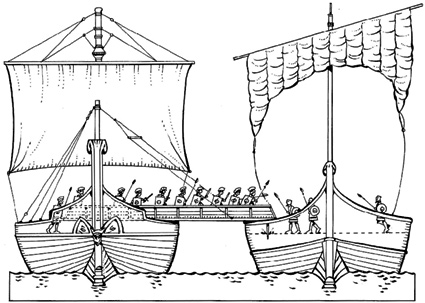
The Roman corvus, a boarding ramp anchored to the enemy
ship by a sharp spike, is estimated to have weighed over
a ton causing severe instability in rough seas.  Though 
advantageous under the right conditions, it was ultimately
abandoned after the loss of an entire fleet in a storm following
the battle of Cape Ecnomus during the First Punic War.


I had known about the corvus from earlier studies but didn't realize that it was actually used for only a few years during the First Punic War because of the massive loss of ships in a storm following the brilliant Roman victory at the battle of Cape Ecnomus.

Perennis commands one of the few ships that survive the storm and is assaulted by charges of incompetence when he returns to Rome to report the loss to the senate.  We learn that in earlier novels Perennis has apparently made a powerful enemy in the form of Gnaeus Cornelius Scipio Asina who earned his cognomen "Asina" meaning "donkey" when, as the first Roman fleet commander, he led an ill-conceived rush to take possession of the Lipari Islands and was subsequently captured by the Carthaginians.   Since I had read only about the glory of the Scipioni in regards to the Second Punic War and the ultimate defeat of Hannibal, I was surprised to learn that the family had someone in the family tree much less militarily successful.  A little research revealed that he was actually a brother to Lucius Cornelius Scipio who begat the much more glorious line of descendants.
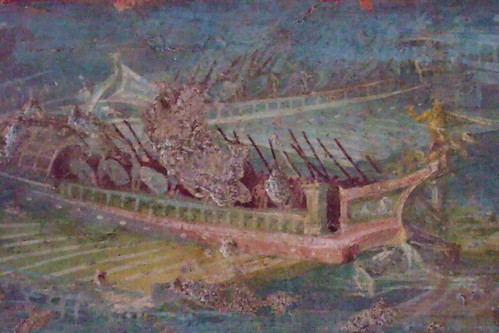
Roman galley depicted in a fresco recovered from Pompeii, 1st century BCE -
1st century CE.  Photographed by Mary Harrsch at the Archaeologico Nazionale 
di Napoli in Naples, Italy.


Fortunately, Perennis has a powerful Senator in his corner, and he survives the spurious charges and is placed in command of a new fleet no longer equipped with the corvus.  But this change brings the Romans back to their original problem.  How do they overcome the supremely skilled Carthaginian seamen?   To make matters worse, Scipio Asina is elected consul and ignores any advice Perennis offers to help the Romans achieve victory.

Perennis trains his men furiously but even the most brutal training schedule cannot equal the skills acquired and handed down for centuries by generations of Carthaginian sailors.  However, Perennis manages to maintain a blockade of the city of Panormus and Scipio's legions eventually breach the city's defenses.  But the Carthaginian defense is spearheaded by Greek mercenaries so Scipio refuses to acknowledge Perennis' crucial contributions to the ultimate Roman victory.

In the meantime, Hamilcar Barca has hired another of Perennis' wily countryman from Rhodes to slip through the Roman blockade and keep Barca informed of Roman dispositions of ships and legions.
This Rhodian, a  real historical figure named Hannibal the Rhodian, was almost equal to Perennis in command seamanship and Perennis has to employ every ounce of his mariner's skill as well as a cuning ruse to finally overwhelm the Rhodian's sleek quadreme when the Rhodian attempts once again to run the Roman blockade.  (I noticed in my research that the Rhodian's ship is thought to have been used subsequently as the model for faster Roman ships as the war progressed.)

The Rhodian's capture yields valuable intelligence about the location of the main Carthaginian fleet at Drepana and Scipio Asini is once again, all too quick to jump on the opportunity to grab a fistful of glory and orders a night voyage to surprise the Carthaginians.

Battle of DrepanaImage via Wikipedia

For the sake of historical accuracy, I must point out that in history, Publius Claudius Pulcher, not Scipio Asini, was consul by then, and it is Pulcher who supposedly threw the uncooperative sacred chickens overboard when they refused to eat during the auguries before the battle of Drepana, declaring "Bibant, quoniam esse nolunt " - "Let them drink, since they don't wish to eat!".  Stack includes this bit of theater in his story although some scholars point out that it was only referenced indirectly by Cicero and not documented by Polybius, recognized as the definitive ancient source on the Punic Wars, so  whether it really happened is questionable.

Some reviewers have criticized Stack's consolidation of some of the Roman commanders but I think he meant to streamline the story to improve pacing and allow the reader to focus on the actions of  the main protagonist and antagonists.  Stack also simplifies the Carthaginian command structure by having Hamilcar Barca, Hannibal's father, in primary command of all Carthaginian forces, including the fleet.  In reality, Hamilcar Barca commanded the land forces and did not possess the level of naval acumen attributed to him by Stack in this story.   However, since the story was so engaging I was obviously motivated to research the time period and battles covered further so I gained an understanding of the real details eventually anyway.

Hoping to surprise the Carthaginians, the Roman consul plans to sail under cover of darkness and trap the Carthaginians inside the harbor.  But, Perennis feels his crews are not experienced enough to maintain battle formation at night.  However, Perennis is once again ignored as orders are given to set sail for Drepana.  As Perennis predicted, the ships are soon strung out in a long disorderly line and are spotted by the Carthaginians as they approach the harbor.  The Carthaginians not only escape the trap but turn the tables on the Romans and destroy almost the entire fleet.

But the ever tenacious Romans once again rebuild their fleet and exact their revenge at the Battle of the Aegates Islands, the rousing climax of the novel.

Although a relatively new author, Stack demonstrates a command of the history of the era and the cultures involved coupled with the crucial ability to people his stories with vibrant personalities as well.  I have little doubt that Stack will eventually be ranked among such bestselling historical fiction writers as Conn Iggulden and Harry Sidebottom.

Furthermore, I found Stack's ability to conjure up the terrifying ferocity of an ancient naval engagement with its splintering oars, screaming crewmen, shuddering timbers and gore-slickened decks absolutely riveting.  I definitely plan to go back and read the other books in this series.

An excellent summary of the battles immediately preceding and including the events in this novel can also be read here.


Enhanced by Zemanta


Saturday, January 23, 2010

Review: The Jupiter Myth by Lindsey Davis

The Jupiter Myth (Marcus Didius Falco Mysteries)Davis' Roman super-sleuth Marcus Didus Falco returns to Britain in this tale and must investigate the death of  a roguish courtier of King Togidubnus who ends up head first down a tavern well in a rather primitive Londonium.  The town, still scarred by fires and devastation wrought by Queen Boudicca in the Iceni Revolt a little over a decade before, holds no pleasant memories for Falco, who served there with the Second Augusta.  The Second Augusta Legion, under Petillius Cerialis, met Boudicca's eighty to one-hundred thousand rebels near Verulamium (modern St. Alban's ) with only two thousand Roman troops. Needless to say, few of the legion survived although Falco and his old friend Petro were among them.

Now, it seems gangsters from Rome have decided to exploit the new province. Falco discovers their hired muscle leaning on bakers, tavern keepers and even the local familia gladiatorix.  Davis does a good job of conjuring up the rough and tumble world of this colonial village on the Thames but I found passages to be exasperating as Falco would discover important information that should have been reported to the governor right away but instead, Falco decides he's too tired and figures it can wait until the next day which, of course, is too late.  The showdown between the imported thugs and the women gladiators seems more contrived than exciting and the villain's escape borders on the ridiculous.

I listened to the unabridged audio version of this book while I was exercising alone on my exercise bike and it's a good thing since I found myself blurting out derisive comments about Falco's contrived missteps.

Davis also has Petro acting remote and brooding for no particular reason and when the reason is finally revealed it doesn't really make any sense since Petro acknowledges he figured Falco would be watching his back.  I also found it pretty implausible that Helena Justina would be wandering the seamier neighborhoods of this grimy little backwater with her young children in tow and no escort. 

The frustrations I felt while reading this book were roughly equivalent to my generally negative reactions to "Last Act in Palmyra" and "See Delphi and Die".  Each time I read one of the Falco mysteries, I am hoping to catch a glimpse of the solid writing and plot development I experienced reading "The Course of Honor", "Silver Pigs", and "The Iron Hand of Mars".  Perhaps my biggest problem is that I don't really enjoy reading about a man who has such a negative view of life in general.  I guess some people consider Falco an interesting curmudgeon but I've had enough interactions with negative personalities in the real world that I prefer not to spend my fantasy world with them.

 Roman Myths (The Legendary Past)  The Course of Honour    The Iron Hand of Mars: A Marcus Didius Falco Mystery  

Friday, November 07, 2008

Conn Iggulden delivers riveting tale in Genghis: Birth of an Empire

A history resource article by  © 2015


I knew very little about the Mongol people before reading this novel. But Conn Iggulden brought the culture to life in a riveting narrative that kept me exercising way beyond my required minutes each day (I listened to the unabridged audible version). Iggulden's incarnation of "Timujin" is that of a warrior of admirable strength and skill as well as a man of vision and deep conviction. Some may also perceive him as ruthless although he appears to have demonstrated more restraint than other men spawned in such an environment. The tribal society Iggulden depicts on the unforgiving steppes is that of a hard people struggling just to survive in a land where the dispossessed (or just unfortunate) were often prey to any passing group desirous of their meager belongings, even if the spoils were just an old worn deel (coat) and a small pouch of rancid mutton. Yet, it was from these very wanderers that Genghis Khan forged a nation.

Mongolian Eagle Master Khairat Khan by Glenn Lewis.  Reproduced by permission CC by nc-nd 2.0
Hunting with eagles is a traditional form of falconry found throughout the Eurasian steppe,  Under Mongol rule, the Kyrgyz preserved their nomadic culture as well as eagle falconry tradition until the 1990s
I appreciated the author's notes at the end that pointed out where his tale diverged from actual events. I had heard that Iggulden had took such liberty with history in his Emperor series about Julius Caesar that some reviewers had said it resembled fantasy rather than historical fiction so I was a little apprehensive about believing too much of what I "learned" about the Mongol culture by reading this work. But, after hearing his explanations about which parts of the story veered from the actual events, I thought Iggulden had done an admirable job of crafting an intensely interesting story that, for the most part, followed the trajectory of Genghis Khan's early life closely enough in most areas that mattered.

Tuesday, March 13, 2007

Review: Rome's Gothic Wars by Michael Kulikowski

A history text review by  © 2007- 5 stars

I was recently asked by Cambridge University Press to review "Rome's Gothic Wars: From the Third Century to Alaric (Key Conflicts of Classical Antiquity) by Michael Kulikowski. I finally got a chance to begin reading it and find it clearly written and thankfully devoid of the stilted academic jargon that pervades many history texts. As most
of my studies have focused on the Roman Republic, I am learning all kinds of fascinating things about this later period.

For example, I did not realize that there were reports of cannibalism
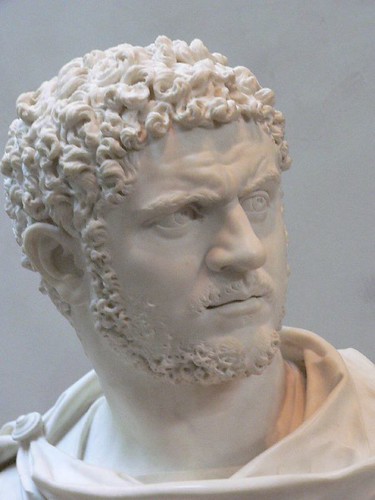
inside the city of Rome during Alaric's siege. Kulikowski also postulates that one of the stimuli for the beginning of Gothic invasions of the Empire was in response to Caracalla's granting of citizenship to all free residents of the empire. He felt that this action opened up the possibilities for anyone - not just provincial
elites who had gained senatorial rank - to gain the throne.


Cavaceppi's 18th century portrait of 2nd
century CE Roman Emperor Caracalla

 photographed at the J. Paul Getty Museum
in Los Angeles, CA
by
© 2005
Evidently, Mr. Kulikowski has another problem with Caracalla. He says in his opinion, much of the civil unrest in Rome itself resulting from the long string of assassinated emperors was triggered unwittingly by Caracalla when he defeated the last Parthian king. This left a power vacuum in the east that was filled by the much more problematic (for the Romans)Sassanids who were not content to control the former Parthian Empire but launched numerous incursions into Roman territory. Less successful responses to these incursions would often result in deposition of the current emperor. Likewise, success would bring a new challenger to the imperial throne.

He also went on to describe the problems created by Roman interference in Barbarian tribal control with Roman subsidy of particular tribal leaders. Although this may have brought temporary loyalty, ultimately it garnered a larger core of support around these subsidized chieftains who would then be in a position to challenge the authority of Rome itself along the frontiers. He pointed out that Decablus was just such an example. The Romans initially subsidized his power base in Dacia.

I found an article that described how this came about:

"In 60 BC, King Burebista of Dacia began a series of expansionistic moves to relieve pressure from nomadic incursions, which eventually threatened Roman Danubian and Black Sea territories. Julius Caesar began to lay plans for a campaign in Dacia and Partha, which came to naught when both Caesear and Burebista were assassinated in 44 BC. Later, during the reign of Nero (54-68 AD), Dacian raids into Roman Moesia became so serious that the Romans engaged the Roxolani to help defend their frontier, thus placing Dacia's sometime Sarmatian allies on their enemies list.
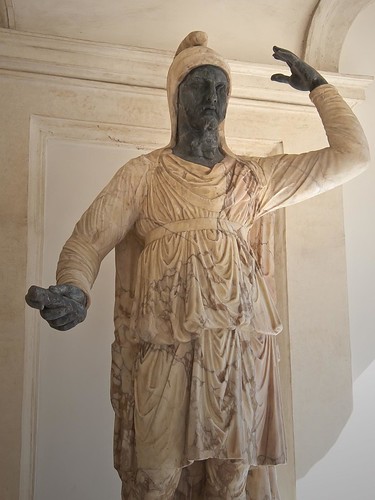
Colossal statue of a Dacian Roman 2nd century CE
photographed at the Palazzo Altemps, Rome, Italy by
 © 2009
In 85 AD, King Decebalus assumed the Dacian throne, adopting a hostile Roman policy that posed a serious challenge to the Emperor Domitian (81-96 AD). A Dacian army raided across the Danube into the Roman province of Moesia, killing the Roman governor and looting the
countryside. This prompted an retaliatory expedition under command of  praetorian prefect Cornelius Fuscus that was wiped out in eastern Dacia (including the loss of Legio V Alaudae) . A second Roman expedition was severely defeated in 87 AD.
Finally, a Roman army under Tettius Julianus defeated the Dacians at Tapae in 88 or 89 A.D. King Decabalus of Dacia was forced to pay tribute and allow Roman armies passage through Dacian territory. Domitian, however, was distracted by Saturninus' Revolt on the Rhine Frontier and uprisings by the Sarmatian Iazyges, Marcomanni and Quaid tribes on Rome's Pannonian frontier. He sought the favor of Decabalus to avoid a Dacian-Sarmatian alliance, offering skilled artisans and hostages to ensure Dacian neutrality while he contended with his other headaches." - DBA Resource, Fanaticus.org 

I couldn't help but think that we certainly didn't learn much from these Roman experiences in political interference since we so recently repeated their mistakes!

Kulikowski, also pointed out something that is important to know if you are reading original historical sources from the period. He says that, even though the Goths contemporaries referred to them as Goths,
historical scholars of the day used the formal designation "Scythians" because the Goths had originated north of the Black Sea in the same region once occupied by the true Scythians recorded by Herodotus.

I also found little controversies pointed out by Michael Kulikowski quite interesting. He appears to be very skeptical of Jordanes narrative of the origin and migration of the Goths from Scandanavia to the Black Sea region ("Getica"). Supposedly, Jordanes sixth century account was based on the lost barbarian histories by Cassiodorus. But Kulikowski maintains that Jordanes work was prepared while attached to the court of
Theodoric so he feels it was meant to provide a glorious history of descent for that monarch and can't be solely relied upon when no other sources are available - much like the skepticism that always surrounds
the narratives by Suetonius.

He went on to say that the connection between the Goths and Scandanavia has been disproved archaeologically but did not elaborate on how. He feels the Goths arose as a result of barbarian
relationships with the Roman army along the frontiers in the third century and that they did not exist as a recognizable cultural group before that time.

Detail of a tapestry by Peter Paul Reubens depicting Constantine's victory over Maxentius at the battle of the Milvian
Bridge in 312 CE
photographed at the Philadelphia Museum of Art in Philadelphia, PA by © 2011

Kulikowski, also observed that Constantine apparently deliberately shifted from the former emperors' claims to be descended from Hercules to claim a descent from Claudius Gothicus. The author seemed to think this was a way to demonstrate a rejection of pagan philosophies. Richard D. Weigel of Western Kentucky University seems to support the observation that any connection with Claudius Gothicus was a fiction:

"M. Aurelius Claudius, known to history as Claudius Gothicus or Claudius II, was born in either Dalmatia or Illyria on May 10, probably in A.D. 213 or 214, " Wiegel says, "Although the most substantive source on Claudius is the biography in the Scriptores Historiae Augustae (SHA), this account is riddled with fabrications and slanted with fawning praise for this particular emperor, who in the fourth century was viewed as an ancestor of Constantine's father and thus of the ruling imperial family. This biography, attributed to one Trebellius Pollio, must be read with extreme caution and supplemented with information from other sources, including Aurelius Victor, the Epitome de Caesaribus, Eutropius, Orosius, Zonaras, and Zosimus, as well as coins and inscriptions." - De Imperatorabus Romanis
The first one of the two twin bronze busts of ...
The first one of the two twin bronze busts of Claudius II "the Gothic" (268/269 d.C.). The gilded bronze portraits, five of Roman emperors and one of an empress, were hidden beneath the Capitoline temple in Brescia, together with other bronze objects, to prevent the consequences of a possible sack of the town in the 4th or 5th century, and unearthed only in 1826. They are now exhibited in the archaeological Santa Giulia Museum, in Brescia, Italy. (Photo credit: Wikipedia)


Although his reign was short, Claudius Gothicus did appear to be an emperor worth emulating:
"The Gothic challenge in 269 CE proved to be the greatest that Claudius II would face. The Goths assembled a large invading force, reportedly amounting to 320,000 men transported on a fleet of at least 2,000 ships, and first attacked coastal cities along the Black Sea in Moesia. After passing into the Aegean the Goths besieged Thessalonica. At this point, in 269, Claudius left Rome to stop the invasion. The Goths then sent the larger segment of their troops on land toward the Danube, while the fleet took the remaining group to continue the naval attack on Aegean coastal cities. Claudius sent Aurelian's cavalry to Macedonia to protect Illyria from attack, while he commanded the forces blocking the route to the Danube. In the area of Doberus and Pelagonia, the Goths lost 3,000 men to Aurelian's cavalry. At Naissus in Moesia, Claudius' force succeeded in killing some 50,000 Goths. There were follow-up operations on both land and sea, but the Gothic War had essentially been won. Staving off the attacks of the Goths was a major contribution to the survival of the Roman Empire. It was a significant step leading to the subsequent success of Aurelian and the resurrection of the Empire under Diocletian and Constantine. When the Goths eventually succeeded in taking parts of the western Empire in the fifth century, their disruption to the course of civilization was likely much less violent than it would have been had they succeeded in the third century.< 
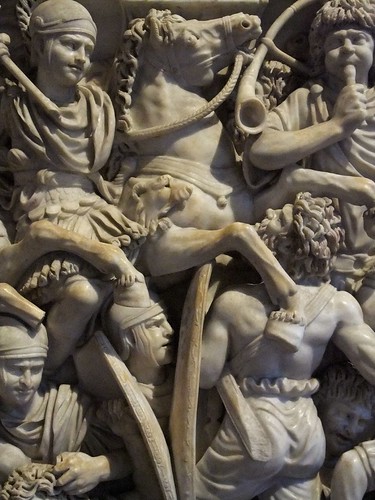
Detail of the Ludovisi sarcophagus thought to depict a
battle between the Romans and the Goths 2nd - 3rd
century CE
photographed at the Palazzo Altemps in
Rome, Italy
by  © 2009
 In addition to bad weather, a lack of supplies, and hunger, plague was a major factor in the defeat of the Goths. Many of the Gothic prisoners were either impressed into Roman military service or settled on farms as coloni. Claudius received the title Gothicus in recognition of his triumph over the Goths. At some point he had also been given the title Parthicus, but the unlikelihood of any conflict with the Parthians in his short reign makes this difficult to explain. Perhaps Damerau was correct in his suggestion that a Parthian unit may have been involved in one of the battles with the Palmyrenes, although on this front there were few achievements to claim. In any case, Claudius' victory over the Goths was short-lived. The emperor himself caught the plague and died at Sirmium early in 270. He was 56 years old  Claudius' brother, Quintillus, became emperor briefly before losing out to Aurelian. Claudius also had another brother, Crispus, and the SHA traces the link to Constantius through Crispus' daughter Claudia. 
The Roman Senate showed its respect for Claudius Gothicus by setting up a gold portrait-shield in the Curia and by approving his deification. He was also honored with a golden statue in front of the great temple of Jupiter Optimus Maximus and a silver statue set on a column on the Rostra." - Wikipedia
All of these issues prompted me to seek out other academic opinions and more information.

Judith Weingarten, who studied classical archaeology at Oxford and is a member of the British School of Athens, disagreed with Kulikowski's suggestion that Caracalla's granting of citizenship to all free residents was a crucial trigger to the Gothic migrations:


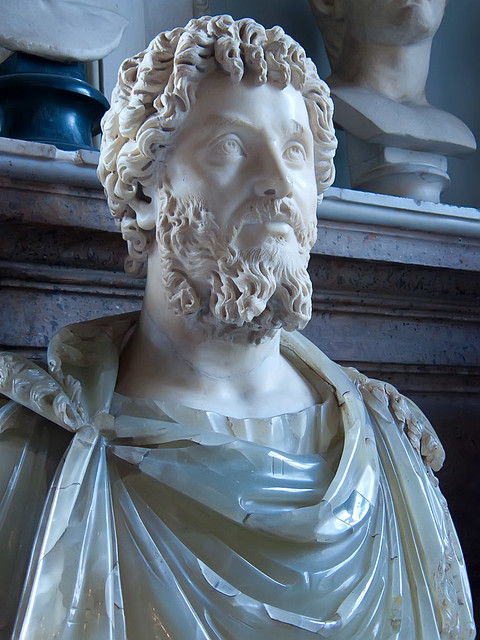
Bust of the Roman emperor Septimius Severus
photographed at the Capitoline Museum in
Rome, Italy
by  © 2009
"Caracalla's father, the Emperor Septimius Severus, had already started the rot," Weingarten exclaims,  "As the first of the Soldier Emperors, he came to power over the bodies of three emperors (all murdered in a single year!) and fought two bloody civil wars against rival generals to boot. He was, however, the last emperor, for a very long time, to die in bed. For the next 60 years, emperor after emperor - and there were many - fell to the assassin’s knife - and that is only to speak of the so-called legitimate emperors, who managed to fight off and kill their rivals - the losers then being called ‘usurpers’ or ‘pretenders’. [An old English jingle makes the point: Treason doth never prosper/ what’s the reason?/ For if it prosper/ none dare call it treason.] Caracalla’s murder, in turn,, did usher in a new age of instability. Legitimacy gave way to force and absolute despotism, in which the losers, their friends and supporters, were slaughtered and their property confiscated."
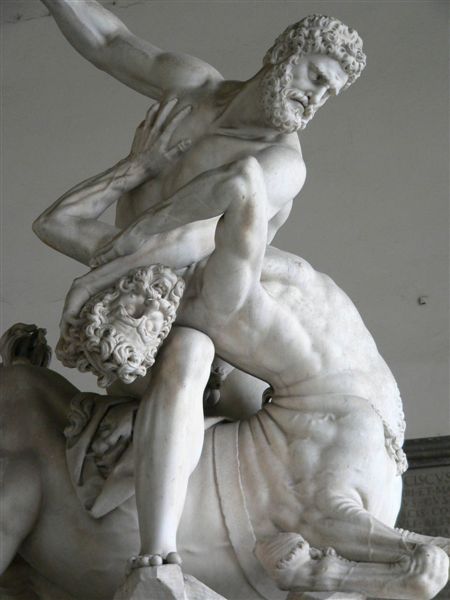
Hercules battling the centaur Nessus by
by Giovanni Bologna 1599 CE
photographed
at the Palazzo Vechio in Florence, Italy by
 © 2005

"In my opinion," she continues, "the true reason for Caracalla granting citizenship to all free men in the Empire, was his need to raise revenue: in return for citizenship, he taxed them. When even that was insufficient, he debased the currency...."

Another historian, Volker Carlton Bach of Denmark, took issue with the speculation that Constantine's rejection of the emperor's traditional descent from Hercules was a demonstration of rejection of pagan philosophy.

"I think this is based on a misunderstanding," Bach states, "The descent of the Herculian Emperors (not the Jovian ones) from Hercules was purely a notional, cultic (for want of a better word) concept. The closest we have today, I think, is the link between the popes and St Peter - not an arogation of genetic descent, but a claim of spiritual successorship and close association. The Romans knew that Maximian and his successors were not the great-great-great-repeat ad nauseam-grandsons of the heros Hercules. After all, they had real mothers and fathers, and in some cases even knew both with a degree of certainty. The descent claim from Claudius Gothicus, on the other hand, *is* a 'real' paternity claim, similar to the adoption of Antonine nomenclature by third-century emperors. So Constantine doesn't really replace one claim with another. The Herculian designation was unnecessary simply because with Constantine's victories, as it had been used to distinguish junior colleagues from senior (Jovian) ones. Constantine was *the* emperor, so that was that. Claudius Gothicus, on the other hand, was a very attractive ancestor to claim, a successful and legendary warrior and, unlike Aurelian or Diocletian, without anti-Christian baggage."

Any book that can generate this type of quality discussion is a worthy addition to any history enthusiast's collection. I notice it is one of a series of introductory-level texts exploring the key conflicts of classical antiquity. I look forward to reading others in this series.

Related articles
Enhanced by Zemanta