Showing posts with label Goths. Show all posts

Saturday, October 24, 2009

The Gothic War


A period of stability in the early sixth century AD gave the Eastern Roman emperor Justinian an opportunity to recapture parts of the Western Empire that had been lost to invading barbarians in the preceding centuries. It was an ambitious plan to attack such a vast territory with relatively few soldiers and resources. Yet Justinian's army succeeded in checking the Persians in the East and in retaking North Africa from the Vandals and Italy from the Ostrogoths, the strongest and most organized Barbarian tribe in the West. The climactic conflict over Italy between 535 and 554--the Gothic War--decided the political future of Europe, holding in its balance the possibility that the Roman Empire might rise again. While large portions of the original territory of the ancient Roman Empire were recaptured, the Eastern Empire was both unwilling and incapable of retaining much of its hard-won advances, and soon the empire once again retracted. As a result of the Gothic War, Italy was invaded by the Lombards, who began their important kingdom, the Franks began transforming Gaul into France, and without any major force remaining in North Africa, that territory was quickly overrun by the first wave of Muslim expansion in the ensuing century.

Written as a general overview of this critical period, The Gothic War opens with a history of the conflict with Persia and the great Roman general Belisarius's successful conquest of the Vandals in North Africa. After an account of the Ostrogothic tribe and their history, the campaigns of the long war for Italy are described in detail, including the three sieges of Rome, which turned the great city from a bustling metropolis into a desolate ruin. In addition to Belisarius, the Gothic War featured many of history's most colorful antagonists, including Rome's Narses the Eunuch, and the Goths' ruthless and brilliant tactician, Totila. Two appendices provide information about the armies of the Romans and Ostrogoths, including their organization, weapons, and tactics, all of which changed over the course of the war.

The Inheritance of Rome: Illuminating the Dark Ages, 400-1000


Prizewinning historian Chris Wickham defies the conventional view of the Dark Ages in European history with a work of remarkable scope and rigorous yet accessible scholarship. Drawing on a wealth of new material and featuring a thoughtful synthesis of historical and archaeological approaches, Wickham argues that these centuries were critical in the formulation of European identity. Far from being a middle period between more significant epochs, this age has much to tell us in its own right about the progress of culture and the development of political thought.

Sweeping in its breadth, Wickham's incisive history focuses on a world still profoundly shaped by Rome, which encompassed the remarkable Byzantine, Carolingian, and Ottonian empires, and peoples ranging from Goths, Franks, and Vandals to Arabs, Anglo- Saxons, and Vikings. Digging deep into each culture, Wickham constructs a vivid portrait of a vast and varied world stretching from Ireland to Constantinople, the Baltic to the Mediterranean. The Inheritance of Rome brilliantly presents a fresh understanding of the crucible in which Europe would ultimately be created.

About the Author

Chris Wickham is Chichele Professor of Medieval History at the University of Oxford and a Fellow of All Souls College. His book Framing the Middle Ages won the Wolfson Prize, the Deutscher Memorial Prize, and the James Henry Breasted Prize of the American Historical Association.

Monday, June 23, 2008

The Lost Gold of Rome: The Hunt for Alaric's Treasure


by Daniel Costa

"In AD 410, the Roman world suffered a catastrophe of unprecedented proportions when for the first time in 800 years a foreign army, led by the Visigoth King Alaric, sacked Rome and carried off its most valuable treasures. Alaric played a significant role in the dismemberment of the western Roman empire but he died before he could leave Italy. His followers buried him in a secret tomb laden with the plunder of Rome including, possibly, the sacred Temple treasures of the Jews. In The Lost Gold of Rome, Costa traces the life and death of Alaric and explores the modern quest to discover his grave."

Tuesday, March 13, 2007

Review: Rome's Gothic Wars by Michael Kulikowski

A history text review by  © 2007- 5 stars

I was recently asked by Cambridge University Press to review "Rome's Gothic Wars: From the Third Century to Alaric (Key Conflicts of Classical Antiquity) by Michael Kulikowski. I finally got a chance to begin reading it and find it clearly written and thankfully devoid of the stilted academic jargon that pervades many history texts. As most
of my studies have focused on the Roman Republic, I am learning all kinds of fascinating things about this later period.

For example, I did not realize that there were reports of cannibalism
inside the city of Rome during Alaric's siege. Kulikowski also postulates that one of the stimuli for the beginning of Gothic invasions of the Empire was in response to Caracalla's granting of citizenship to all free residents of the empire. He felt that this action opened up the possibilities for anyone - not just provincial
elites who had gained senatorial rank - to gain the throne.


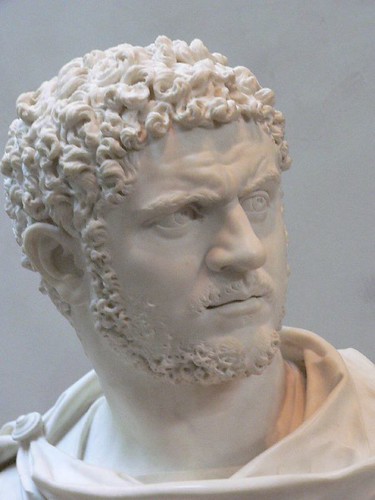
Cavaceppi's 18th century portrait of 2nd
century CE Roman Emperor Caracalla

 photographed at the J. Paul Getty Museum
in Los Angeles, CA
by
© 2005
Evidently, Mr. Kulikowski has another problem with Caracalla. He says in his opinion, much of the civil unrest in Rome itself resulting from the long string of assassinated emperors was triggered unwittingly by Caracalla when he defeated the last Parthian king. This left a power vacuum in the east that was filled by the much more problematic (for the Romans)Sassanids who were not content to control the former Parthian Empire but launched numerous incursions into Roman territory. Less successful responses to these incursions would often result in deposition of the current emperor. Likewise, success would bring a new challenger to the imperial throne.

He also went on to describe the problems created by Roman interference in Barbarian tribal control with Roman subsidy of particular tribal leaders. Although this may have brought temporary loyalty, ultimately it garnered a larger core of support around these subsidized chieftains who would then be in a position to challenge the authority of Rome itself along the frontiers. He pointed out that Decablus was just such an example. The Romans initially subsidized his power base in Dacia.

I found an article that described how this came about:

"In 60 BC, King Burebista of Dacia began a series of expansionistic moves to relieve pressure from nomadic incursions, which eventually threatened Roman Danubian and Black Sea territories. Julius Caesar began to lay plans for a campaign in Dacia and Partha, which came to naught when both Caesear and Burebista were assassinated in 44 BC. Later, during the reign of Nero (54-68 AD), Dacian raids into Roman Moesia became so serious that the Romans engaged the Roxolani to help defend their frontier, thus placing Dacia's sometime Sarmatian allies on their enemies list.
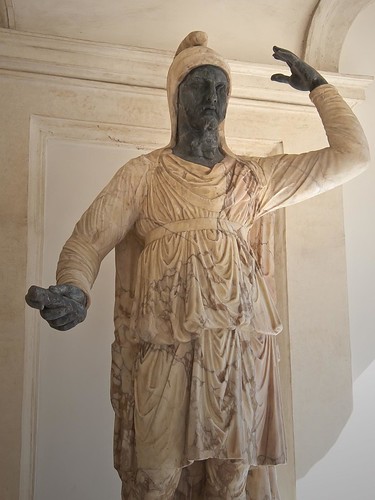
Colossal statue of a Dacian Roman 2nd century CE
photographed at the Palazzo Altemps, Rome, Italy by
 © 2009
In 85 AD, King Decebalus assumed the Dacian throne, adopting a hostile Roman policy that posed a serious challenge to the Emperor Domitian (81-96 AD). A Dacian army raided across the Danube into the Roman province of Moesia, killing the Roman governor and looting the
countryside. This prompted an retaliatory expedition under command of  praetorian prefect Cornelius Fuscus that was wiped out in eastern Dacia (including the loss of Legio V Alaudae) . A second Roman expedition was severely defeated in 87 AD.
Finally, a Roman army under Tettius Julianus defeated the Dacians at Tapae in 88 or 89 A.D. King Decabalus of Dacia was forced to pay tribute and allow Roman armies passage through Dacian territory. Domitian, however, was distracted by Saturninus' Revolt on the Rhine Frontier and uprisings by the Sarmatian Iazyges, Marcomanni and Quaid tribes on Rome's Pannonian frontier. He sought the favor of Decabalus to avoid a Dacian-Sarmatian alliance, offering skilled artisans and hostages to ensure Dacian neutrality while he contended with his other headaches." - DBA Resource, Fanaticus.org 

I couldn't help but think that we certainly didn't learn much from these Roman experiences in political interference since we so recently repeated their mistakes!

Kulikowski, also pointed out something that is important to know if you are reading original historical sources from the period. He says that, even though the Goths contemporaries referred to them as Goths,
historical scholars of the day used the formal designation "Scythians" because the Goths had originated north of the Black Sea in the same region once occupied by the true Scythians recorded by Herodotus.

I also found little controversies pointed out by Michael Kulikowski quite interesting. He appears to be very skeptical of Jordanes narrative of the origin and migration of the Goths from Scandanavia to the Black Sea region ("Getica"). Supposedly, Jordanes sixth century account was based on the lost barbarian histories by Cassiodorus. But Kulikowski maintains that Jordanes work was prepared while attached to the court of
Theodoric so he feels it was meant to provide a glorious history of descent for that monarch and can't be solely relied upon when no other sources are available - much like the skepticism that always surrounds
the narratives by Suetonius.

He went on to say that the connection between the Goths and Scandanavia has been disproved archaeologically but did not elaborate on how. He feels the Goths arose as a result of barbarian
relationships with the Roman army along the frontiers in the third century and that they did not exist as a recognizable cultural group before that time.

Detail of a tapestry by Peter Paul Reubens depicting Constantine's victory over Maxentius at the battle of the Milvian
Bridge in 312 CE
photographed at the Philadelphia Museum of Art in Philadelphia, PA by © 2011

Kulikowski, also observed that Constantine apparently deliberately shifted from the former emperors' claims to be descended from Hercules to claim a descent from Claudius Gothicus. The author seemed to think this was a way to demonstrate a rejection of pagan philosophies. Richard D. Weigel of Western Kentucky University seems to support the observation that any connection with Claudius Gothicus was a fiction:

"M. Aurelius Claudius, known to history as Claudius Gothicus or Claudius II, was born in either Dalmatia or Illyria on May 10, probably in A.D. 213 or 214, " Wiegel says, "Although the most substantive source on Claudius is the biography in the Scriptores Historiae Augustae (SHA), this account is riddled with fabrications and slanted with fawning praise for this particular emperor, who in the fourth century was viewed as an ancestor of Constantine's father and thus of the ruling imperial family. This biography, attributed to one Trebellius Pollio, must be read with extreme caution and supplemented with information from other sources, including Aurelius Victor, the Epitome de Caesaribus, Eutropius, Orosius, Zonaras, and Zosimus, as well as coins and inscriptions." - De Imperatorabus Romanis
The first one of the two twin bronze busts of ...
The first one of the two twin bronze busts of Claudius II "the Gothic" (268/269 d.C.). The gilded bronze portraits, five of Roman emperors and one of an empress, were hidden beneath the Capitoline temple in Brescia, together with other bronze objects, to prevent the consequences of a possible sack of the town in the 4th or 5th century, and unearthed only in 1826. They are now exhibited in the archaeological Santa Giulia Museum, in Brescia, Italy. (Photo credit: Wikipedia)


Although his reign was short, Claudius Gothicus did appear to be an emperor worth emulating:
"The Gothic challenge in 269 CE proved to be the greatest that Claudius II would face. The Goths assembled a large invading force, reportedly amounting to 320,000 men transported on a fleet of at least 2,000 ships, and first attacked coastal cities along the Black Sea in Moesia. After passing into the Aegean the Goths besieged Thessalonica. At this point, in 269, Claudius left Rome to stop the invasion. The Goths then sent the larger segment of their troops on land toward the Danube, while the fleet took the remaining group to continue the naval attack on Aegean coastal cities. Claudius sent Aurelian's cavalry to Macedonia to protect Illyria from attack, while he commanded the forces blocking the route to the Danube. In the area of Doberus and Pelagonia, the Goths lost 3,000 men to Aurelian's cavalry. At Naissus in Moesia, Claudius' force succeeded in killing some 50,000 Goths. There were follow-up operations on both land and sea, but the Gothic War had essentially been won. Staving off the attacks of the Goths was a major contribution to the survival of the Roman Empire. It was a significant step leading to the subsequent success of Aurelian and the resurrection of the Empire under Diocletian and Constantine. When the Goths eventually succeeded in taking parts of the western Empire in the fifth century, their disruption to the course of civilization was likely much less violent than it would have been had they succeeded in the third century.< 
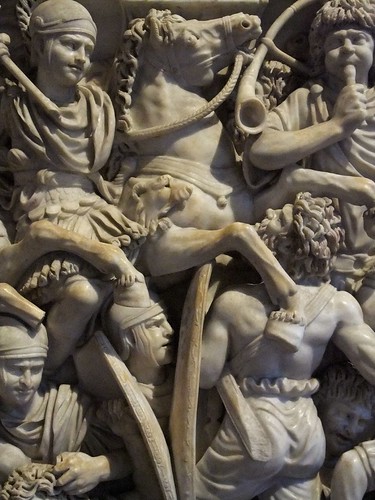
Detail of the Ludovisi sarcophagus thought to depict a
battle between the Romans and the Goths 2nd - 3rd
century CE
photographed at the Palazzo Altemps in
Rome, Italy
by  © 2009
 In addition to bad weather, a lack of supplies, and hunger, plague was a major factor in the defeat of the Goths. Many of the Gothic prisoners were either impressed into Roman military service or settled on farms as coloni. Claudius received the title Gothicus in recognition of his triumph over the Goths. At some point he had also been given the title Parthicus, but the unlikelihood of any conflict with the Parthians in his short reign makes this difficult to explain. Perhaps Damerau was correct in his suggestion that a Parthian unit may have been involved in one of the battles with the Palmyrenes, although on this front there were few achievements to claim. In any case, Claudius' victory over the Goths was short-lived. The emperor himself caught the plague and died at Sirmium early in 270. He was 56 years old  Claudius' brother, Quintillus, became emperor briefly before losing out to Aurelian. Claudius also had another brother, Crispus, and the SHA traces the link to Constantius through Crispus' daughter Claudia. 
The Roman Senate showed its respect for Claudius Gothicus by setting up a gold portrait-shield in the Curia and by approving his deification. He was also honored with a golden statue in front of the great temple of Jupiter Optimus Maximus and a silver statue set on a column on the Rostra." - Wikipedia
All of these issues prompted me to seek out other academic opinions and more information.

Judith Weingarten, who studied classical archaeology at Oxford and is a member of the British School of Athens, disagreed with Kulikowski's suggestion that Caracalla's granting of citizenship to all free residents was a crucial trigger to the Gothic migrations:


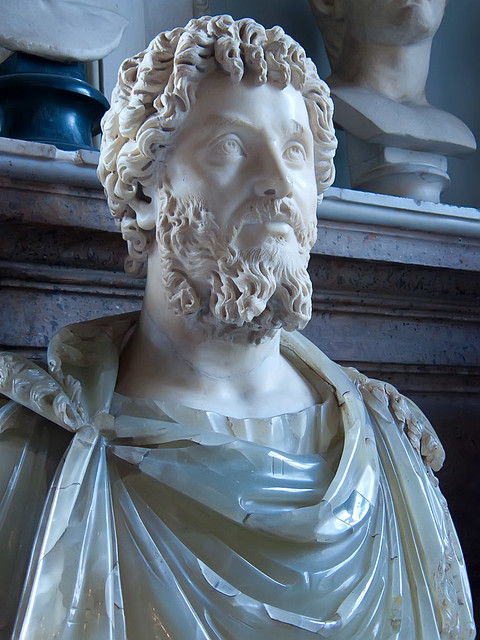
Bust of the Roman emperor Septimius Severus
photographed at the Capitoline Museum in
Rome, Italy
by  © 2009
"Caracalla's father, the Emperor Septimius Severus, had already started the rot," Weingarten exclaims,  "As the first of the Soldier Emperors, he came to power over the bodies of three emperors (all murdered in a single year!) and fought two bloody civil wars against rival generals to boot. He was, however, the last emperor, for a very long time, to die in bed. For the next 60 years, emperor after emperor - and there were many - fell to the assassin’s knife - and that is only to speak of the so-called legitimate emperors, who managed to fight off and kill their rivals - the losers then being called ‘usurpers’ or ‘pretenders’. [An old English jingle makes the point: Treason doth never prosper/ what’s the reason?/ For if it prosper/ none dare call it treason.] Caracalla’s murder, in turn,, did usher in a new age of instability. Legitimacy gave way to force and absolute despotism, in which the losers, their friends and supporters, were slaughtered and their property confiscated."
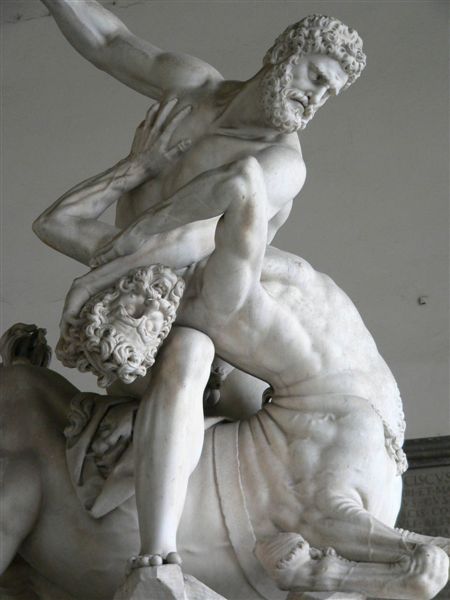
Hercules battling the centaur Nessus by
by Giovanni Bologna 1599 CE
photographed
at the Palazzo Vechio in Florence, Italy by
 © 2005

"In my opinion," she continues, "the true reason for Caracalla granting citizenship to all free men in the Empire, was his need to raise revenue: in return for citizenship, he taxed them. When even that was insufficient, he debased the currency...."

Another historian, Volker Carlton Bach of Denmark, took issue with the speculation that Constantine's rejection of the emperor's traditional descent from Hercules was a demonstration of rejection of pagan philosophy.

"I think this is based on a misunderstanding," Bach states, "The descent of the Herculian Emperors (not the Jovian ones) from Hercules was purely a notional, cultic (for want of a better word) concept. The closest we have today, I think, is the link between the popes and St Peter - not an arogation of genetic descent, but a claim of spiritual successorship and close association. The Romans knew that Maximian and his successors were not the great-great-great-repeat ad nauseam-grandsons of the heros Hercules. After all, they had real mothers and fathers, and in some cases even knew both with a degree of certainty. The descent claim from Claudius Gothicus, on the other hand, *is* a 'real' paternity claim, similar to the adoption of Antonine nomenclature by third-century emperors. So Constantine doesn't really replace one claim with another. The Herculian designation was unnecessary simply because with Constantine's victories, as it had been used to distinguish junior colleagues from senior (Jovian) ones. Constantine was *the* emperor, so that was that. Claudius Gothicus, on the other hand, was a very attractive ancestor to claim, a successful and legendary warrior and, unlike Aurelian or Diocletian, without anti-Christian baggage."

Any book that can generate this type of quality discussion is a worthy addition to any history enthusiast's collection. I notice it is one of a series of introductory-level texts exploring the key conflicts of classical antiquity. I look forward to reading others in this series.

Related articles
Enhanced by Zemanta