Showing posts with label emperor. Show all posts

Saturday, October 24, 2009

Hadrian and the Triumph of Rome


Acclaimed author Anthony Everitt, whose Augustus was praised by the Philadelphia Inquirer as “a narrative of sustained drama and skillful analysis,” is the rare writer whose work both informs and enthralls. In Hadrian and the Triumph of Rome–the first major account of the emperor in nearly a century–Everitt presents a compelling, richly researched biography of the man whom he calls arguably “the most successful of Rome’s rulers.”

Born in A.D. 76, Hadrian lived through and ruled during a tempestuous era, a time when the Colosseum was opened to the public and Pompeii was buried under a mountain of lava and ash. Everitt vividly recounts Hadrian’s thrilling life, in which the emperor brings a century of disorder and costly warfare to a peaceful conclusion while demonstrating how a monarchy can be compatible with good governance. Hadrian was brave and astute–despite his sometimes prickly demeanor–as well as an accomplished huntsman, poet, and student of philosophy.

What distinguished Hadrian’s rule, according to Everitt, were two insights that inevitably ensured the empire’s long and prosperous future: He ended Rome’s territorial expansion, which had become strategically and economically untenable, by fortifying her boundaries (the many famed Walls of Hadrian), and he effectively “Hellenized” Rome by anointing Athens the empire’s cultural center, thereby making Greek learning and art vastly more prominent in Roman life.

With unprecedented detail, Everitt illuminates Hadrian’s private life, including his marriage to Sabina–a loveless, frequently unhappy bond that bore no heirs–and his enduring yet doomed relationship with the true love of his life, Antinous, a beautiful young Bithynian man. Everitt also covers Hadrian’s war against the Jews, which planted the seeds of present-day discord in the Middle East.

Despite his tremendous legacy–including a virtual “marble biography” of still-standing structures–Hadrian is considered one of Rome’s more enigmatic emperors. But making splendid use of recently discovered archaeological materials and his own exhaustive research, Everitt sheds new light on one of the most important figures of the ancient world.

Saturday, October 18, 2008

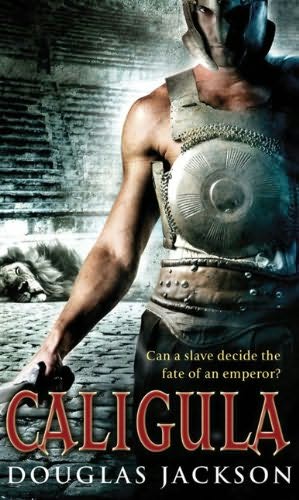
Caligula: The Tyranny of Rome by Douglas Jackson


Gaius Julius Caesar Augustus Germanicus, the third Roman Emperor, is better known by another name: Caligula, a name synonymous with decadence, cruelty and madness. His reign was marked by excess, huge building projects, the largest gladiatorial battles Rome was ever to see - men and animals killed in their hundreds - conspiracies, assassination attempts and sexual scandal. Rufus as a young slave grows up far from the corruption of the imperial court. His master is a trainer of animals for the gladiatorial arena. Rufus discovers that he has a natural ability with animals, a talent for controlling and schooling them. It is at the arenas that Rufus meets his great friend Cupido, one of Rome's greatest gladiators. It is his growing reputation as an animal trainer and his friendship with Cupido that attracts the cruel gaze of the Emperor.Caligula wants a keeper for the imperial elephant and Rufus is bought from his master and taken to the imperial palace. Life here is dictated by Caligula's ever shifting moods. Caligula is as generous as he is cruel, he is a megalomaniac who declares himself a living god and simultaneously lives in constant fear of the plots against his life.Technorati Tags: , , , , , ,

Monday, June 23, 2008

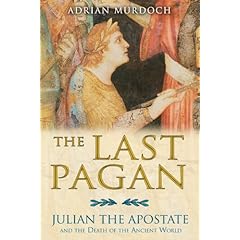
The Last Pagan: Julian The Apostate and the Death of the Ancient World


"Since his death on a Persian battlefield in AD 363, the violent end of the Emperor Julian (Flavius Claudius Julianus, 332-363_ has become synonymous with the death of paganism. Vilified throughout history as the `Apostate', the young philosopher-warrior was the last and arguably the most potent threat to Christianity.
The Last Pagan examines Julian's emergence as the sole survivor of a political dynasty soaked in blood. It traces his journey from an aristocratic Christian Childhood to his initiation into pagan cults and his mission to establish paganism as the dominant faith of the Roman world."

I've been interested in Julian ever since I read Michael Curtis Ford's novel "Gods and Legions". It, too, was a sympathetic portrait of the last pagan Roman emperor. So, when I was researching Adrian Murdoch's work, "The Last Roman:
Romulus Augustulus and the Decline of the West' and noticed he had also written about Julian the Apostate, I couldn't help but order it to have a look. I also got a great buy up at the David Brown Book Company - only $6.98!

I found a very interesting "Meet the Author" interview up at OxBow Books. An excerpt:

"
Constantine’s reign is usually heralded as a golden age and is celebrated as the beginning of the Christian era. The Last Pagan adopts a different approach, mourning the death of antiquity. Is this how you feel?

Very much so. The Emperor Julian has often been portrayed as an anomaly and regarded with slight embarrassment. It’s useful I think to change historical perspective. Instead of seeing Julian as the young man who came along and upset a Christian empire, he stood at the end of a line of Roman emperors.

At the same time, one of the premises with which I started the book is that while Constantine is conventionally heralded as the great hero and saviour of the empire, as a person he’s always appeared to me as a cynical and ruthless political operative. A deeply unpleasant man. It was natural, I suppose, to make Julian’s actions and values stand in contrast to those of Christian relatives.

Julian died aged only 31. Do you think that he had the qualities as a ruler to have shaped history if he had lived longer?

Arguably the largest problem for any biographer is that you have the benefit of hindsight – you know how the story ends. The challenge is to remember this and to stop seeing your subject’s fate as preordained. It’s too easy to see portents of doom wherever you look. This is especially true of Julian as all of the contemporaries tripped over themselves to editorialise his fate: his supporters painted him as a tragic hero and his opponents saw him as doomed from the moment of his apostasy.

If I’m being honest, even had Julian survived the war he might not have survived the peace. Religion has always attracted extremists, and it’s unlikely that Julian and his Christian opponents could have found any kind of middle ground. Plots to murder the emperor were uncovered before his death and so impassioned was the opposition to Julian’s religious reforms that I suspect one assassination attempt would have succeeded before too long.

The Last Pagan remembers a time when conflict over religion was rife, coming to a head on a battlefield in present-day Iraq. Did these parallels with recent events inspire you to choose Julian the Apostate as your subject?

Although I’d originally planned to draw parallels with the First Gulf War, the chapters on Julian’s invasion of Persia were written to a background of the build-up to the current conflict in Iraq. As Western governments began their build-up to what was obviously going to be an invasion last year, the parallels with Julian’s campaign made for distinctly uncomfortable writing – a foreign policy dictated by domestic necessity; support for the invasion from what is now Israel and the Gulf Arabs; debates about an illegal arms trade with Persia – swords of mass destruction if you will; a media campaign to encourage popular support for the war; even the fact that one of the most vocal opponents to the war was the administrator of Gaul. With Julian’s fate in mind (and the fact that his opponent outlasted his rule by some sixteen years) it is hard not to be discouraged about what the future holds.

Do you think that Roman paganism has any relevance for everyday life in the 21st century?

It’s more that the big questions that dominated Julian reign – the search for belief and the question of religious tolerance – are centre stage once more in the modern world. It’s easy to see similarities between Julian’s lack of comprehension of Christianity and the West’s frequent blindness to the Islamic world. It remains a historical irony that where Christianity was once the persecuted minority, it is now all-too often perceived as the aggressor.

At the same time, Julian’s search for his own faith as a young man mirrors the disillusionment and confusion that many today have with organised religion and the search for alternative forms of worship – a case in point is the startling growth in the interest in paganism over the past few years." - More

I'm not a big fan of Constantine either so I found Mr. Murdoch's comments quite interesting.

I also got "The Last Roman" since I wanted to read more about this era that essentially marked the formal end of the Roman Empire, especially after reading my friend, Boris Raymond's historical novel, "The Phoenix Circle" in which Orestes and Odovacar (Odacer) play major roles.

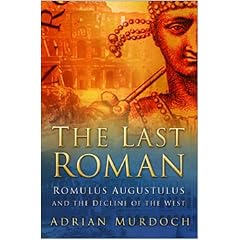
The Last Roman: Romulus Augustulus and the Decline of the West

“It is valid to ask whether one should attempt to write something that purports to be a biography about a character of whom we know so little. The answer has to be yes for three reasons. The first is that the drawn-out collapse of the Western empire makes it easy to forget the human aspect. All too often, historians get lost in the sweep of events, the broad brush strokes of barbarian settlements, military retrenchment and economic turmoil. Focusing on Romulus and his family gives a different and more personal perspective to the fall of the Roman Empire.

“The second reason is a growing interest – popular rather than just scholarly – in this period of late antiquity. It is an era that has always attracted poets and a smattering of novelists. The much-cited 1876 novel Der Kampf um Rom (‘The Fight for Rome’) by Felix Dahn is set in the first half of the sixth century. Despite its huge popularity, wild success and continuing availability, I must confess I fail to see its charms. Its 750 plodding pages have beaten me on several occasions. But the last few years have seen the later Roman Empire as a theme of films, books and computer games. The 2004 Antoine Fuqua-directed film King Arthur and the 2007 Doug Leffler film The Last Legion both have explicitly late Roman themes, the latter a fantasy on Romulus himself (they are both discussed in the final chapter of this book), while the latest addition to the immensely successful Rome: Total War computer game series is set around the barbarian invasions. There is increasingly a recognition among the public that this is a period in its own right.

“The third aim of the book is to make the case that 476 was important. It may seem arrogant almost to the point of lunacy to take the stand against some of late antiquity's greatest historians … [it] is not enough to argue for Romulus’ importance from the point of common usage, its canonisation, if you will. The Last Roman argues not just that something changed in AD 476, but that it was felt to have changed. The empire had been declining for decades, some would say centuries. Certainly, different Roman provinces declined at different rates. … There was no single moment. But 476 was what the sociologist and journalist Malcolm Gladwell would call a tipping point – a pivotal event after which it became impossible to return to the previous status quo. No matter how young he was, how little he affected his citizens or even how faint a historical footprint he left, Romulus Augustulus was the last Roman emperor. It was the end of autonomous Roman rule in the West. When he was forced into retirement, the baubles of imperial rule left Rome. Although Italy's new leaders continued to wear a toga for a few more years, they emerged as new types of rulers.

“The idea of decline had become so contagious by the time Romulus was placed on the throne that it had become a self-fulfilling prophecy.” - Author Adrian Murdoch

Friday, September 28, 2007

The Phoenix Circle by Boris Raymond


'The Phoenix Circle' by Dr. Boris Raymond is an engrossing and insightful novel that examines the changes occurring in western civilization as the Roman Empire succumbs to barbarian encroachment and the growing power of Christianity and dominance of spiritual philosophy in social experience.

Dr. Raymond, a professor of history, sociology, and library science at Dalhousie University in Nova Scotia, shares his in-depth knowledge of the period artfully, providing a tactile context for each event and insight into the thoughts and ideas that motivated the key players during this period. His characters are well developed and he changes scenes deftly without confusing the reader or disrupting the overall continuity of his tale.

I particularly found his examination of the various conflicts within the early Christian church interesting. He shows us how the princes of the church struggled for supremacy almost like rival Roman generals vying for the scepter and how the church was impacted by changes in secular power when rulers or their consorts supported or opposed various theological positions. We feel the tension of a society whose people, like Attila's hapless secretary, must have felt like they were tied spread-eagled to four horses precariously controlled by duplicitous power brokers from both church and state.

Dr. Raymond’s "The Phoenix Circle" reflects the growth of the author in his understanding of the genre of historical fiction since the release of his first book "The Twelfth Vulture of Romulus" and I recommend this work to Roman history enthusiasts and anyone with an interest in how events of late antiquity forged the society we have inherited.