Showing posts with label ritual. Show all posts

Monday, March 15, 2010

Review: Ransom by David Malouf

Ransom: A Novel"Ransom" by award-winning Australian author David Malouf is unlike any novel I have ever read.  In it, Malouf explores the inner dialog that people often have with themselves when they review their lives to gain meaning from current circumstances or ponder obstacles they now face.  In this case, the feelings we explore are those experienced by King Priam as he attempts to ransom the body of his son Hector from the fiercesome Achilles.

Priam has a dream that he must shed all trappings of kingship including bodyguards or fawning courtiers, and personally beseech Achilles for the body of his eldest son.  He thinks back over how he became king, despite the fact that, as a young boy he was almost sold off as a slave when his ancestral city was sacked by his father's enemies.  He ponders the brutality he experienced during the sack and as a reader you wince with the foreknowledge of what will befall him again. He then marvels at the life he has led since then, one of privilege but also one of staggering responsibility.

We discover that Priam's life as a monarch has been one in which he is insulated from normal human emotions usually shared within the nucleus of the family.  Instead, the pomp and ceremony of court life have required him to play the role of supreme ruler at all times, even with his offspring, numbering 50 sons and 19 daughters.

As dictated by his dream, Priam orders some of his remaining sons to secure a simple wagon to be driven by a common carter to carry the king and all the treasure that can be collected to purchase the body of a prince of Troy.  His queen, Hecuba, and his other family members and court advisers think the old man has become so enslaved by his grief that his mind has left him altogether but eventually comply with his instructions.

When the cart is hired and practically overloaded with gold and silver objects, the old king is hoisted onto the plain wooden seat next to a grizzled old man in a worn homespun garment. The two old men set off for the Myrmidon encampment.  They jostle along in the cart for some time without speaking, the poor driver wondering what a person is supposed to say to the grief-stricken king.  They then stop to rest beside a river and in the course of trying to get the old king to eat something, the elderly mule cart driver begins to describe the loss of his own sons and recalls some of their endearing antics, bringing tears to the old man's eyes in the telling.

 Considering the old driver's words, Priam realizes he can't even recall which of his wives and concubines bore some of his children let alone some of the little triumphs the children may have taken pride in over the years.  Then the veil of grief slips from his eyes and he looks about him and begins to savor each sight and smell he perceives, from the pleasant taste of the little buttermilk cakes the driver has brought along and shared with him to the tickle of the fishlings nibbling his bare toes as he wades in the water along the river bank.

Ultimately, he realizes that performing the rituals of burial will probably be the most intimate moments he will ever share with his eldest son and heir to his kingdom.

In the meantime, Achilles, too has been reflecting on the meaning of his life and speculating on what will happen to his own son, Neoptolemus, when Achilles embraces his own fate, to die young but wreathed in immortal glory.  So ultimately, it is with shared understanding that king and hero finally confront the requirements of duty and acceptance of fate when they meet at last in Achilles' mess tent.

This is not really a story-driven narrative but an anecdotal treatise on human relationships that encourages the reader to reflect on their own journey and their own losses.  

The Trojan War: A New History   In Search of the Trojan War   The War That Killed Achilles: The True Story of Homer's Iliad and the Trojan War

Sunday, June 29, 2008

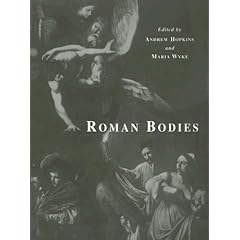
Roman Bodies. Antiquity to the Eighteenth Century


While I was researching other works published by The British School in Rome, I came across a listing for this fascinating-sounding book, Roman Bodies. Antiquity to the Eighteenth Century, edited by Andrew Hopkins and Maria Wyke:

"
The seventeen wide-ranging and interdisciplinary essays explore dramatic changes in Western conceptions of the body. Divided into three sections, ‘Empire’, ‘Church’ and ‘Religion and science’, topics discussed include gender, sexuality, social and political identity, health and sickness, the body in death and after, and corporeal aesthetics.

[1] The body of Rome: introduction, Maria Wyke and Andrew Hopkins; [2] Archetypally Roman? Representing Seneca’s ageing body, Catharine Edwards; [3] Circumcision, de-circumcision and self-image: Celsus’s ‘operation on the penis’, Ralph Jackson; [4] A Roman perspective on circumcision, Pierre Cordier; [5] In the foreskin of your flesh’: the pure male body in late antiquity, Gillian Clark; [6] Headhunters of the Roman army, Nic Fields; [7] Execution in effigy: severed heads and decapitated statues in Imperial Rome, Eric R. Varner; [8] Disabled bodies: the (mis)representation of the lame in antiquity and their reappearance in early Christian and medieval art, Livio Pestilli; [9]Truth, perception and the pagan body in the Roman martyr narratives, Kristina Sessa; [10] The paradoxical body of Saint Agnes, Lucy Grig; [11] The relic translations of Paschal I: transforming city and cult, Caroline Goodson; [12] Majesty and mortality: attitudes towards the corpse in papal funeral ceremonies, Minou Schraven; [13] A theatre of cruelty and forgiveness: dissection, institutions and the moral discourse of anatomy in sixteenth-century Rome, Andrea Carlino; [14] Not torments, but delights: Antonio Gallonio’s Trattato de gli instrumenti di martirio of 1591 and its illustrations, Opher Mansour; [15] Ancient bodies and contested identities in the English College martyrdom cycle, Rome, Richard L. Williams; [16] Secrets of the heart: the role of saintly bodies in the medical discourse of Counter-Reformation Rome, Catrien Santing; [17] Contesting the Sacred Heart of Jesus in late eighteenth-century Rome, Jon L. Seydl."

I thought the sections on executions in effigy and the decapitation of statues in Roman art as well as the discussion of the misrepresentation of the disabled in antiquity sounded particularly interesting.

Private Worship, Public Values, and Religious Change in Late Antiquity


"Conventional histories of late antique Christianity tell the story of a public institution - the Christian church. In this book, Kim Bowes relates another history, that of the Christian private. Using textual and archaeological evidence, she examines the Christian rituals of home and rural estate, which took place outside the supervision of bishops and their agents. These domestic rituals and the spaces in which they were performed were rooted in age-old religious habits. They formed a major, heretofore unrecognized force in late ancient Christian practice. The religion of home and family, however, was not easily reconciled with that of the bishop's church. Domestic Christian practices presented challenges to episcopal authority and posed thorny questions about the relationship between individuals and the Christian collective. As Bowes suggests, the story of private Christianity reveals a watershed in changing conceptions of "public" and "private," one whose repercussions echo through contemporary political and religious debate."

"Dr. Kim Bowes joined the Art History faculty at Fordham in January of 2004 after a doctorate at Princeton University and a post-doctoral fellowship at Yale University. Her research focuses on the art, archaeology and history of late antiquity and early Christianity. Her particular interests are Christian practice in the home, domestic architecture and landscape archaeology. She has articles in the Journal of Roman Archaeology, Art History and the Journal of Early Christian Studies, and is the co-editor of two books, Between Text and Territory: Survey and Excavation in the Terra of San Vicenzo al Volturno (forthcoming); and Hispania in the Late Antique World: New Perspectives (Brill, 2005). Kim is also a practicing field archaeologist, and has excavated sites ranging from Israel to Portugal, most recently a Roman amphitheater in Albania. Kim spent the last year as a Fellow at the American Academy in Rome where she completed a monograph entitled, Possessing the Holy: Private Worship in Late Antiquity." - faculty profile, Fordham University.

- This book is scheduled for release August 31, 2008.