Researching a book can be as exciting as investigating a murder and authors often end up with hundreds of notes about fascinating details of a person's life or a culture's social practices or unusual uses for obscure compounds. A love of learning can lead authors, particularly new authors, to include every last factoid into their novel or treatise, unfortunately often to the detriment of the work they are preparing.
 So what do you do with all of that intriguing background research? Well, if you're Vicki Léon, you release a compendium of these factoids under the unlikely title of "How to Mellify a Corpse and Other Human Stories of Ancient Science", a bibliophile's answer to the iPhone! Just ask a question about the ancient world and chances are Léon has a chapter about that!
Although I have probably read more about the ancient world than the average person, I was astounded by the sheer variety of little-known pearls of wisdom Léon had managed to unearth.
Scholars have argued for centuries about what caused the fall of the Roman Empire and I had read about the "lead made them do it" theory blaming the Romans' lead water pipes for the apparent mental illness recorded by some ancient sources. In fact, as recently as 1983, geochemist Jerome Nriagu argued that lead poisoning contributed to the decline of the Roman Empire in an article published in the New England Journal of Medicine. However, Nriagu's evidence was almost immediately challenged by scholars who point to the protective nature of calcium carbonate deposits on Roman plumbing.
But in Léon's segment, Lead and Saturnism: Sweetly damning evidence, we discover that sweet-tasting "sugar of lead" compounds were commonly used to enrich wines, syrups and sauces.
"In a parallel development, Greek and Roman cooks learned to reduce unfermented grape juice to concentrate its natural sugars. Their cullinary secret? Lead cookware. The resulting high-octane syrup (called defrutum or sapa) was added to fruit preserves and also to entrees from meat to fish - much as fructose syrup is added to countless processed foods today." - How to Mellify a Corpse
Léon goes on to tell us that inside fermenting vats lead strips were glued to the lids and smaller vessels were lead lined. She also notes that the Romans prepared infected teeth for extraction by pouring molten lead over them. Léon points to early symptoms of lead poisoning, a persistent metallic taste and loss of appetitte, as a possible reason Romans loved strongly flavored sauces like garum made from fermented fish entrails and such a variety of spices in their cooking.
Naturally, I had to find out more about this so I turned to Google and found an excellent summary of the scholarly debates surrounding the impact of lead consumption on the Roman Empire on a University of Chicago website.
The article I found pointed out that the Romans were certainly not oblivious to the toxic nature of lead.
"Water conducted through earthen pipes is more wholesome than that through lead; indeed that conveyed in lead must be injurious, because from it white lead [cerussa, cerussite or lead carbonate, PbCO3] is obtained, and this is said to be injurious to the human system. Hence, if what is generated from it is pernicious, there can be no doubt that itself cannot be a wholesome body. This may be verified by observing the workers in lead, who are of a pallid colour; for in casting lead, the fumes from it fixing on the different members, and daily burning them, destroy the vigour of the blood; water should therefore on no account be conducted in leaden pipes if we are desirous that it should be wholesome. That the flavour of that conveyed in earthen pipes is better, is shewn at our daily meals, for all those whose tables are furnished with silver vessels, nevertheless use those made of earth, from the purity of the flavour being preserved in them" (VIII.6.10-11). - Vetruvius, De Architectura
In fact the elite even complained about the unwholesomeness of gourmet wines being manipulated to improve their flavor. (I wonder what the Romans would have thought of genetically engineered fish?)
"Martial accuses a wine merchant of Marseilles of shipping poisonous and overpriced wines to his friends and, indeed, being reluctant to visit Rome for fear of having to drink them himself (Epigrams, X.36). Pliny, too, complains that "genuine, unadulterated wine is not to be had now, not even by the nobility" (XXIII.1), ruefully remarking "So many poisons are employed to force wine to suit our taste--and we are surprised that it is not wholesome!" (XIV.130). Indeed, "So low has our commercial honesty sank that only the names of vintages are sold, the wines being adulterated as soon as they are poured into the vats. Accordingly, strange though it may seem, the more common the wine is today, the freer it is from impurities" (XXIII.34)." - Lead poisoning and Rome, Emcyclopaedia Romana, University of Chicago
Of course after reading about the dire effects that ingesting lead could cause, including infertility if lead levels reached 40 to 50 µg/dL, it also got me to thinking about Augustus wrestling with the problem of the reduced birth rate during his reign. But scholars including the Needlemans dismiss this possibility, claiming that couples simply preferred a single or childless state:
"Augustus sought to promote marriage and encourage procreation by legislation (the Julian laws of 18/17 BC and the Lex Papia Poppaea a generation later in AD 9). "And yet, marriages and the rearing of children did not become more frequent, so powerful were the attractions of a childless state" (Tacitus, Annals, III.25). Sheidel, too, in a review of the life span of emperors and aristocrats, dismisses any impact of lead ingestion on fertility: "Nor is there any need to suspect that the incidence of marital sterility in the Roman ruling class might have been much higher than in other groups, times, and places." - Lead poisoning and Rome, Emcyclopaedia Romana, University of Chicago
I also found Léon's discussion of early attempts at air conditioning and the method used to produce block ice to chill the elite's beverages interesting. Léon explained that the ancients harvested snow and packed it into large underground pits that were deep enough so that the weight and pressure of the snow gradually turned the bottom layer to hard ice. She pointed out that these underground icehouses had been in use as far back as 1700 BCE. Even Alexander the Great had icehouses built during the seige of Petras to chill his officers wine.
I had read about the Romans using snow to chill wines and juices and even to create an ancient snowcone flavored with honey but I didn't realize cold beverages were so routinely consumed because of such an industrialized production of ice. I also have to laugh about it a little, as one of my frustrations when traveling in Europe now is being served a beverage without ice. Asking for ice may produce unexpected results as well. When I was in Paris, I tried to ask for a soda with ice and was served carbonated water. My French was pretty rusty and I guess the waiter didn't hear the "l" and thought I asked for water with "gas!"
 |
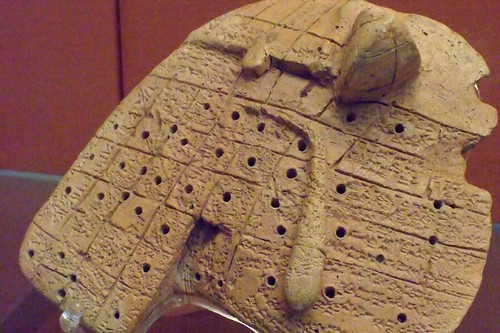
| Although the Etruscans are recognized as quintessential diviners of the future from the study of an animal's liver, this model of a liver used for instruction was found in the ancient Babylonian city of Sipar. Photographed at the British Museum by Mary Harrsch. |
All the crossword gurus out there would get some great words reading Léon's section on divination entitled "Wide Open to Interpretation. I already knew quite a bit about Etruscan haruspicy, foretelling the future by examining sacrificial animal entrails - usually the liver but also the gall, heart and lungs - after reading Mika Waltari's novel "The Etruscan". Steven Saylor's new novel "Empire" (my review) did an excellent job of describing Roman augury, divination through the study of bird flight, when one of his protagonists studies augury beside the stammering future emperor Claudius. I'd even read other sources that mentioned how the Roman army carried chickens with them to divine the auspices before battle by studying the way the chickens gobbled up scattered grain. But I didn't know it was called alectryomancy.
 |
When Julius Caesar tossed the dice before crossing the Rubicon, he was practicing the divination technique of cleromancy. This heroic nude statue of "the divine Julius" is dated to the 1st century CE. Photographed at the Louvre in Paris by Mary Harrsch. |
She also gave me one more big word to add to my vocabulary - Teratoskopos - the interpretation of human deformities. I wonder if that one will ever show up in the New York Times crossword puzzle?
Several years ago I watched an absolutely fascinating program on the History Channel about the work of classical folklorist Adrienne Mayor and her study of the ancients' collection and interpretation of prehistoric remains. In the program, Mayor explained how the ancients may have mistaken a wooly mammoth skull for the skull of a Cyclops because of the large hole in it where the trunk once protruded. I noticed that Léon referenced Mayor's work in her section on Paleontology and the possible source of Griffins in ancient mythology but she actually discussed Cyclopean myths later under a section on Eye Afflictions and Surgery. In addition to discussing the mammoth skull speculations, Léon mentioned real life occurences of Cyclopean humans that could result from an overdose of a toxic plant called white hellebore. I had never heard of this kind of birth defect.
 |
| Roman lamp depicting Ulysses offering wine to the Cyclops Polyphemos from the 1st century CE. Photographed at the Getty Villa by Mary Harrsch. |
"White hellebore actually became fashionable, used to treat a host of ailments from giddiness and palsy to epilepsy, tetanus and white leprosy. As Pliny noted in his encyclopedia, scholars took it regularly to sharpen their brains. It was also prescribed to patients for mental problems. Besides its propensity to provoke vomiting in a stunning variety of colors, white hellebore contained the alkaloids cyclopamine and hervine. It's now recognized that both are teratogens, which may cause one-eyed Cyclopean birth defects." - How to Mellify a Corpse
I think Pliny should have told them to stick to Sudoku puzzles!
I hope through these examples I have illustrated the mind-blowing diversity of topics contained in this book. I believe that even those of you who, like me, have read quite a bit about the ancient world, will find fascinating nuggets of information in this book that not only entertain but could be used to enliven your next novel, next blog post or next classroom presentation. Léon also includes an extensive bibliography and an index which comes in handy to find particular references since the material is so eclectic it is only loosely grouped into geographic categories.


 "Ransom" by award-winning Australian author David Malouf is unlike any novel I have ever read. In it, Malouf explores the inner dialog that people often have with themselves when they review their lives to gain meaning from current circumstances or ponder obstacles they now face. In this case, the feelings we explore are those experienced by King Priam as he attempts to ransom the body of his son Hector from the fiercesome Achilles.