Showing posts with label ancient warfare. Show all posts

Thursday, October 30, 2008

Shadows In the Desert by Dr. Kaveh Farrokh

Shadows in the Desert: Ancient Persia at War (General Military)The ruins of Persepolis evoke the best-known events of ancient Persia's history: Alexander the Great's defeat of Darius III, his conquest of the Achaemenid empire, and the burning of the great palace complex at Persepolis. However, most of the history of ancient Persia remains as mysterious today as it was to contemporary Western scholars. Compared to the world-famous Alexander, the many wars won by the Achaemenid, Parthian, and Sassanian empires, and their revolutionary military technology, have been almost forgotten in the sands of the East.

In its day, Persia was a superpower to rival Greece and Rome, and conflict between them spanned over a millennium. Through these wars, and trade, these foes learnt from each other, not only adopting elements of military technology, but influences in the arts, architecture, religion, technology and learning. In this beautifully illustrated book, Dr Kaveh Farrokh narrates the history of Persia from before the first empires, through their wars with East and West to the fall of the Sassanians. He also delves into the forgotten cultural heritage of the Persians, spread across the world through war and conquest, which, even after the fall of the Sassanians, continued to impact upon the Western world.

The author was awarded the 2008 Persia Golden Lioness Award for outstanding literature for this work.

Technorati Tags: , , , , , , , ,

Monday, June 16, 2008

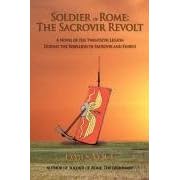
Soldier of Rome: The Sacrovir Revolt: A Novel of the Twentieth Legion During the Rebellion of Sacrovir and Florus


"It has been three years since the wars against Arminius and the Cherusci. Gaius Silius, Legate of the Twentieth Legion, is concerned that the barbarians-though shattered by the war-may be stirring once again. He also seeks to confirm the rumors regarding Arminius' death. What Silius does not realize is that there is a new threat to the Empire, but it does not come from beyond the frontier; it is coming from within, where a disenchanted nobleman looks to sow the seeds of rebellion in Gaul.

Legionary Artorius has greatly matured during his five years in the legions. He has become stronger in mind; his body growing even more powerful. Like the rest of the Legion, he is unaware of the shadow growing well within the Empire's borders, where a disaffected nobleman seeks to betray the Emperor Tiberius. A shadow looms; one that looks to envelope the province of Gaul as well as the Rhine legions. The year is A.D. 20."

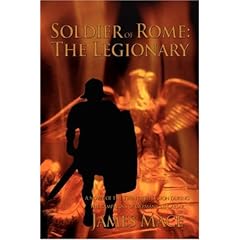
Soldier of Rome: The Legionary: A novel of the Twentieth Legion during the campaigns of Germanicus Caesar


"In the year A.D. 9, three Roman Legions under Quintilius Varus were betrayed by the Germanic war chief, Arminius, and then destroyed in the forest known as Teutoburger Wald. Six years later, Rome is finally ready to unleash Her vengeance on the barbarians. The Emperor Tiberius has sent Germanicus Caesar, his adopted son, into Germania with an army of 40,000 legionaries. They come not on a mission of conquest, but one of annihilation. With them is a young Legionary named Artorius. For him, the war is a personal vendetta—a chance to avenge his brother, who was killed in Teutoburger Wald.

In Germania, Arminius knows the Romans are coming. He realizes that the only way to fight the Romans is through deceit, cunning, and plenty of well-placed brute force. In truth, he is leery of Germanicus, knowing that he was trained to be a master of war by the Emperor himself.

The entire Roman Empire held its breath as Germanicus and Arminius faced each other in what would become the most brutal and savage campaign the world had seen in a generation; a campaign that could only end in a holocaust of fire and blood.

About the Author
James Mace has served in the U.S. military since 1993. He is a full-time soldier with the Idaho Army National Guard and a veteran of the Iraq War. He wrote numerous articles on bodybuilding and physical fitness before turning his attention to writing historical novels. He lives in Meridian, Idaho.

Friday, May 09, 2008

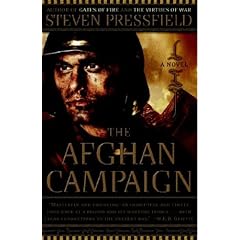
The Afghan Campaign - A Review


by Mary Harrsch

Stephen Pressfield has garnered laurels for his ability to describe the utter brutality of ancient warfare and his descriptions of battles fought during the campaign of Alexander the Great in Afghanistan in his novel "The Afghan Campaign" are as wrenching as those depicted in Pressfield's "Gates of Fire".

Told from the perspective of a common soldier rather than from Alexander's viewpoint or the viewpoint of one of Alexander's commanders, "The Afghan Campaign" provides the reader the opportunity to experience the grinding existence of a man struggling to maintain some shred of integrity in a hostile and intractable world.

Alexander is most often glimpsed from a distance and we are not privy to his strategic debates or daily dispatches to help us understand the "big picture" he sees in his efforts to add the tribes of the Hindu Kush to his role of conquered nations. We must, through Matteius' eyes, simply endure the relentless wind, quagmires of mud, and bitterly cold snow and sleet, as we climb and descend the deadly precipices that score the Afghan countryside in search of a foe that materializes suddenly to engage in deadly tribal rituals, counting coup and scalping or mutilating their victims, then escapes back into the mountains where, unlike the Macedonians, they appear to thrive. We feel Mattteius' frustration rise to an excruciating level as his comrades are butchered in ambushes or slain by duplicitous camp followers.

As the war wears on, he participates in retaliatory strikes where entire villages are put to the sword and torched as efforts intensify to "win" an ultimately unwinnable war. Matteius' acceptance of these measures poignantly demonstrates the ultimate result of living amidst so much brutality - the loss of one's own humanity as both sides must cultivate ruthlessness to simply survive.