Friday, April 03, 2009

Rome's Cultural Revolution


I always love watching Professor Andrew Wallace-Hadrill discuss ancient Rome on the History Channel because he so obviously enjoys his work and is genuinely fascinated by Roman culture and civilization. Every time I visit Pompeii I hope I will run into him there but so far I have not been so fortunate!

The period of Rome's imperial expansion, the late Republic and early Empire, saw transformations of its society, culture and identity. Drawing equally on archaeological and literary evidence, this book offers an original and provocative interpretation of these changes. Moving from recent debates about colonialism and cultural identity, both in the Roman world and more broadly, and challenging the traditional picture of 'Romanization' and 'Hellenization', it offers instead a model of overlapping cultural identities in dialogue with one another. It attributes a central role to cultural change in the process of redefinition of Roman identity, represented politically by the crisis of the Republican system and the establishment of the new Augustan order. Whether or not it is right to see these changes as 'revolutionary', they involve a profound transformation of Roman life and identity, one that lies at the heart of understanding the nature of the Roman Empire.

Andrew Wallace-Hadrill is Professor of Classics at the University of Reading and has been Director of the British School at Rome since 1995. His previous books are Suetonius: The Scholar and his Caesars (1983), Houses and Society in Pompeii and Herculaneum (1994) and Domestic Space in the Roman World (co-edited with Ray Laurence, 1997). He is currently directing a major project on a Pompeian neighbourhood with Michael Fulford and, since 2001, has directed the Herculaneum Conservation Project. He frequently contributes to radio and television programmes on various aspects of Roman life and in 2004 was awarded an OBE for services to Anglo-Italian cultural relations.

Ten Books That Illustrate Why Romans Were Great Lovers


While I was browsing new ancient-themed books on Amazon I saw this interesting list by Mary Beard of ten books that illustrate why Romans were great lovers. I definitely agree with item 9. When I visited the Museo Archaeologico in Naples a couple of years ago and ventured into the "Secret Room" I did not find the semi-erotic paintings particularly shocking, as did the first female Victorian visitors, but found the heaps of phallic-shaped votive offerings and explicit terracotta lamps a little unnerving. They still make me blush and I haven't gotten my nerve up enough to upload my photographs of them to Flickr even yet. When I do so I will flag them as "may offend" so they will be filtered. I don't want any teachers angry with me for including such graphic sexual images in collections I promote for classroom use.


1. Staying power
Roman lovers could keep going all night (at least if we take their word for it). Ovid – the first-century-BC’s man about town – claims that he could perform nine times in a single night. Read all about it in his ‘Love Poems” (Book 3, number 7). Read: Ovid, The Erotic Poems (Penguin Classics)
, translated by Peter Green.

2. Sweet talk
Roman men could make you feel so good. Mark Antony and Julius Caesar both talked their way into the heart of feisty Cleopatra. The chat-up lines of Rome’s founding father Aeneas drove Queen Dido senseless. Read: Virgil, The Aeneid (Penguin Classics Deluxe Edition)
, translated by Robert Fagles. (Go straight to Book 4)

3. Body beautiful
There was no flab or beer belly on these six-pack hunks. All that gym and exercise kept Greeks and Romans bronzed and trim. Read: Nigel Spivey, The Ancient Olympics: A History
.

4. Inventiveness

Sexual positions became (literally) an art-form for the Romans--two-somes, three-somes and more. You’d better stay supple though, or those more testing acrobatics will be beyond you. Read: John Clarke, Looking at Lovemaking: Constructions of Sexuality in Roman Art, 100 B.C. - A.D. 250
.

5. Romantic agony
Roman men could do anguish better than any others. “I hate and I love . . . and it hurts” as the poet Catullus succinctly wrote to his fickle mistress. Don’t expect to escape a Roman affair without tears. Read: Catullus,The Poems of Catullus: A Bilingual Edition
, translated by Peter Green.

6. Great pick-up lines
Romans knew they had to work hard at the first impressions. Ovid, in a lover’s manual, gives the beginner plenty of advice on how to break the ice. Stand right next to her at a procession, and when some elaborate display goes past explain to her what it is. It doesn’t matter, says Ovid, if you don’t really know – make it sound plausible, to impress. Read: Ovid, Ovid: The Art of Love and Other Poems (Loeb Classical Library No. 232)
, translated by J. H. Mozley.

7. Open minds
Not many Romans were prudes. Most men were happy to contemplate sex with women, men, or if it came to it, animals – just so long as they were the active, not the passive partner. Read: Apuleius, The Golden Ass (Penguin Classics)
, translated by E. J. Kenney.

8. Rough-trade

Roman women went for the rough, tough sporting heroes of the ancient world. Successful gladiators became the heart-throbs of the Roman girls. Read: Catharine Edwards, The Politics of Immorality in Ancient Rome
.

9. In touch with their inner-selves
The anxiety of Roman men was one of their more endearing features. Images of the phallus were everywhere in Roman towns – but so too were images of castration and mutilation. The ancient man never took his prowess for granted. Carlin A. Barton,The Sorrows of the Ancient Romans
.

10. Not afraid to say 'I love you'


The walls of the buried city of Pompeii are covered with written messages from satisfied (and a few unsatisfied) men. ‘Oh Chloe, I had a wonderful time, twice over in this very spot, I love you. . . .’
Read: Antonio Varone, Eroticism in Pompeii
. And, in case you are looking for the woman’s point of view, try Marilyn B. Skinner, Sexuality in Greek and Roman Culture (Ancient Cultures)
.

Augustus: A modest first among equals? I think not.


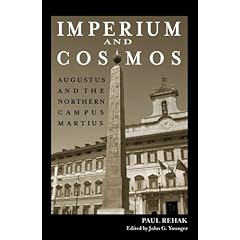
When I read the product description of this book by Paul Rehak, scheduled for release April 8, I was pleased to see that someone besides me thinks Augustus was not as interested in being viewed as a modest citizen as many historians have suggested. I just returned from Rome a few weeks ago and while there had a chance to view the new rooms of the villa of Augustus on the Palatine that have been recently restored and saw nothing "modest" about them. They were as richly frescoed as most sumptuous villas of the wealthy that have been unearthed in Pompeii or Oplontis. You also can't help but be awestruck by the ornate naturalistic murals of a subterranean room from the villa of Livia recreated in a gallery of the National Museum in Rome either. Each time I see them I feel they envelope a visitor in a sense of luxury as real as if you were left to stroll in a richly planted peristyle garden.

"Caesar Augustus promoted a modest image of himself as the first among equals (princeps), a characterization that was as recognized with the ancient Romans as it is with many scholars today. Paul Rehak argues against this impression of humility and suggests that, like the monarchs of the Hellenistic age, Augustus sought immortality—an eternal glory gained through deliberate planning for his niche in history while flexing his existing power. Imperium and Cosmos focuses on Augustus’s Mausoleum and Ustrinum (site of his cremation), the Horologium-Solarium (a colossal sundial), and the Ara Pacis (Altar to Augustan Peace), all of which transformed the northern Campus Martius into a tribute to his major achievements in life and a vast memorial for his deification after death.

Rehak closely examines the artistic imagery on these monuments, providing numerous illustrations, tables, and charts. In an analysis firmly contextualized by a thorough discussion of the earlier models and motifs that inspired these Augustan monuments, Rehak shows how the princeps used these on such an unprecedented scale as to truly elevate himself above the common citizen. "