By the late Augustan age, the emerging empire of the people who settled the seven hills clustered around the Tiber River had crystallized around the central nucleus of a single powerful individual who, though posing as "first among equals", directed the activities of both conquering legions and a society convinced of their destiny but uncertain as to the path they should follow to achieve it. The political structure of the government was no longer in flux as it was during the years of the early monarchy and Roman Republic, but the disruption of the "Coursus Honorum" left gifted and ambitious people without a career path, so to speak, so people began exploring new ideas and philosophies in their search for individual identity and purpose. It is these seekers who Steven Saylor has elected to populate his latest novel "Empire".
In his previous novel "Roma", we accompanied members of the Pinarii family, through almost one thousand years of Roman cultural development beginning with the first neolithic settlement and ending with the fall of the Roman Republic. A fictional patrician family, the Pinarii became augurs who could read omens and portents to help guide the society's leaders in momentous decisions. As such they often found themselves in the eye of the storm as powerful and ambitious men wrestled with issues of political control, strategic defense and, ultimately, wealth distribution, as conquest brought in mounds of treasure from territories around the Mediterranean as well as Gaul and the Iberian peninsula.
Pinarii have even managed to become related to a clan that would ultimately produce the Julio-Claudian emperors, with a Pinarii named as one of the lesser heirs to the fortune left behind by the Divine Julius (Caesar). As "Empire" opens, we meet the latest Pinarii descendant, Lucius, who has studied augury and is about to be inducted into the prestigious College of Augurs with his cousin Claudius. Having the protagonist be an observer and at times a participant in the ballet of imperial administration but not the emperor himself is a choice Saylor has made that I feel gives the reader more opportunity to experience the helplessness of being in the control of volatile personalities who struggle to orchestrate not only their own lives but the existence of millions of men, women and children across the ancient world.
We soon discover that having family ties to the imperial household is often more dangerous than advantageous as the frail, aging Augustus passes from the scene and Tiberius takes the helm. We also learn that the insecurities of those in control make them fear ideas even more than actual threats and something as seemingly harmless as studying astrology, encouraged by studious cousin Claudius, almost leads to Lucius' death at the hands of the scheming Sejanus.
 |
The future emperor Claudius cowers behind a curtain in this painting by
Sir Lawrence Alma-Tadema (1871) |
Eventually, of course, Sejanus is executed and Tiberius dies leaving a promising young Caligula to advance to the throne. But Lucius' identical twin sons, Kaeso and Titus, find themselves facing a new madman. After a particularly humiliating interview with the new emperor, Kaeso drops out of aristocratic society and seeks the anonymity of the Saburra where he can practice his new religion, Christianity, relatively undisturbed. Titus, however, a man who embraces his family's past, becomes an augur and renews his friendship with his father's cousin, Claudius.
Saylor does not dwell on Caligula's perversions or spend a lot of time with Claudius in the subsequent reign with the exception of a glimpse of the excesses of Messalina and the human fallout that ensued. But when Titus becomes the trusted augur of Nero, we have the opportunity to explore more thoroughly a court that was filled with artists, philosophers and poets who have influenced centuries of western thought. Nero has been vilified almost universally in western history, primarily, I think, because he initiated one of the first major persecutions of the early Christians. But Saylor presents this man and his administration from the viewpoint of a non-political observer. He does not gloss over Nero's ruthlessness, with characters speculating that Nero poisoned Claudius' son, Britannicus. But Britannicus is not presented as merely a guileless victim either. Likewise, we see Agrippina as openly manipulative and ambitious, so much so that she must be dragged from the imperial audience chamber when she emerges from behind the curtain where she normally lurks and tries to mount the imperial dais to directly negotiate with an ambassador of Armenia. This is a real incident attested to in the ancient sources. We also learn that Agrippina openly begins to support other candidates for the throne. So, Nero's execution of his mother can be understood from the perspective of Nero reacting to a very real threat to his powerbase. But the novel's characters seem to view news of Nero kicking his pregnant wife to death as unfounded rumor. Some modern scholars have voiced this suspicion as well. Nero was generally detested by the aristocratic elites, and this indefensible act may have been invented to further vilify Nero when in fact his wife merely suffered a miscarriage.
Of course no passage about Nero could be complete without including the terror of the conflagration that almost swallowed Rome in 64 C.E. The Pinarii lived on the Aventine Hill where a number of homes suffered destruction. We are caught up in the terror as Titus and his family flee the flames. But Titus cannot abandon his brother living in the squalor of the Saburra. So he fights his way through the streets to find his brother, along with other Christians, celebrating the apparent end of the world while others interfere with the vigiles, who were fighting the blaze with backfires to create fire breaks. Some Christian readers may be troubled by this depiction but it too is based on actual references in the ancient sources.
"None ventured to combat the fire, as there were reiterated threats from a large number of persons who forbade extinction, and others were openly throwing firebrands and shouting that "they had their authority" - (minis restinguere prohibentes, Tacitus, Ann. XV.38)
 |
What appears to be a depiction of Nero looking at a Christian woman who
has been executed as part of a tableau reenacting the death of Dirce.
by Henryk Siemiradzki. (1843-1902) |
In 1900, an Italian professor, Pascal of Milan, published a pamphlet in which he makes a case for the Christians actually being the source of the great fire. He describes the early Christian community in Rome as composed of desperate fanatics with subversive ideas and energetic enough to lead a "propoganda of acts". Of course his research was almost immediately attacked, most vehemently by Dr. A. Profumo who published a rebuttal in 1905 that not only attempted to refute the Christian role in the spread of the blaze but insisted that the entire disaster was meticulously planned by Nero for the purpose of allowing him to reconstruct Rome. The truth probably lies somewhere in the middle, more closely resembling the scenario put forward by C.H. Hülsen in his article "The Burning of Rome Under Nero" published in Vol. 13, No. 1 (Jan.‑Mar. 1909) of the American Journal of Archaeology. Hülsen expressed his opinion that Pascal may have placed too much importance on the size and nature of early Christian groups in Rome.
"...the primitive community of Christians in Rome was surely not so large as he thinks; that the revolutionary ideas of its members have been greatly exaggerated, and that the supposed propagation of Christianity among the praetorians is based on an erroneous translation: St. Paul's words (Philipp. I.13) do not signify "in the Praetorian Camp," as it is supposed, but "in the judge's house" or "in the residence (of the emperor)" (Mommsen, Röm. Staatsrecht, II3, p807, n2)." - C.H. Hülsen
But he also goes on to dismiss the notion that the extent and direction of the conflagration could have been planned and executed by Nero as put forth by Profumo.
"The idea of deliberately planning such an enormous conflagration, and of actually calculating the direction in which the fire must spread, appears too fantastic even for Nero; to start the fire in the immediate neighborhood of the imperial palace with the intention of destroying quarters •nearly half a mile distant is still more fantastic. Any little unsuspected incident might upset the plan, and divert the fire from the course intended; and in fact, what really took place did not correspond at all to the design as conceived by Profumo and represented on his plan (Tav. 2)." - C.H. Hülsen
Hülsen concludes that the fire itself was most probably just an accident, but one in which the behaviors of some of the victims/observers could have been seriously misconstrued.
"I conclude, therefore, that the outbreak of the fire was really due to accident. It may be that some of the Christian party fell under suspicion because of their behavior during and after the conflagration. Seeing the terrible catastrophe which was happening to the capital of the world, it was very easy to think that this was the beginning of the last judgment, which they were expecting in the very near future. The fire appeared to have come upon the wretched town providentially, so that it might be regarded as wrong to interfere with its progress. It may be that among those who menaced the firemen (minis restinguere prohibentes, Tacitus, Ann. XV.38) were some zealous Christians. And when, after the extinction of the fire, Nero attempted to regain the favor of the gods by sacrifices and ceremonies, the Christians naturally abstained from participating in the sacrifices to Vulcan and Juno and in the processions to the temples of the Olympic gods. Their insensibility to the general feeling could easily promote the suspicion that they had been the real authors of the great conflagration. " - C.H. Hülsen
He does go on to point out that Nero's behavior also could have been misinterpreted as well.
"It may be that the magnificent view of the conflagration made him break out into admiring words, and aroused in his mind the remembrance of the burning of Ilium. These and other imprudent expressions were naturally noted and were sufficient to forge the material for the accusations we find suggested in the writings of Tacitus and Suetonius, and definitely expressed in Dio Cassius and Xiphilinus." - C.H. Hülsen
Saylor's characters also discuss the significant extent of Nero's assistance in rendering aid to the fire's victims and in enacting building codes to help prevent such disasters in the future, an aspect of Nero's reign that somehow always gets overlooked in the rush to disparage his overindulgence in the construction of his famous Golden House.
"...as a relief to the homeless and fugitive populace, he opened the Campus Martius, the buildings14 of Agrippa, even his own Gardens, and threw up a number of extemporized shelters to accommodate the helpless multitude. The necessities of life were brought up from Ostia and the neighbouring municipalities, and the price of grain was lowered to three sesterces." -
Tacitus, Ann. XV.39
"In the capital, however, the districts spared by the palace were rebuilt, not, as after the Gallic fire, indiscriminately and piecemeal, but in measured lines of streets, with broad thoroughfares, buildings of restricted height, and open spaces, while colonnades were added as a protection to the front of the tenement-blocks. These colonnades Nero offered to erect at his own expense, and also to hand over the building-sites, clear of rubbish, to the owners. He made a further offer of rewards, proportioned to the rank and resources of the various claimants, and fixed a term within which houses or blocks of tenement must be completed, if the bounty was to be secured. As the receptacle of the refuse he settled upon the Ostian Marshes, and gave orders that vessels which had carried grain up the Tiber must run down-stream laden with débris. The buildings themselves, to an extent definitely specified, were to be solid, untimbered structures of Gabine or Alban stone,26 that particular stone being proof against fire. Again, there was to be a guard to ensure that the water-supply — intercepted by private lawlessness a — should be available for public purposes in greater quantities and at more points; appliances for checking fire were to be kept by everyone in the open; there were to be no joint partitions between buildings, but each was to be surrounded by its own walls. " -
Tacitus, Ann. XV.43
So at least Saylor, through the experiences of the Pinarii, helps us to understand the context of the events and motivations that prompted Nero to undertake the first major persecution of Christian believers. The macabre event Nero staged, though, as a cathartic spectacle to assuage the anguished Roman mob and play a twisted practical joke on poor Titus Pinarius keeps you on the edge of your seat.
Another somewhat controversial theory that Saylor raises in this portion of his story is the circumstances of Nero's suicide. I didn't realize there had been any disputes about Nero's final hours. I had always read that Nero fled the city and when informed he had been decreed an enemy of the state and would be punished in the ancient manner (beaten to death with rods), he sought the help of one of his slaves to commit suicide. In "Empire", Saylor raises the question of whether Nero had really been decreed an enemy of the state or simply misled into thinking so. Knowing how meticulously Saylor researches historical events that occur in his novels, I couldn't help but do a little research of my own to see if this was one of the author's creative flourishes or if it, too, had a basis in ancient reports.
I found this reference in Plutarch's "Life of Galba" that would certainly lend support to the theory that Nero was not condemned before he committed suicide:
"...the leading military tribune, Antonius Honoratus, calling together the soldiers under his command, reviled himself, and reviled them for changing about so often in so short a time, not according to any plan or choice of better things, but because some evil spirit drove them from one treachery to another. In the first instance, he said, they had an excuse in the crimes of Nero; but now, if they were to betray Galba, what charge of murdering his mother or slaying his wife could they bring against him, or what feelings of shame that their emperor should appear in public as musician or tragic actor? "Nay, not even with these provocations would we consent to abandon a Nero, but we had to be persuaded by Nymphidius that Nero had first abandoned us and fled to Egypt. Shall we, then, sacrifice Galba after Nero, and choosing the son of Nymphidia as our Caesar, shall we slay the scion of the house of Livia, as we have slain the son of Agrippina? Or, shall we inflict punishment on Nymphidius for his evil deeds, and thereby show ourselves avengers of Nero, but true and faithful guardians of Galba?" -
Plutarch, Life of Galba
Apparently the troops did not declare for Galba until after they thought Nero had abandoned them and fled to Egypt. The Senate would not have done anything to condemn Nero and ratify Galba if the legions were still loyal to Nero, especially in view of the fact that Verginius, who was one of the most powerful generals during this period and victor in the recent Battle of Vesontio, had steadfastly remained loyal to Nero when he, himself, was offered the throne.
Of course as Nero's reign draws to a close we embark upon the infamous year of the four emperors where the reign of Galba gives way to Otho which quickly ends with the rise of Vitellius who is beheaded by the supporters of the Flavians (although Vespasian himself has not yet entered the city). Our story now focuses on Lucius Pinarius, the son of Titus, who has been raised by
Epaphroditus , a freedman and courtier of Nero, who is thought to have helped the emperor commit suicide. The ancient sources are a bit confusing about Epaphroditus. Tiberius Claudius Epaphroditus served as a libellis, the man who drafted official replies to petitions received by the emperor Nero. Epaphroditus of Chaeronea, on the other hand, was a teacher who had once been owned by a member of the equestrian order who served as a prefect in Egypt. Epaphroditus of Chaeronea was freed in Alexandria then traveled to Roma where he founded a school and wrote several treatises on works by Homer, Hesiod and Callimachus of Cyrene. Some scholars think the two men may have actually been the same person. Saylor's Epaphroditus certainly seems to combine certain aspects of both of these men into his character. In Epahroditus' household, Lucius Pinarius enjoys conversations with the famous philosophers Epictetus, and Dio of Prusa as well as endures the barbs from the famous poet Martial.
But Lucius does not embrace any of the philosophies espoused by his friends or even Christianity that had been so fervently adopted by his late uncle. Instead, he meets Apollonius of Tyana whose example he almost immediately begins to emulate. I'm afraid I had never heard of Apollonius of Tyana so, of course, had to do a bit of research.
Apollonius of Tyana has been described as a Greek Neopythagorean philosopher from the town of Tyana in the Roman province of Cappadocia in Asia Minor. Like many Pythagoreans, Apollonius opposed animal sacrifice, and lived on a frugal, strictly vegetarian diet. In a fragment of the only work that most scholars agree is authentic from his treatise "On Sacrifices", Apollonius points out "that God, who is the most beautiful being, cannot be influenced by prayers or sacrifices and has no wish to be worshipped by humans, but can be reached by a spiritual procedure involving nous (intellect), because he himself is pure nous and nous is also the greatest faculty of humankind." A number of miracles were attributed to Apollonius placing him on a level roughly equivalent to Jesus of Nazareth. In fact, in later antiquity, the achievements of Apollonius were used by anti-Christian forces to disprove the special nature of Jesus' ministry.
"...in the late third century Porphyry, an anti-Christian Neoplatonic philosopher, claimed in his treatise Against the Christians that the miracles of Jesus were not unique, and mentioned Apollonius as a non-Christian who had accomplished similar achievements. Around 300, Roman authorities used the fame of Apollonius in their struggle to wipe out Christianity. Hierocles, one of the main instigators of the persecution of Christians in 303, wrote a pamphlet where he argued that Apollonius exceeded Christ as a wonder-worker and yet wasn’t worshipped as a god, and that the cultured biographers of Apollonius were more trustworthy than the uneducated apostles." -
Wikipedia
I had to smile, though, when I read that one of the most witnessed of Apollonius' miracles (documented by both Philostratos and Cassius Dio) was his sudden declaration during a gathering of followers in Ephesus "Take heart, gentlemen, for the tyrant has been slain this day..." at the very hour that Domitian was assassinated in Rome. In the novel, Lucius, who has been drawn into the assassination plot, revealed the details of the plan in a coded letter to Apollonius, a scenario modern scholars have suggested as a plausible explanation for the so-called "miracle".
Something a little more supernatural occurred, though, in the third century CE. When the emperor Aurelian attacked Apollonius' hometown of Tyana, the emperor reportedly saw a vision of Apollonius asking him to spare Tyana's innocent citizens. Aurelian was a fervent proponent of one God, one Empire (yes, even before Constantine). He may have studied the teachings of Apollonius and been influenced by them when he approached the birthplace of the renowned philosopher.
But, back to our story - Lucius Pinarius also befriends Sporus, the eunuch who Nero took as a wife because of the youth's uncanny resemblence to Nero's dead wife Poppaea. The young man dresses as a woman and wears makeup so Lucius thinks of him as a "her". I had read some time ago that Nero had unmanned a youth and taken him for a wife late in his reign. But the character of Sporus intrigued me so I wanted to learn more about "her". Sporus survived Nero's reign and was appropriated by the first usurper Galba. When Otho replaced Galba as emperor, he too was swept away by Sporus' resemblance to Poppaea. Otho was actually married to Poppaea before Nero. He had divorced Poppaea so she could marry his good friend Nero. Otho apparently did not hold Nero responsible for her death (another circumstance that points to the possibility that the story about Nero kicking a pregnant Poppaea to death was a fabrication). But when the vicious Vitellius appeared on the scene, Sporus learned "she" was to be the object of a cruel public spectacle so Sporus takes her own life. These scenes in Saylor's story leave you breathless!
With the rapid succession of emperors and continuing decline in authority of the Senate, many aristocratic Romans, like Lucius Pinarius, shun public life. Lucius plans to keep a low profile, do what is necessary to maintain the family wealth and engage in quiet scholarly pursuits. We are treated to an extensive description of the inaugural games at the Colosseum, though, as Lucius accepts an invitation from Martial who has ingratiated himself to the ruling Flavians. Vespasian, of course, has already died. I was surprised that little of his reign is covered other than the fact that many of his building projects were funded by booty from the Jewish wars. His son, Titus completes the Flavian amphitheater (Colosseum) and is host of some of the most spectacular (and bloody!) games ever presented in Rome. Titus, like Trajan and Hadrian who will come sometime afterwards, openly pursued young boys. I must admit I was surprised by this information. I had always considered the presence of eunuchs in the imperial court to be more of a feature of Byzantine court life than prevalent in the western Empire as well.
 |
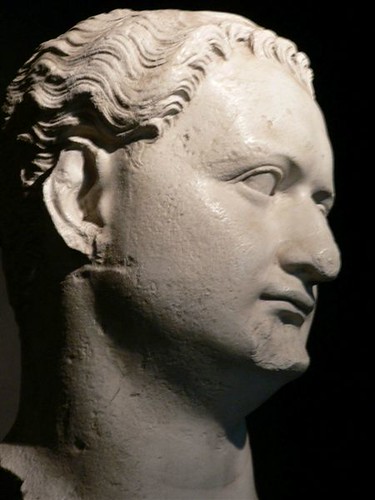
The Emperor Domitian Roman Marble 1st
century C.E. Photographed by Mary Harrsch
in Rome, Italy. |
Titus is also portrayed as a congenial leader, secure in his position and content with himself. But, Titus dies within a couple of years and Domitian ascends the throne. Lucius finds that Domitian is a dour, insecure individual who soon begins to suspect everyone and is, quite honestly, a control freak. He soon resurrects the old magistracy of censor so he can dictate even public morals despite his own debauched activities. This creates a precarious situation for our quiet Lucius who has fallen in love with a Vestal virgin. Their relationship and its consequences are truly poignant.
I couldn't help but ponder the personality of Domitian. His extremely negative world view and apparent low self-esteem are traits I have seen in victims of post traumatic stress disorder. I wonder if his very close brush with death at a young age in Rome when the forces of Vitellius attacked the Flavian supporters could have triggered this apparent psychological disorder. Of course he was also struggling with how to compete with the reputations of a wildly popular brother and successful father as well.
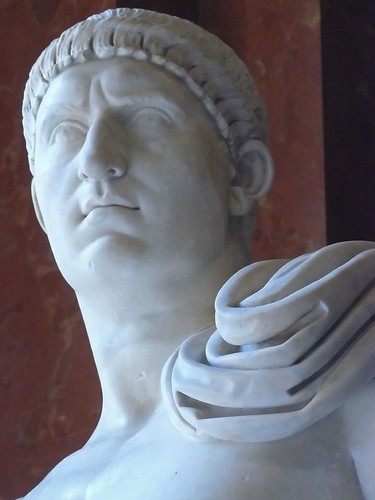
Domitian is aided in his tyranny by L. Valerius Catullus Messallinus. Catullus was a reviled informer who had once served as Domitian's consular colleague. Although an illness left him blinded, his other senses served him well enough to terrorize a number of Roman citizens, including Lucius Pinarius and the Vestal he loved. Surprisingly, Lucius survives the reign of Domitian and even has a hand in its end. The stage is now set for Lucius' son Marcus, a gifted sculptor, to capture a new emperor's attention. Nerva's brief reign is portrayed as relatively benign followed by the rule of a competent self-assured military man from Spain, Trajan. Trajan, despite his outstanding military successes, walks into Rome with his wife beside him like a common man (maybe this is where President Jimmy Carter got the idea). He dubs the palace the House of the People and maintains this egalitarian persona throughout his reign.
 |
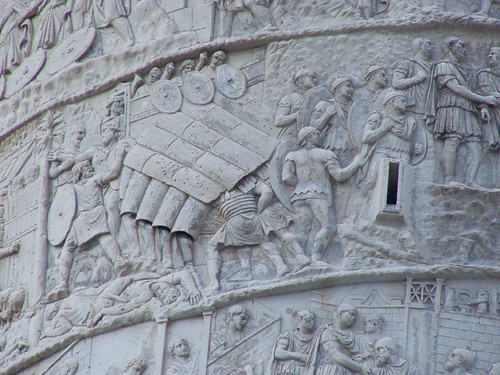
A scene on Trajan's column depicting the famous
Testudo (tortoise formation). Photographed in Rome by
Mary Harrsch. |
Marcus is chosen to assist the architect Apollodorus in the construction of a number of temples as well as the famous column depicting Trajan's victories in Dacia. Marcus has actually accompanied Trajan's armies in Dacia so sculpts scenes, many of which he has witnessed himself. I would have enjoyed a section describing Marcus' adventures in Dacia but I understand Saylor's desire to keep the action focused in Roma (besides, the novel is already over 500 pages by now!)
I have thoroughly enjoyed exploring various philosophies that cropped up in earlier chapters, so I was once more intrigued by a reference to a Dacian philosopher named Zalmoxis that Saylor mentions at this point in the story. Although some sources claim Zalmoxis was a freedman disciple of Pythagoras, others, like Herodotus, believe he lived much earlier, claiming Zalmoxis traveled to Egypt where he taught people about the immortal nature of their soul and the eternal bliss of the afterlife.
Zalmoxis was originally a Getae, an ancient people of Thrace, and he supposedly returned to his homeland and entered a cave on or near Mt. Kogaion where he lived for three years. When he emerged, people thought he had been resurrected since they assumed he was long dead. Plato says in the Charmides dialogue that Zalmoxis was also a great physician who took a holistic approach to healing body and mind; not just the body, as was the Greek practice. After he died, a cult grew up around his teachings in which worshipers practiced monotheism, celebrated with music and dance and avoided the depiction of divine beings in images.
Supposedly Julian the Apostate wrote that Trajan claimed the Dacian belief in Zalmoxis made it easier to conquer them since they did not fear death because of its transitory nature. These types of interesting tidbits is why I enjoy reading Steven Saylor's books so much!
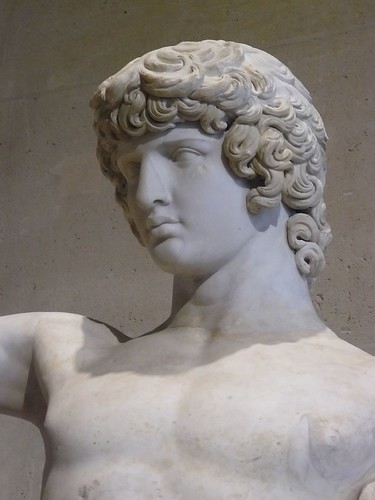
 |
Antinous from the Braschi collection
2nd century CE Photographed at the
Musee du Louvre in Paris, France by
Mary Harrsch. |
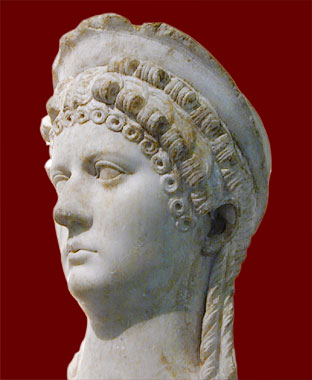
Anyway, eventually, Trajan becomes ill while campaigning in the east and dies before reaching Rome. His wife, Plotina, engineers the succession of Hadrian, a second cousin of Trajan, also from Spain. In Hadrian, though, we see a gifted man but with the hallmarks of an individual not totally content with himself. He is self-conscious about his acne scars (until he grows his famous beard) and works diligently with a grammaticus to try to eliminate his embarrassing Spanish accent - even though Trajan's was more pronounced and Trajan was unconcerned about it. Hadrian's personality is therefore more volatile and he is less tolerant of dissension. Problems for Marcus' family arise when his father-in-law, the architect Apollodorus, a man with a rather high opinion of his own worth, blurts out derisive observations of architectural plans Hadrian has developed himself. At least Marcus and his family, including his son little Lucius, are not forced to follow Apollodorus into exile in Damascus. In fact, Marcus' own career flourishes under Hadrian as he works on such famous structures as the Pantheon, Hadrian's expansive villa in Tibur (modern Tivoli) and Hadrian's mausoleum (now the Castel S. Angelo). Of course he is also called upon to resurrect the emperor's drowned lover, Antinous, in marble as well.
Sadly, as the years pass and an aged Hadrian falls ill, he starts to issue execution orders for what, in many cases, are imaginary offenses. Fortunately, Hadrian has adopted Titus Aurelius Fulvus Boionius Arrius Antoninus who countermands such orders and protects the people around the emperor. Antoninus is ultimately rewarded by the senate with the cognomen Pius.
"He never bathed at odd hours or took a passion for building; never set up for a table connoisseur, and expert on textures and tints, or an authority on good looks... One might fairly apply to him what is recorded of Socrates, that he could either enjoy or leave things which most people find themselves too weak to abstain from, and too self-indulgent to enjoy." -
Marcus Aurelius, Meditations.
So we leave Roma at the apex of her civilization. By order of Hadrian, before his decline, little Lucius has become the companion of Marcus Verus, a precocious boy who by the age of eleven has already embraced Stoicism. The youth, later adopted by Antoninus Pius, would become the famous warrior/philosopher Marcus Aurelius. But Steven Saylor has yet to tell that tale!!


 Researching a book can be as exciting as investigating a murder and authors often end up with hundreds of notes about fascinating details of a person's life or a culture's social practices or unusual uses for obscure compounds. A love of learning can lead authors, particularly new authors, to include every last factoid into their novel or treatise, unfortunately often to the detriment of the work they are preparing.