Friday, May 23, 2008

New Edition of Encyclopedia of Invasions and Conquests Now Available


"Throughout history, invasions and conquests have played a remarkable role in shaping our world and defining our boundaries, both physically and culturally.

Updated through 2006, this brand new second edition of the popular Encyclopedia of Invasions & Conquests is a comprehensive guide to over 150 invasions, conquests, battles and occupations, from the ancient times to the present. With brand new articles on the Coalition Invasion of Iraq, the Serbian Invasion of Bosnia-Herzegovina, the Soviet & UN's Invasions of Afghanistan, this text offers complete coverage of the most current invasions and those dating back to the earliest times. Plus, a brand new Historical Timeline has been added along with over 70 brand new Maps.

Categories of entries include countries, invasions and conquests, and individuals. In addition to covering the military aspects of invasions and conquests, entries cover some of the political, economic, and cultural aspects, for example, the effects of a conquest on the invading country's political and monetary system and in its language and religion. The entries on leaders -- among them Sargon, Alexander the Great, William the Conqueror, and Adolf Hitler -- deal with the people who sought to gain control, expand power, or exert religious or political influence over others through military means.

Revised and updated for this second edition, entries are arranged alphabetically within historical periods. Each chapter provides a map to help readers locate key areas and geographical features, and bibliographical references appear at the end of each entry. Other useful features include hundreds of Maps, cross-references, a cumulative bibliography and a comprehensive subject index."

Wednesday, May 14, 2008

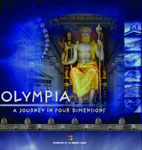
Olympia: A Journey to Four Dimensions


"The publication "Olympia. A Journey to Four Dimensions" is a "digital album" with three-dimensional reconstructions of the most important buildings of ancient Olympia, which are presented with emphasis on historical accuracy and construction details. For the first time the site of ancient Olympia is presented in a book, as it was in its heyday, exclusively through digital pictures.

The main part of the book consists of large coloured images of the various monuments of Olympia, as well as general perspectives of the site, the birthplace of the Olympic Games. Architectural monuments and areas that no longer exist in their original form come to life through the use of computers and of three-dimensional graphics programs.

The book has been created as part of the activities of the Foundation of the Hellenic World for the Olympic Games that were organized in our country in 2004. At the same time, a series of twelve postal cards has been published with select pictures from this book. The production of digital reconstructions was done exclusively by the 3D Reconstruction and Animation Department (http://3d.fhw.gr/) of the Foundation of the Hellenic World."

Olympia: A Journey to Four Dimensions is available in Greek or English.

Friday, May 09, 2008

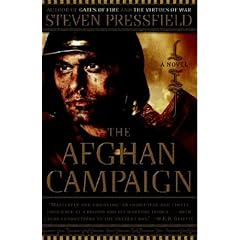
The Afghan Campaign - A Review


by Mary Harrsch

Stephen Pressfield has garnered laurels for his ability to describe the utter brutality of ancient warfare and his descriptions of battles fought during the campaign of Alexander the Great in Afghanistan in his novel "The Afghan Campaign" are as wrenching as those depicted in Pressfield's "Gates of Fire".

Told from the perspective of a common soldier rather than from Alexander's viewpoint or the viewpoint of one of Alexander's commanders, "The Afghan Campaign" provides the reader the opportunity to experience the grinding existence of a man struggling to maintain some shred of integrity in a hostile and intractable world.

Alexander is most often glimpsed from a distance and we are not privy to his strategic debates or daily dispatches to help us understand the "big picture" he sees in his efforts to add the tribes of the Hindu Kush to his role of conquered nations. We must, through Matteius' eyes, simply endure the relentless wind, quagmires of mud, and bitterly cold snow and sleet, as we climb and descend the deadly precipices that score the Afghan countryside in search of a foe that materializes suddenly to engage in deadly tribal rituals, counting coup and scalping or mutilating their victims, then escapes back into the mountains where, unlike the Macedonians, they appear to thrive. We feel Mattteius' frustration rise to an excruciating level as his comrades are butchered in ambushes or slain by duplicitous camp followers.

As the war wears on, he participates in retaliatory strikes where entire villages are put to the sword and torched as efforts intensify to "win" an ultimately unwinnable war. Matteius' acceptance of these measures poignantly demonstrates the ultimate result of living amidst so much brutality - the loss of one's own humanity as both sides must cultivate ruthlessness to simply survive.