Sunday, June 29, 2008

Roman Bodies. Antiquity to the Eighteenth Century


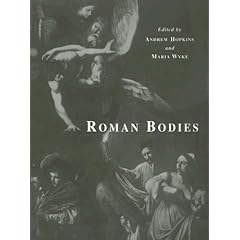
While I was researching other works published by The British School in Rome, I came across a listing for this fascinating-sounding book, Roman Bodies. Antiquity to the Eighteenth Century, edited by Andrew Hopkins and Maria Wyke:

"
The seventeen wide-ranging and interdisciplinary essays explore dramatic changes in Western conceptions of the body. Divided into three sections, ‘Empire’, ‘Church’ and ‘Religion and science’, topics discussed include gender, sexuality, social and political identity, health and sickness, the body in death and after, and corporeal aesthetics.

[1] The body of Rome: introduction, Maria Wyke and Andrew Hopkins; [2] Archetypally Roman? Representing Seneca’s ageing body, Catharine Edwards; [3] Circumcision, de-circumcision and self-image: Celsus’s ‘operation on the penis’, Ralph Jackson; [4] A Roman perspective on circumcision, Pierre Cordier; [5] In the foreskin of your flesh’: the pure male body in late antiquity, Gillian Clark; [6] Headhunters of the Roman army, Nic Fields; [7] Execution in effigy: severed heads and decapitated statues in Imperial Rome, Eric R. Varner; [8] Disabled bodies: the (mis)representation of the lame in antiquity and their reappearance in early Christian and medieval art, Livio Pestilli; [9]Truth, perception and the pagan body in the Roman martyr narratives, Kristina Sessa; [10] The paradoxical body of Saint Agnes, Lucy Grig; [11] The relic translations of Paschal I: transforming city and cult, Caroline Goodson; [12] Majesty and mortality: attitudes towards the corpse in papal funeral ceremonies, Minou Schraven; [13] A theatre of cruelty and forgiveness: dissection, institutions and the moral discourse of anatomy in sixteenth-century Rome, Andrea Carlino; [14] Not torments, but delights: Antonio Gallonio’s Trattato de gli instrumenti di martirio of 1591 and its illustrations, Opher Mansour; [15] Ancient bodies and contested identities in the English College martyrdom cycle, Rome, Richard L. Williams; [16] Secrets of the heart: the role of saintly bodies in the medical discourse of Counter-Reformation Rome, Catrien Santing; [17] Contesting the Sacred Heart of Jesus in late eighteenth-century Rome, Jon L. Seydl."

I thought the sections on executions in effigy and the decapitation of statues in Roman art as well as the discussion of the misrepresentation of the disabled in antiquity sounded particularly interesting.

Private Worship, Public Values, and Religious Change in Late Antiquity


"Conventional histories of late antique Christianity tell the story of a public institution - the Christian church. In this book, Kim Bowes relates another history, that of the Christian private. Using textual and archaeological evidence, she examines the Christian rituals of home and rural estate, which took place outside the supervision of bishops and their agents. These domestic rituals and the spaces in which they were performed were rooted in age-old religious habits. They formed a major, heretofore unrecognized force in late ancient Christian practice. The religion of home and family, however, was not easily reconciled with that of the bishop's church. Domestic Christian practices presented challenges to episcopal authority and posed thorny questions about the relationship between individuals and the Christian collective. As Bowes suggests, the story of private Christianity reveals a watershed in changing conceptions of "public" and "private," one whose repercussions echo through contemporary political and religious debate."

"Dr. Kim Bowes joined the Art History faculty at Fordham in January of 2004 after a doctorate at Princeton University and a post-doctoral fellowship at Yale University. Her research focuses on the art, archaeology and history of late antiquity and early Christianity. Her particular interests are Christian practice in the home, domestic architecture and landscape archaeology. She has articles in the Journal of Roman Archaeology, Art History and the Journal of Early Christian Studies, and is the co-editor of two books, Between Text and Territory: Survey and Excavation in the Terra of San Vicenzo al Volturno (forthcoming); and Hispania in the Late Antique World: New Perspectives (Brill, 2005). Kim is also a practicing field archaeologist, and has excavated sites ranging from Israel to Portugal, most recently a Roman amphitheater in Albania. Kim spent the last year as a Fellow at the American Academy in Rome where she completed a monograph entitled, Possessing the Holy: Private Worship in Late Antiquity." - faculty profile, Fordham University.

- This book is scheduled for release August 31, 2008.

Wednesday, June 25, 2008

Steven Pressfield offers thought provoking insight into his writing goals


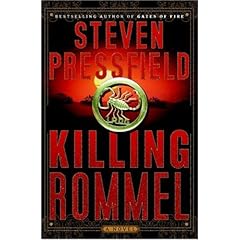
GoodReads.com posted an interesting interview with fellow Oregonian, Steven Pressfield. His current book is entitled "Killing Rommel" about the efforts of the British Long Range Desert Group (I think this group was the basis for the TV series "Rat Patrol") to assassinate the "Desert Fox" in WWII. This is quite a departure from the ancient world that has been his focus in "Gates of Fire", "Tides of War", "The Virtues of War", and "The Afghan Campaign".

In the course of the interview, though, he explained his theme and reasons for writing "Gates of Fire", one of my favorite books, as it pertains to members of the modern military that I found very thought provoking and inspiring:

"Randy, a Goodreads member and Marine comments, "Pressfield uses the battle of Thermopylae...as a backdrop for studying the psychological makeup of what a soldier should be. This is a great book for anyone who is thinking of, or soon will be joining, military service. Those who are confused as to why a friend or loved one wants to join the military can very likely gain their answers from this book." Gates of Fire is required reading at several military schools around the country. Why do you think this is the case? What is it about your book that appeals to the military-inclined mind? Who else could learn from your books?

Steven Pressfield: Gates of Fire has a theme, and the theme is courage. It's also very much about the camaraderie of fighting men and of the warrior ethos. Believe me, this is still alive and well, despite all P.C. efforts to exile it into the past. Today's Marines and soldiers, however, like the rest of us, are woefully undereducated. No one has studied the past, so we all feel as if we're the first people on the planet to be confronting the issues we're confronting. That's where a book like Gates fills a gap. Marines and Army guys read it and realize that the same stuff they're going through has been gone through by a lot of other warriors before them, and that those warriors and the societies they lived in had highly evolved codes of honor and conduct. It gives our young soldiers and Marines a longer historical perspective and inspires them that they're not alone and they're not the first; in fact, they're part of a long and honorable tradition of the profession of arms. It helps!" - more interview