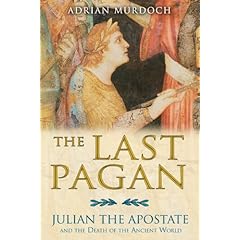
 "Since his death on a Persian battlefield in AD 363, the violent end of the Emperor Julian (Flavius Claudius Julianus, 332-363_ has become synonymous with the death of paganism. Vilified throughout history as the `Apostate', the young philosopher-warrior was the last and arguably the most potent threat to Christianity.
The Last Pagan examines Julian's emergence as the sole survivor of a political dynasty soaked in blood. It traces his journey from an aristocratic Christian Childhood to his initiation into pagan cults and his mission to establish paganism as the dominant faith of the Roman world."
I've been interested in Julian ever since I read Michael Curtis Ford's novel "Gods and Legions". It, too, was a sympathetic portrait of the last pagan Roman emperor. So, when I was researching Adrian Murdoch's work, "The Last Roman: Romulus Augustulus and the Decline of the West' and noticed he had also written about Julian the Apostate, I couldn't help but order it to have a look. I also got a great buy up at the David Brown Book Company - only $6.98!
I found a very interesting "Meet the Author" interview up at OxBow Books. An excerpt:
"Constantine’s reign is usually heralded as a golden age and is celebrated as the beginning of the Christian era. The Last Pagan adopts a different approach, mourning the death of antiquity. Is this how you feel? Very much so. The Emperor Julian has often been portrayed as an anomaly and regarded with slight embarrassment. It’s useful I think to change historical perspective. Instead of seeing Julian as the young man who came along and upset a Christian empire, he stood at the end of a line of Roman emperors.
At the same time, one of the premises with which I started the book is that while Constantine is conventionally heralded as the great hero and saviour of the empire, as a person he’s always appeared to me as a cynical and ruthless political operative. A deeply unpleasant man. It was natural, I suppose, to make Julian’s actions and values stand in contrast to those of Christian relatives.
 Julian died aged only 31. Do you think that he had the qualities as a ruler to have shaped history if he had lived longer?
Arguably the largest problem for any biographer is that you have the benefit of hindsight – you know how the story ends. The challenge is to remember this and to stop seeing your subject’s fate as preordained. It’s too easy to see portents of doom wherever you look. This is especially true of Julian as all of the contemporaries tripped over themselves to editorialise his fate: his supporters painted him as a tragic hero and his opponents saw him as doomed from the moment of his apostasy.
If I’m being honest, even had Julian survived the war he might not have survived the peace. Religion has always attracted extremists, and it’s unlikely that Julian and his Christian opponents could have found any kind of middle ground. Plots to murder the emperor were uncovered before his death and so impassioned was the opposition to Julian’s religious reforms that I suspect one assassination attempt would have succeeded before too long.
The Last Pagan remembers a time when conflict over religion was rife, coming to a head on a battlefield in present-day Iraq. Did these parallels with recent events inspire you to choose Julian the Apostate as your subject?
Although I’d originally planned to draw parallels with the First Gulf War, the chapters on Julian’s invasion of Persia were written to a background of the build-up to the current conflict in Iraq. As Western governments began their build-up to what was obviously going to be an invasion last year, the parallels with Julian’s campaign made for distinctly uncomfortable writing – a foreign policy dictated by domestic necessity; support for the invasion from what is now Israel and the Gulf Arabs; debates about an illegal arms trade with Persia – swords of mass destruction if you will; a media campaign to encourage popular support for the war; even the fact that one of the most vocal opponents to the war was the administrator of Gaul. With Julian’s fate in mind (and the fact that his opponent outlasted his rule by some sixteen years) it is hard not to be discouraged about what the future holds.
Do you think that Roman paganism has any relevance for everyday life in the 21st century?
It’s more that the big questions that dominated Julian reign – the search for belief and the question of religious tolerance – are centre stage once more in the modern world. It’s easy to see similarities between Julian’s lack of comprehension of Christianity and the West’s frequent blindness to the Islamic world. It remains a historical irony that where Christianity was once the persecuted minority, it is now all-too often perceived as the aggressor.
At the same time, Julian’s search for his own faith as a young man mirrors the disillusionment and confusion that many today have with organised religion and the search for alternative forms of worship – a case in point is the startling growth in the interest in paganism over the past few years." - More
I'm not a big fan of Constantine either so I found Mr. Murdoch's comments quite interesting.
I also got "The Last Roman" since I wanted to read more about this era that essentially marked the formal end of the Roman Empire, especially after reading my friend, Boris Raymond's historical novel, "The Phoenix Circle" in which Orestes and Odovacar (
Odacer) play major roles.

 "In A.D. 381, Theodosius, emperor of the eastern Roman empire, issued a decree in which all his subjects were required to subscribe to a belief in the Trinity of the Father, Son and Holy Spirit. This edict defined Christian orthodoxy and brought to an end a lively and wide-ranging debate about the nature of God; all other interpretations were now declared heretical. It was the first time in a thousand years of Greco-Roman civilization free thought was unambiguously suppressed. Why has Theodosius's revolution been airbrushed from the historical record? In this groundbreaking book, acclaimed historian Charles Freeman argues that Theodosius's edict and the subsequent suppression of paganism not only brought an end to the diversity of religious and philosophical beliefs throughout the empire, but created numerous theological problems for the Church, which have remained unsolved. The year A.D. 381, as Freeman puts it, was "a turning point which time forgot."


