Showing posts with label Theodosius. Show all posts

Wednesday, January 13, 2010

A.D. 381: Heretics, Pagans, and the Christian State By Charles Freeman

AD 381"In A.D. 381, Theodosius, emperor of the eastern Roman empire, issued a decree in which all his subjects were required to subscribe to a belief in the Trinity of the Father, Son and Holy Spirit. This edict defined Christian orthodoxy and brought to an end a lively and wide-ranging debate about the nature of God; all other interpretations were now declared heretical. It was the first time in a thousand years of Greco-Roman civilization free thought was unambiguously suppressed. Why has Theodosius's revolution been airbrushed from the historical record? In this groundbreaking book, acclaimed historian Charles Freeman argues that Theodosius's edict and the subsequent suppression of paganism not only brought an end to the diversity of religious and philosophical beliefs throughout the empire, but created numerous theological problems for the Church, which have remained unsolved. The year A.D. 381, as Freeman puts it, was "a turning point which time forgot."

 An Introduction to Roman Religion   Religion in the Roman Empire (Blackwell Ancient Religions)   Religions of Rome: Volume 2: A Sourcebook   Pagan Theology: Paganism as a World Religion   Her Share of the Blessings: Women's Religions among Pagans, Jews, and Christians in the Greco-Roman World   Myths and Symbols in Pagan Europe: Early Scandinavian and Celtic Religions

Saturday, October 24, 2009

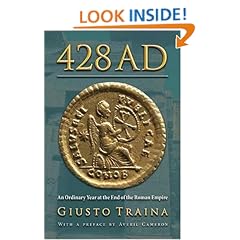
428 AD: An Ordinary Year at the End of the Roman Empire


This is a sweeping tour of the Mediterranean world from the Atlantic to Persia during the last half-century of the Roman Empire. By focusing on a single year not overshadowed by an epochal event,428 AD provides a truly fresh look at a civilization in the midst of enormous change--as Christianity takes hold in rural areas across the empire, as western Roman provinces fall away from those in the Byzantine east, and as power shifts from Rome to Constantinople. Retracing the kind of route a contemporary gazetteer might have taken, Giusto Traina describes the empire's people, places, and events in all their simultaneous richness and variety. The result is an original snapshot of a fraying Roman world on the edge of the medieval era.

Readers meet many important figures, including the Roman general Flavius Dionysius as he encounters a delegation from Persia after the Sassanids annex Armenia; the Christian ascetic Simeon Stylites as he stands and preaches atop his column near Antioch; the eastern Roman emperor Theodosius II as he prepares to commission his legal code; and Genseric as he is elected king of the Vandals and begins to turn his people into a formidable power. We are also introduced to Pulcheria, the powerful sister of Theodosius, and Galla Placidia, the queen mother of the western empire, as well as Augustine, Pope Celestine I, and nine-year-old Roman emperor Valentinian III.

Full of telling details, 428 AD illustrates the uneven march of history. As the west unravels, the east remains intact. As Christianity spreads, pagan ideas and schools persist. And, despite the presence of the forces that will eventually tear the classical world apart, Rome remains at the center, exerting a powerful unifying force over disparate peoples stretched across the Mediterranean.