Showing posts with label Roman Republic. Show all posts

Thursday, June 23, 2011

Review: Master of Rome by John Stack


The glamor surrounding Hannibal and his amazing trek through the Alps with a cadre of elephants during the Second Punic War has captivated history buffs for so long that the First Punic War has been virtually overlooked by many historical novelists.  Likewise, although many authors have written thousands of pages about Rome's fierce legions, Rome's first tentative efforts to build a navy and develop seamanship that would eventually rival Carthaginian mariners who had ruled the Mediterranean for centuries have been largely ignored as well.   But Irish author John Stack has redressed  both of these oversights in his "Masters of the Sea" series of novels.

I was unaware of Stack's efforts until the third book in his series, "Master of Rome", popped up in the available titles on Audible.com.  As I am always on the lookout for stories set in the ancient world, I immediately selected it as one of my choices and was pleased to discover that its story focussed on the naval battles of the last years of the First Punic War.

The story's protagonist, a Greek born Roman prefect named Atticus Perennis, has honed his seamanship fighting pirates (which I learned later is covered by the first book in the series, Ship of Rome) and has learned to use the corvus, a boarding ramp introduced by the Romans to allow them to take advantage of land-type assault maneuvers at sea, to deadly effect.
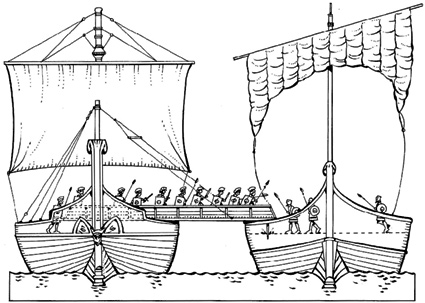
The Roman corvus, a boarding ramp anchored to the enemy
ship by a sharp spike, is estimated to have weighed over
a ton causing severe instability in rough seas.  Though 
advantageous under the right conditions, it was ultimately
abandoned after the loss of an entire fleet in a storm following
the battle of Cape Ecnomus during the First Punic War.


I had known about the corvus from earlier studies but didn't realize that it was actually used for only a few years during the First Punic War because of the massive loss of ships in a storm following the brilliant Roman victory at the battle of Cape Ecnomus.

Perennis commands one of the few ships that survive the storm and is assaulted by charges of incompetence when he returns to Rome to report the loss to the senate.  We learn that in earlier novels Perennis has apparently made a powerful enemy in the form of Gnaeus Cornelius Scipio Asina who earned his cognomen "Asina" meaning "donkey" when, as the first Roman fleet commander, he led an ill-conceived rush to take possession of the Lipari Islands and was subsequently captured by the Carthaginians.   Since I had read only about the glory of the Scipioni in regards to the Second Punic War and the ultimate defeat of Hannibal, I was surprised to learn that the family had someone in the family tree much less militarily successful.  A little research revealed that he was actually a brother to Lucius Cornelius Scipio who begat the much more glorious line of descendants.
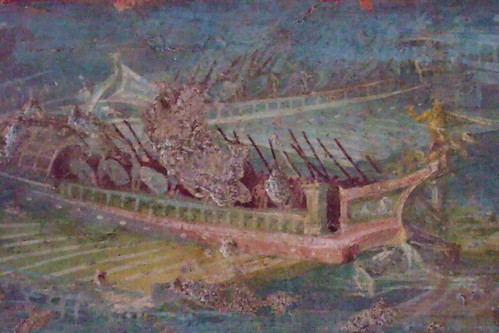
Roman galley depicted in a fresco recovered from Pompeii, 1st century BCE -
1st century CE.  Photographed by Mary Harrsch at the Archaeologico Nazionale 
di Napoli in Naples, Italy.


Fortunately, Perennis has a powerful Senator in his corner, and he survives the spurious charges and is placed in command of a new fleet no longer equipped with the corvus.  But this change brings the Romans back to their original problem.  How do they overcome the supremely skilled Carthaginian seamen?   To make matters worse, Scipio Asina is elected consul and ignores any advice Perennis offers to help the Romans achieve victory.

Perennis trains his men furiously but even the most brutal training schedule cannot equal the skills acquired and handed down for centuries by generations of Carthaginian sailors.  However, Perennis manages to maintain a blockade of the city of Panormus and Scipio's legions eventually breach the city's defenses.  But the Carthaginian defense is spearheaded by Greek mercenaries so Scipio refuses to acknowledge Perennis' crucial contributions to the ultimate Roman victory.

In the meantime, Hamilcar Barca has hired another of Perennis' wily countryman from Rhodes to slip through the Roman blockade and keep Barca informed of Roman dispositions of ships and legions.
This Rhodian, a  real historical figure named Hannibal the Rhodian, was almost equal to Perennis in command seamanship and Perennis has to employ every ounce of his mariner's skill as well as a cuning ruse to finally overwhelm the Rhodian's sleek quadreme when the Rhodian attempts once again to run the Roman blockade.  (I noticed in my research that the Rhodian's ship is thought to have been used subsequently as the model for faster Roman ships as the war progressed.)

The Rhodian's capture yields valuable intelligence about the location of the main Carthaginian fleet at Drepana and Scipio Asini is once again, all too quick to jump on the opportunity to grab a fistful of glory and orders a night voyage to surprise the Carthaginians.

Battle of DrepanaImage via Wikipedia

For the sake of historical accuracy, I must point out that in history, Publius Claudius Pulcher, not Scipio Asini, was consul by then, and it is Pulcher who supposedly threw the uncooperative sacred chickens overboard when they refused to eat during the auguries before the battle of Drepana, declaring "Bibant, quoniam esse nolunt " - "Let them drink, since they don't wish to eat!".  Stack includes this bit of theater in his story although some scholars point out that it was only referenced indirectly by Cicero and not documented by Polybius, recognized as the definitive ancient source on the Punic Wars, so  whether it really happened is questionable.

Some reviewers have criticized Stack's consolidation of some of the Roman commanders but I think he meant to streamline the story to improve pacing and allow the reader to focus on the actions of  the main protagonist and antagonists.  Stack also simplifies the Carthaginian command structure by having Hamilcar Barca, Hannibal's father, in primary command of all Carthaginian forces, including the fleet.  In reality, Hamilcar Barca commanded the land forces and did not possess the level of naval acumen attributed to him by Stack in this story.   However, since the story was so engaging I was obviously motivated to research the time period and battles covered further so I gained an understanding of the real details eventually anyway.

Hoping to surprise the Carthaginians, the Roman consul plans to sail under cover of darkness and trap the Carthaginians inside the harbor.  But, Perennis feels his crews are not experienced enough to maintain battle formation at night.  However, Perennis is once again ignored as orders are given to set sail for Drepana.  As Perennis predicted, the ships are soon strung out in a long disorderly line and are spotted by the Carthaginians as they approach the harbor.  The Carthaginians not only escape the trap but turn the tables on the Romans and destroy almost the entire fleet.

But the ever tenacious Romans once again rebuild their fleet and exact their revenge at the Battle of the Aegates Islands, the rousing climax of the novel.

Although a relatively new author, Stack demonstrates a command of the history of the era and the cultures involved coupled with the crucial ability to people his stories with vibrant personalities as well.  I have little doubt that Stack will eventually be ranked among such bestselling historical fiction writers as Conn Iggulden and Harry Sidebottom.

Furthermore, I found Stack's ability to conjure up the terrifying ferocity of an ancient naval engagement with its splintering oars, screaming crewmen, shuddering timbers and gore-slickened decks absolutely riveting.  I definitely plan to go back and read the other books in this series.

An excellent summary of the battles immediately preceding and including the events in this novel can also be read here.


Enhanced by Zemanta


Friday, April 03, 2009

Review: The Forgotten Legion by Ben Kane


James Rollins, author of “The Last Oracle” exclaims, “What Wilbur Smith did for Egypt, Kane does for Rome!”. I’ve only read two of Wilbur Smith’s novels, “The Seventh Scroll” and “River God” but the narrative style of these two novels is quite similar to the storytelling technique used by Ben Kane in this first of a projected series of novels featuring heroes developed in this work.

Kane introduces each character in their own unique context within the boundaries of the Late Roman Republic. We first meet Tarquinius, one of the last of the Etruscan haruspices (soothsayers), raised as a poor freedman on a large latifundia owned by a politically ambitious patron with ties to the richest man in Rome at the time, Marcus Licinius Crassus. Warned by his tutor to escape to the east where he will find his destiny, Tarquinius abandons his home and joins the forces of Lucullus fighting Mithradates in Asia Minor.

Next we meet Brennus, a towering Gallic warrior whose people are crushed by the legions of Julius Caesar. The only survivor of his village, he is taken in chains to Rome where he is sold to the largest gladiatorial school in the capital.

Then we meet the twin brother and sister slaves, Romulus and Fabiola, the spawn of Julius Caesar and a slave girl he ravaged on the streets of Rome when coming home from an evening of revelry with his friends. The twins’ cruel owner, a less-than-profitable merchant in debt to the greedy Crassus, sells the 14-year-old twins, sending Romulus to the gladiator school and Fabiola to the Lupanar – the most prestigious brothel in Rome.

Romulus has fortunately received some earlier training with a sword from his former owner’s steward and is taken under the wing of the brawny Brennus. Fabiola, of course irresistibly beautiful, is tutored by the madame and fellow prostitutes at the Lupanar and becomes the most sought after “companion” in the establishment as well as the regular lover of Caesar’s lieutenant Decimus Brutus.

Romulus swears one day to free his sister and take revenge on his former owner who sold their worn out mother to the salt mines, ensuring her death.

At this point I’m sure you’re thinking this is beginning to sound like a melodramatic made-for-television movie and I would probably agree with that assessment.

Brennus and Romulus sneak out of the gladiator school for an evening’s entertainment and are implicated in the death of a Roman nobleman who just happens to be the hated former patron of Tarquinius. To escape crucifixion, the two flee south where they hear Crassus is assembling an army to invade Parthia. In Brundisium, they meet Tarquinius and our ensemble cast is finally ready to get into some serious trouble in the deserts of Syria where Crassus will meet his inevitable fate at the battle of Carrhae, the climax of this first installment.

Kane obviously knows the rudimentary history of the late Roman Republic and its key players and his characters have some depth. I like the way he interjects the occasional Latin term into the narrative in a context that clearly reveals its meaning without delivering a specific definition. This is the natural way that people learn another language and his use of the technique is appreciated.

However, some background details of Roman culture and some of the scenarios developed in his narrative were grating to me because of my previous studies. As an admirer of Julius Caesar and someone who has read a number of biographies about him, I could not swallow the premise that Caesar would demean himself in public by raping a passing slave girl. First of all, Caesar was abstemious in his dining and drinking habits and meticulous about his personal hygiene so was not the type to participate in public drunken revelries – even as a young man. Second, Caesar prided himself on being a sought after lover. His sexual appetites were well satisfied by his numerous paramours with other men’s wives, whether his own wife was ill or not.

Then Romulus narrowly escapes being run over by an ox cart in the streets of Rome in the middle of the day. I had previously read that wagons and carts were forbidden by law to enter Rome until after dark. I mentioned this to my friend Pat Hunter, author of “Immortal Caesar,” and she told me that she thought the legislation was passed after Caesar returned from Gaul so this criticism may be unjustified.

Later, Romulus defeats an experienced and successful gladiator in a “duel” at the gladiator school. It is hard for me to believe that a 14-year-old boy with occasional training with a sword could defeat a veteran gladiator in single combat on his first outing. Gladiators were burly, barley-fed brutes (how’s that for alliteration!) whose body mass alone would have nearly guaranteed victory in such an encounter. Perhaps Kane was trying to appeal to a younger demographic with that one.

Then, I seriously doubt that a Roman noble, irregardless of how besotted he was with a beautiful prostitute, would have taken her to a formal Roman dinner party. I realize Rome had become Hellenized to some extent since the second Punic War but prostitutes from a brothel were not treated as Greek heitera in Roman social circles. He also would not have taken her to Roman gladiatorial contests or at least not sat with her and discussed combat tactics. Women were relegated to the uppermost seats, totally segregated from the men at Roman games, or at least they were less than a century later when the Flavian amphitheater (Colosseum) was built.

Kane also explained that only the most blood-thirsty Romans stayed for the gladiator bouts late in the afternoon, after watching the beast hunts and executions. This was laughable, as the gladiator contests were viewed as the climax of the entire experience. If anyone left, it was to grab a bite to eat at lunch during the criminal executions.

But, despite these perceived historical missteps, Kane spun a good yarn. I would agree with Rollins that the story was engaging, although “visceral”, no, not after reading one of Bernard Cornwell’s battle sequences in which his protagonist slashes wildly with a battle ax, wiping the spray of blood from a severed artery out of his eyes and flicking a fragment of bone and brain from his cheek – I was listening to Bernard Cornwell’s “Agincourt” during my morning workout at the same time I was reading the hard copy of “The Forgotten Legion” in the evening. Now that is my idea of visceral!

Rome's Cultural Revolution


I always love watching Professor Andrew Wallace-Hadrill discuss ancient Rome on the History Channel because he so obviously enjoys his work and is genuinely fascinated by Roman culture and civilization. Every time I visit Pompeii I hope I will run into him there but so far I have not been so fortunate!

The period of Rome's imperial expansion, the late Republic and early Empire, saw transformations of its society, culture and identity. Drawing equally on archaeological and literary evidence, this book offers an original and provocative interpretation of these changes. Moving from recent debates about colonialism and cultural identity, both in the Roman world and more broadly, and challenging the traditional picture of 'Romanization' and 'Hellenization', it offers instead a model of overlapping cultural identities in dialogue with one another. It attributes a central role to cultural change in the process of redefinition of Roman identity, represented politically by the crisis of the Republican system and the establishment of the new Augustan order. Whether or not it is right to see these changes as 'revolutionary', they involve a profound transformation of Roman life and identity, one that lies at the heart of understanding the nature of the Roman Empire.

Andrew Wallace-Hadrill is Professor of Classics at the University of Reading and has been Director of the British School at Rome since 1995. His previous books are Suetonius: The Scholar and his Caesars (1983), Houses and Society in Pompeii and Herculaneum (1994) and Domestic Space in the Roman World (co-edited with Ray Laurence, 1997). He is currently directing a major project on a Pompeian neighbourhood with Michael Fulford and, since 2001, has directed the Herculaneum Conservation Project. He frequently contributes to radio and television programmes on various aspects of Roman life and in 2004 was awarded an OBE for services to Anglo-Italian cultural relations.

Monday, November 10, 2008

Robert Harris' second novel about Cicero due this month


I noticed with excitement that "Conspirata", Robert Harris' second novel about the career of famous Roman politician Marcus Tullius Cicero is due out this month. I also see that it will be available on audio CD so hopefully I'll be able to get the audio version up on audible.com as well.

All I could find out about the plot was this rather generic blurb up on the Audio Editions website (Amazon, surprisingly, had nothing but a note that it was not yet available):

"Cicero returns to continue his quest for supreme power in the state of Rome. Amid treachery, vengeance, violence, and treason, he finally reaches the summit of all his ambitions: he becomes the world's first professional politician, using his compassion and cunning to overcome all obstacles. By the author of Imperium."

I'll have to be sure to email my son about it. He surprised me recently in a phone call telling me how much he enjoyed "Imperium". He's not normally a fan of historical fiction (he, himself, writes sci-fi) so I'm not quite sure what prompted him to read it except curiousity about what could be prompting his mother's fanatical obsession with the Roman Empire

Friday, August 22, 2008

Philip Freeman's "Julius Caesar": A Review


by Mary Harrsch

Philip Freeman's "Julius Caesar" is a comprehensive biography of the Roman conqueror that is as straightforward and readable as the general's own "Gallic Wars". Freeman not only stitches together the various ancient accounts of Caesar's exploits but adds context to his activities by including helpful background information about his various adversaries pulled from a wealth of modern scholarship. He recounts Caesar's conquest of the Celtic tribes of Gaul against a vivid tapestry of the Celtic culture gleaned from such works as Rankin's "Celts and the Classical World, Cunliff's "The Ancient Celts", and Green's "The World of the Druids". I especially found the defeats or near-defeats suffered at the hands of the Celts as fascinating as Caesar's famous victory at Alesia.

The details of a surprise attack by Belgic tribes was particularly intense and sadly ironic because Caesar was essentially saved by his future Civil War opponent, Labienus.

"He [Caesar] had been caught unprepared for a surprise assault of such force and speed. His army would surely have been overwhelmed had it not been for the training and experience they had gained during the past year. There was no time to call his officers together and form a plan , so each organized whatever men were nearest and struck back at the Belgae. With a herculean effort, the Roman troops on the eastern side of the battlefield were able to push the Atrebates and then the Vironmandui back across the river with heavy losses on both sides, but the Nervii on the western end would not yield and pressed the Romans until they fell back in a hopeless struggle to save their camp. The Nervii stormed over the uncompleted walls of the Roman stronghold, killing many of the legionaries and threatening to outflank the Roman forces who had already crossed the river. Caesar had been rushing madly to every corner of the battlefield, but when he saw the dire threat at the camp, he leapt from his horse, grabbed a sword, and joined the fray."

Although Caesar's men rallied with their commander beside them calling them by name, their plight was dire. They managed to stop the encirclement and were presently reinforced by the the arrival of the two legions that had escorted the baggage train. But the real turning point of the battle hinged on the counterattack led by Labienus who, seeing Caesar's desperate struggle, dashed back across the river.

"His arrival brought such hope to the beleaguered men around Caesar that even those who had been seriously wounded propped themselves against their shields for support to continue to fight."

With the tide of battle now turned the Belgic warriors demonstrated their own ferocity and determination to remain an unconquered people.

"As the hours passed, the Romans slowly tightened the circle on them, hacking and killing as each Belgic warrior fought with all his might. In the end, the few Nervii who were left stood on a mound formed by their fallen comrades and - pulling the Roman spears from the dead bodies of their friends - threw them back down at the legions."

These images brought echoes of Thermopylae to mind.

Many critics of Caesar's activities in Gaul have portrayed Caesar and his commanders as ruthless perpetrators of genocide without significant provocation but Freeman, using the details of engagements retold in Caesar's Gallic Wars, recounts numerous incidents of Gallic duplicity after peace agreements were concluded. But Freeman also points out that Caesar did not delude himself with proclamations that he was bringing "civilization" to the Gauls. Instead he said Caesar candidly observed, "Human nature everywhere yearns for freedom and hates submitting to domination by another."

"The Romans never pretended that they were bringing freedom or a better way of life to the peoples they conquered." Freeman states. "They frankly admitted that they were only interested in increasing their own power, wealth, and security through conquest."

I have previously only read isolated passages of accounts of Caesar's Alexandrian Wars so I also found that portion of Freeman's book particularly fascinating. Many books and films about this period seem to omit most references to intervention by Cleopatra's sister Arsinoe and her commander Ganymedes. Many accounts of the confrontation between the Alexandrians and Caesar seem to focus on the activities of the Egyptian general Achillas and the spoiled child-pharaoh Ptolemy XIII. But Freeman recounts how Achillas was actually murdered by Ganymedes and most of the near disasters suffered by Caesar's forces, beseiged in the palace, were masterminded by this militarily astute courtier. Freeman also details the urban warfare that Caesar was forced to conduct in Alexandria that sounded eerily familiar to anyone who watches CNN regularly. I was also surprised to read that the often-portrayed luxurious "honeymoon" cruise up the Nile was a deliberate show of military force since the royal barge was accompanied by over 400 ships crammed with Roman troops. I am now more convinced than ever that Caesar's effort to father a child with Cleopatra was a deliberate act to obtain a client king related by blood to secure Egypt without annexing it and risking its plunder by a corrupt proconsular governor in the future.

Freeman mentioned Caesar's epilepsy only in passing early on in the text. This surprised me since I have long suspected that a head wound Caesar sustained on campaign was actually the cause of the increased frequency of seizures Caesar suffered toward the end of his life and perhaps one of the reasons for the apparent lack of political judgment he exercised at the time of the Africa triumph when he included unpopular tableaus depicting the deaths of Scipio and Cato. Freeman only observed that Caesar showed particularly bad taste in celebrating a triumph over his Roman opponents and how this had upset his normally adoring crowd. There were at least four significant seizures documented by the ancient sources (Plutarch, Suetonius, Appian, and Pliny) that modern experts conclude, according to J. R. Hughes, Department of Neurology, School of Medicine, University of Illinois at Chicago, "were probably complex partial seizures: (1) while listening to an oration by Cicero, (2) in the Senate while being offered the Emperor's Crown, and in military campaigns, (3) near Thapsus (North Africa) and (4) Corduba (Spain)."

Drs. J.G Gomez, J.A. Kotler, and J.B. Long, Division of Neurological Surgery, Holy Cross Hospital, Fort Lauderdale, Florida, conducted a pathological analysis of Caesar's reported symptoms and behavioral changes in 1995 and suggested he may have been suffering from a brain tumor. "The patient had late onset of seizures in the last two years of his life, headaches, personality changes. Upon reexamination of existing Julius Caesar iconography, busts, statues and minted coins no skull deformities have been noted. Identification of a skull deformity as described by Suetonius would have confirmed the suspicion of meningioma involving the convexity of the cerebral hemispheres. Meningioma or slow-growing supratentorial glioma may well have been responsible for this man's illness."

In any event, I think a man who had demonstrated such a superior grasp of Roman politics in the past would not have committed such blunders on purpose or because success had simply "gone to his head".

Freeman included a wonderful compedium at the end of the book that listed his sources for various sections within the text that is a valuable reference for readers wishing to learn more about specific events in Caesar's life. A comprehensive bibliography and index rounded out the text's impressive list of source materials. There were only two things contained in the book that gave me pause. One was a reference to a pilum not being designed as a throwing weapon but rather a thrusting weapon. I think this must have been a lapse in editing as Freeman was comparing Roman weapons with other weapons of the ancient world. Alexander's Macedonians carried sarissas, that, unlike commonly used Greek spears, were not designed for throwing but for thrusting. Likewise, the Roman gladius was designed for thrusting rather than slashing. But a Roman pilum was designed to bend on impact to make it difficult to remove and Freeman pointed this out. So, I would think a weapon so designed was obviously intended primarily for throwing. The other error was the inclusion of an image of a sculptured head of Lucius Cornelius Sulla labeled as Gaius Marius in the photo insert section. It was provided by the Bridgeman Art Library and perhaps the labeling error was theirs. The head is in the permanent collection of the Glyptotek in Munich, Germany as indicated but according to an overwhelming majority of people on the web, including the scholars who maintain Vroma.org, the head belongs to Marius' arch enemy, Sulla. See http://www.vroma.org/~bmcmanus/optimates.html.