Showing posts with label Rome. Show all posts

Friday, April 03, 2009

Augustus: A modest first among equals? I think not.


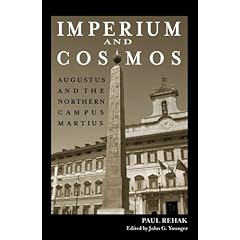
When I read the product description of this book by Paul Rehak, scheduled for release April 8, I was pleased to see that someone besides me thinks Augustus was not as interested in being viewed as a modest citizen as many historians have suggested. I just returned from Rome a few weeks ago and while there had a chance to view the new rooms of the villa of Augustus on the Palatine that have been recently restored and saw nothing "modest" about them. They were as richly frescoed as most sumptuous villas of the wealthy that have been unearthed in Pompeii or Oplontis. You also can't help but be awestruck by the ornate naturalistic murals of a subterranean room from the villa of Livia recreated in a gallery of the National Museum in Rome either. Each time I see them I feel they envelope a visitor in a sense of luxury as real as if you were left to stroll in a richly planted peristyle garden.

"Caesar Augustus promoted a modest image of himself as the first among equals (princeps), a characterization that was as recognized with the ancient Romans as it is with many scholars today. Paul Rehak argues against this impression of humility and suggests that, like the monarchs of the Hellenistic age, Augustus sought immortality—an eternal glory gained through deliberate planning for his niche in history while flexing his existing power. Imperium and Cosmos focuses on Augustus’s Mausoleum and Ustrinum (site of his cremation), the Horologium-Solarium (a colossal sundial), and the Ara Pacis (Altar to Augustan Peace), all of which transformed the northern Campus Martius into a tribute to his major achievements in life and a vast memorial for his deification after death.

Rehak closely examines the artistic imagery on these monuments, providing numerous illustrations, tables, and charts. In an analysis firmly contextualized by a thorough discussion of the earlier models and motifs that inspired these Augustan monuments, Rehak shows how the princeps used these on such an unprecedented scale as to truly elevate himself above the common citizen. "

Wednesday, December 31, 2008

The Gladiators from Capua: A Review

by Mary Harrsch

I just finished listening to Caroline Lawrence's novel for young adults (grades 5-8) "The Gladiators from Capua" and found it both exciting and illustrative of both the Roman cultural attitudes towards bloodsport and the daily life of those involved in the production of Roman games and entertainments. The story's young heroes and heroines, each an interesting individual, acted maturely and, despite my own age, I felt like I was a companion to them as they searched the dank recesses of the Flavian amphitheater searching for a friend hiding among the ranks of the gladiators to escape execution as an arsonist. I found their youthful enthusiasm refreshing compared to the often bellicose and cyncial Marcus Didius Falco featured in adult mysteries by Lindsey Davis.

Inspired by Martial's accounts of Roman spectacles, Lawrence pulled no punches in depicting the brutality of theatrically presented executions and the bleak life of those condemned to serve as slaves in the squalor of the hypogeum. But she also revealed the glamorous life of successful gladiators so the readers could understand why men would choose to become professional fighters and members of a gladiatorial familia.

Lawrence presented the lives of the privileged sharply contrasted with the lives of the lowest classes in Roman society and even mixed in a touch of political intrigue and the social machinations that concerned the emperor Titus as he tries to govern the sometimes fickle Roman mob and thwart the power plays of his brother Domitian. The resulting story kept me as enthralled as many adult novels and provided an insightful slice of Roman life in the Flavian period that I think would encourage any child (or adult) to want to learn more about the classical world.

Seattle educator B. Goh observes, "The protagonists--all children--adroitly negotiate a morally difficult world where men, womnen and even children are victims of spectacular (and bloodthirsty) games in the Flavian amphitheater. However, the narration is also quite sensitive to the young reader's possible reactions, and sympathetic views are always heard from at least one character. The subject of personal loss and family tragedy is well explored here. I'm not a a mental health professional, but this books feels like the type that might help a child who has had to cope with the loss of a loved one. I've read every book in the series and as an educator in literature, I highly recommend it, and also the other books in the series."

Although this was my first exposure to Lawrence's work, the novel is actually the sixth in her Roman mysteries series. I definitely look forward to reading more adventures of these intrepid young sleuths.

Monday, November 10, 2008

Robert Harris' second novel about Cicero due this month


I noticed with excitement that "Conspirata", Robert Harris' second novel about the career of famous Roman politician Marcus Tullius Cicero is due out this month. I also see that it will be available on audio CD so hopefully I'll be able to get the audio version up on audible.com as well.

All I could find out about the plot was this rather generic blurb up on the Audio Editions website (Amazon, surprisingly, had nothing but a note that it was not yet available):

"Cicero returns to continue his quest for supreme power in the state of Rome. Amid treachery, vengeance, violence, and treason, he finally reaches the summit of all his ambitions: he becomes the world's first professional politician, using his compassion and cunning to overcome all obstacles. By the author of Imperium."

I'll have to be sure to email my son about it. He surprised me recently in a phone call telling me how much he enjoyed "Imperium". He's not normally a fan of historical fiction (he, himself, writes sci-fi) so I'm not quite sure what prompted him to read it except curiousity about what could be prompting his mother's fanatical obsession with the Roman Empire

Saturday, October 18, 2008

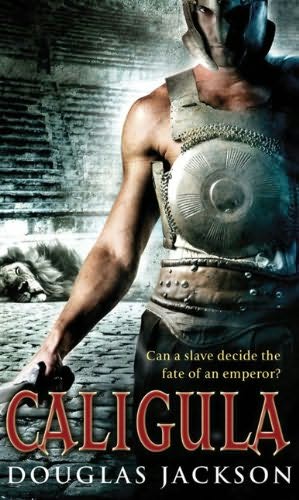
Caligula: The Tyranny of Rome by Douglas Jackson


Gaius Julius Caesar Augustus Germanicus, the third Roman Emperor, is better known by another name: Caligula, a name synonymous with decadence, cruelty and madness. His reign was marked by excess, huge building projects, the largest gladiatorial battles Rome was ever to see - men and animals killed in their hundreds - conspiracies, assassination attempts and sexual scandal. Rufus as a young slave grows up far from the corruption of the imperial court. His master is a trainer of animals for the gladiatorial arena. Rufus discovers that he has a natural ability with animals, a talent for controlling and schooling them. It is at the arenas that Rufus meets his great friend Cupido, one of Rome's greatest gladiators. It is his growing reputation as an animal trainer and his friendship with Cupido that attracts the cruel gaze of the Emperor.Caligula wants a keeper for the imperial elephant and Rufus is bought from his master and taken to the imperial palace. Life here is dictated by Caligula's ever shifting moods. Caligula is as generous as he is cruel, he is a megalomaniac who declares himself a living god and simultaneously lives in constant fear of the plots against his life.Technorati Tags: , , , , , ,

Friday, August 17, 2007

Steven Saylor's "Roma" focuses on life within the Eternal City

My enthusiasm for Steven Saylor's work dates back to the 1990s when I found a used copy of an audiobook of his detective novel "Arms of Nemesis" at the campus used book store. I found his writing immersed me in the world of 1st century BCE Rome like no one else, with, perhaps, the exception of Colleen McCullough. I snapped up as many of Steven's books as I could and soon felt I was almost a confidante to his hero, Gordianus The Finder. I found his books not only entertaining but filled with fascinating glimpses of events that really happened and served as starting points for me to conduct further research about this empire that our own culture has, in many respects, so closely emulated.

When I heard Steven was shifting gears a little and focusing his efforts on an epic novel, I could hardly wait for it to be released. I was even more pleased to find that the unabridged audio version would be available for download since I have more time on my commute than I have time or energy to read after getting home from work.

I downloaded a copy from Audible.com and embarked on Steven's latest adventure. I was surprised to discover Steven went all the way back to "prehistoric" times to introduce the winged phallus amulet of gold that would become the thread tying each successive generation in the story together.

As the story progresses, I vicariously became a citizen of Roma and experienced its history from a resident's viewpoint. Most novels I have read about the Roman Republic and Empire focus on the military conquests as viewed from the perspective of a famous general or emperor since conquest created the building blocks of Roman civilization. However, the average resident of Roma heard about these great conquests from messengers and gossips in the forum. The cataclysmic events of Cannae or Pharsalus happened out in the distant provinces or on the frontier. They provided interesting fodder for discussion but events within the city itself were of far more immediate concern.

So, "Roma" is filled with vignettes of characters dealing with the political and social turmoil swirling about its citizens within the city from day to day and from one generation to the next. Beneath it all simmers the class struggle between the noble patricians and the common plebians that seems to escalate with each generation. By focusing on events that shaped the culture and belief systems of the Romans themselves, Steven gives us a window into their thoughts as they grappled with the social upheavals that beset their classical world.

My main regret was that, due to the huge span of time covered by the novel, I could not linger with any characters for any length of time. Steven does such a wonderful job of characterization that my brief encounters were populated with fascinating individuals that I regretted leaving so soon, as the story, like the relentless current of the Tiber River, swept me along. It's like being invited to a banquet but being rushed along so that you can only sample a handful of succulent hors d'oeuvres and never get a chance to sit down and relish the main course.

I hope Steven will consider casting some of his character groups into full fledged novels of their own. I particularly liked the slave and Vestal Virgin who became lovers during the first sack of Rome when they were among the few defenders atop the Capitoline Hill. Since I have concentrated most of my study on the late Republican Period, I was unaware of the extent of the first sack. I always assumed the sack was over in a few days like most sacks. I didn't realize it went on for seven long months.

I also did not realize that the Veii question was so disruptive. I knew the Romans had conquered Veii but I assumed they simply added its people to the expanding Republic. I didn't realize the people of Veii were sold away into slavery and the city was left abandoned. Perhaps its people were treated so harshly because of the legendary massacre of the 300 Fabii at Cremora. Anyway, the hotly debated question became whether to rebuild Rome or to transfer her entire population to the empty city of Veii only twelve miles away. These events not only revealed interesting details often overlooked in so-called "epic" novels but provided a rich context to help the reader understand the complexity of the Roman psyche and the politics resulting from it.

The poisoning trials of 331 BCE also served as a basis for another interesting vignette. I had never heard of them before and since I knew Steven based his work on meticulous research I knew that this incident must have a historical basis. So, I researched it further and found a reference to the prosecutions in Livy:

"After many leading citizens had died from the same disease, a slave-girl gave
information to the curule aediles that the reason for this high mortality
was the poisons prepared and administered by the Roman matrons.

On investigation they found about twenty matrons, including patrician
ladies, in the act of brewing poisons, which they declared were
salutary. On being forced to drink their own concoctions to prove
the charges false, they perished by their own wickedness. Following
this, a hundred and seventy more were found guilty of the same
offense."

This incident alone could provide sufficient suspense for a novel in its own right.

I was also intrigued by the interactions among the characters involved with Plautus' playwriting activities. I found the characterization of Publius Cornelius Scipio with his luxurious mane of chesnut hair much more fascinating than the man I imagined when I gazed upon the strained face and bald head of Scipio's extant bust. Steven’s Scipio was truly the personification of a "Roman Alexander".

The vivid portrayal of the riots surrounding the murder of Tiberius Gracchus also brought the turmoil of that period to life for me. As I read about one of the characters making a flailing descent from the Tarpeian Rock, grasping at other men clutching roots and outcroppings in an attempt to break their fall, I couldn't help but visualize their desperation and recall my own view from the promontory the modern Romans advertise as the Tarpeian Rock that overlooks the remains of the Forum Romanum. Then I shuddered at the thought of trying to make my way across a corpse-glutted Tiber to relative safety on the far bank. These images will definitely remain with me in my future studies of this fascinating period of history.
Tuesday, March 13, 2007

Review: Rome's Gothic Wars by Michael Kulikowski

A history text review by  © 2007- 5 stars

I was recently asked by Cambridge University Press to review "Rome's Gothic Wars: From the Third Century to Alaric (Key Conflicts of Classical Antiquity) by Michael Kulikowski. I finally got a chance to begin reading it and find it clearly written and thankfully devoid of the stilted academic jargon that pervades many history texts. As most
of my studies have focused on the Roman Republic, I am learning all kinds of fascinating things about this later period.

For example, I did not realize that there were reports of cannibalism
inside the city of Rome during Alaric's siege. Kulikowski also postulates that one of the stimuli for the beginning of Gothic invasions of the Empire was in response to Caracalla's granting of citizenship to all free residents of the empire. He felt that this action opened up the possibilities for anyone - not just provincial
elites who had gained senatorial rank - to gain the throne.


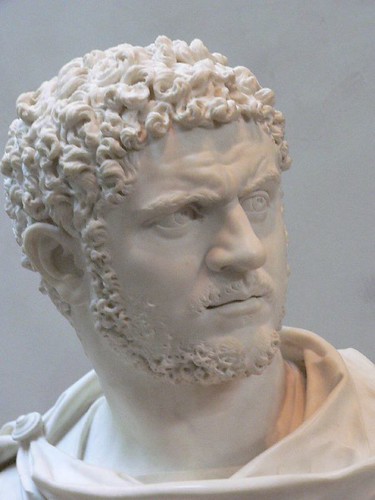
Cavaceppi's 18th century portrait of 2nd
century CE Roman Emperor Caracalla

 photographed at the J. Paul Getty Museum
in Los Angeles, CA
by
© 2005
Evidently, Mr. Kulikowski has another problem with Caracalla. He says in his opinion, much of the civil unrest in Rome itself resulting from the long string of assassinated emperors was triggered unwittingly by Caracalla when he defeated the last Parthian king. This left a power vacuum in the east that was filled by the much more problematic (for the Romans)Sassanids who were not content to control the former Parthian Empire but launched numerous incursions into Roman territory. Less successful responses to these incursions would often result in deposition of the current emperor. Likewise, success would bring a new challenger to the imperial throne.

He also went on to describe the problems created by Roman interference in Barbarian tribal control with Roman subsidy of particular tribal leaders. Although this may have brought temporary loyalty, ultimately it garnered a larger core of support around these subsidized chieftains who would then be in a position to challenge the authority of Rome itself along the frontiers. He pointed out that Decablus was just such an example. The Romans initially subsidized his power base in Dacia.

I found an article that described how this came about:

"In 60 BC, King Burebista of Dacia began a series of expansionistic moves to relieve pressure from nomadic incursions, which eventually threatened Roman Danubian and Black Sea territories. Julius Caesar began to lay plans for a campaign in Dacia and Partha, which came to naught when both Caesear and Burebista were assassinated in 44 BC. Later, during the reign of Nero (54-68 AD), Dacian raids into Roman Moesia became so serious that the Romans engaged the Roxolani to help defend their frontier, thus placing Dacia's sometime Sarmatian allies on their enemies list.
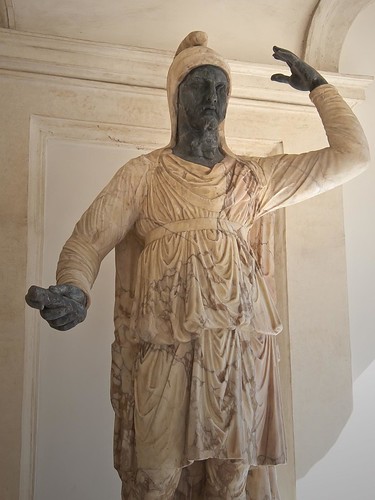
Colossal statue of a Dacian Roman 2nd century CE
photographed at the Palazzo Altemps, Rome, Italy by
 © 2009
In 85 AD, King Decebalus assumed the Dacian throne, adopting a hostile Roman policy that posed a serious challenge to the Emperor Domitian (81-96 AD). A Dacian army raided across the Danube into the Roman province of Moesia, killing the Roman governor and looting the
countryside. This prompted an retaliatory expedition under command of  praetorian prefect Cornelius Fuscus that was wiped out in eastern Dacia (including the loss of Legio V Alaudae) . A second Roman expedition was severely defeated in 87 AD.
Finally, a Roman army under Tettius Julianus defeated the Dacians at Tapae in 88 or 89 A.D. King Decabalus of Dacia was forced to pay tribute and allow Roman armies passage through Dacian territory. Domitian, however, was distracted by Saturninus' Revolt on the Rhine Frontier and uprisings by the Sarmatian Iazyges, Marcomanni and Quaid tribes on Rome's Pannonian frontier. He sought the favor of Decabalus to avoid a Dacian-Sarmatian alliance, offering skilled artisans and hostages to ensure Dacian neutrality while he contended with his other headaches." - DBA Resource, Fanaticus.org 

I couldn't help but think that we certainly didn't learn much from these Roman experiences in political interference since we so recently repeated their mistakes!

Kulikowski, also pointed out something that is important to know if you are reading original historical sources from the period. He says that, even though the Goths contemporaries referred to them as Goths,
historical scholars of the day used the formal designation "Scythians" because the Goths had originated north of the Black Sea in the same region once occupied by the true Scythians recorded by Herodotus.

I also found little controversies pointed out by Michael Kulikowski quite interesting. He appears to be very skeptical of Jordanes narrative of the origin and migration of the Goths from Scandanavia to the Black Sea region ("Getica"). Supposedly, Jordanes sixth century account was based on the lost barbarian histories by Cassiodorus. But Kulikowski maintains that Jordanes work was prepared while attached to the court of
Theodoric so he feels it was meant to provide a glorious history of descent for that monarch and can't be solely relied upon when no other sources are available - much like the skepticism that always surrounds
the narratives by Suetonius.

He went on to say that the connection between the Goths and Scandanavia has been disproved archaeologically but did not elaborate on how. He feels the Goths arose as a result of barbarian
relationships with the Roman army along the frontiers in the third century and that they did not exist as a recognizable cultural group before that time.

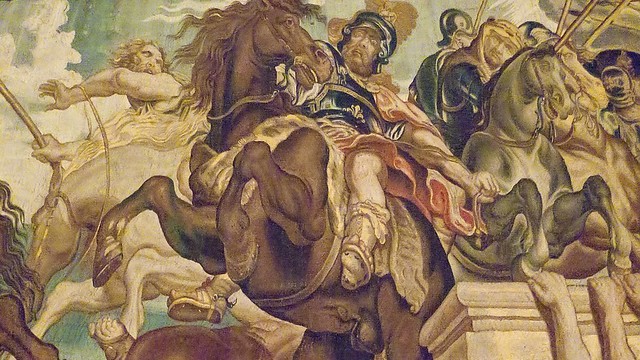
Detail of a tapestry by Peter Paul Reubens depicting Constantine's victory over Maxentius at the battle of the Milvian
Bridge in 312 CE
photographed at the Philadelphia Museum of Art in Philadelphia, PA by © 2011

Kulikowski, also observed that Constantine apparently deliberately shifted from the former emperors' claims to be descended from Hercules to claim a descent from Claudius Gothicus. The author seemed to think this was a way to demonstrate a rejection of pagan philosophies. Richard D. Weigel of Western Kentucky University seems to support the observation that any connection with Claudius Gothicus was a fiction:

"M. Aurelius Claudius, known to history as Claudius Gothicus or Claudius II, was born in either Dalmatia or Illyria on May 10, probably in A.D. 213 or 214, " Wiegel says, "Although the most substantive source on Claudius is the biography in the Scriptores Historiae Augustae (SHA), this account is riddled with fabrications and slanted with fawning praise for this particular emperor, who in the fourth century was viewed as an ancestor of Constantine's father and thus of the ruling imperial family. This biography, attributed to one Trebellius Pollio, must be read with extreme caution and supplemented with information from other sources, including Aurelius Victor, the Epitome de Caesaribus, Eutropius, Orosius, Zonaras, and Zosimus, as well as coins and inscriptions." - De Imperatorabus Romanis
The first one of the two twin bronze busts of ...
The first one of the two twin bronze busts of Claudius II "the Gothic" (268/269 d.C.). The gilded bronze portraits, five of Roman emperors and one of an empress, were hidden beneath the Capitoline temple in Brescia, together with other bronze objects, to prevent the consequences of a possible sack of the town in the 4th or 5th century, and unearthed only in 1826. They are now exhibited in the archaeological Santa Giulia Museum, in Brescia, Italy. (Photo credit: Wikipedia)


Although his reign was short, Claudius Gothicus did appear to be an emperor worth emulating:
"The Gothic challenge in 269 CE proved to be the greatest that Claudius II would face. The Goths assembled a large invading force, reportedly amounting to 320,000 men transported on a fleet of at least 2,000 ships, and first attacked coastal cities along the Black Sea in Moesia. After passing into the Aegean the Goths besieged Thessalonica. At this point, in 269, Claudius left Rome to stop the invasion. The Goths then sent the larger segment of their troops on land toward the Danube, while the fleet took the remaining group to continue the naval attack on Aegean coastal cities. Claudius sent Aurelian's cavalry to Macedonia to protect Illyria from attack, while he commanded the forces blocking the route to the Danube. In the area of Doberus and Pelagonia, the Goths lost 3,000 men to Aurelian's cavalry. At Naissus in Moesia, Claudius' force succeeded in killing some 50,000 Goths. There were follow-up operations on both land and sea, but the Gothic War had essentially been won. Staving off the attacks of the Goths was a major contribution to the survival of the Roman Empire. It was a significant step leading to the subsequent success of Aurelian and the resurrection of the Empire under Diocletian and Constantine. When the Goths eventually succeeded in taking parts of the western Empire in the fifth century, their disruption to the course of civilization was likely much less violent than it would have been had they succeeded in the third century.< 
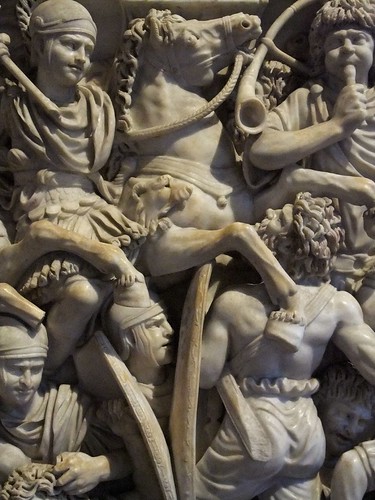
Detail of the Ludovisi sarcophagus thought to depict a
battle between the Romans and the Goths 2nd - 3rd
century CE
photographed at the Palazzo Altemps in
Rome, Italy
by  © 2009
 In addition to bad weather, a lack of supplies, and hunger, plague was a major factor in the defeat of the Goths. Many of the Gothic prisoners were either impressed into Roman military service or settled on farms as coloni. Claudius received the title Gothicus in recognition of his triumph over the Goths. At some point he had also been given the title Parthicus, but the unlikelihood of any conflict with the Parthians in his short reign makes this difficult to explain. Perhaps Damerau was correct in his suggestion that a Parthian unit may have been involved in one of the battles with the Palmyrenes, although on this front there were few achievements to claim. In any case, Claudius' victory over the Goths was short-lived. The emperor himself caught the plague and died at Sirmium early in 270. He was 56 years old  Claudius' brother, Quintillus, became emperor briefly before losing out to Aurelian. Claudius also had another brother, Crispus, and the SHA traces the link to Constantius through Crispus' daughter Claudia. 
The Roman Senate showed its respect for Claudius Gothicus by setting up a gold portrait-shield in the Curia and by approving his deification. He was also honored with a golden statue in front of the great temple of Jupiter Optimus Maximus and a silver statue set on a column on the Rostra." - Wikipedia
All of these issues prompted me to seek out other academic opinions and more information.

Judith Weingarten, who studied classical archaeology at Oxford and is a member of the British School of Athens, disagreed with Kulikowski's suggestion that Caracalla's granting of citizenship to all free residents was a crucial trigger to the Gothic migrations:


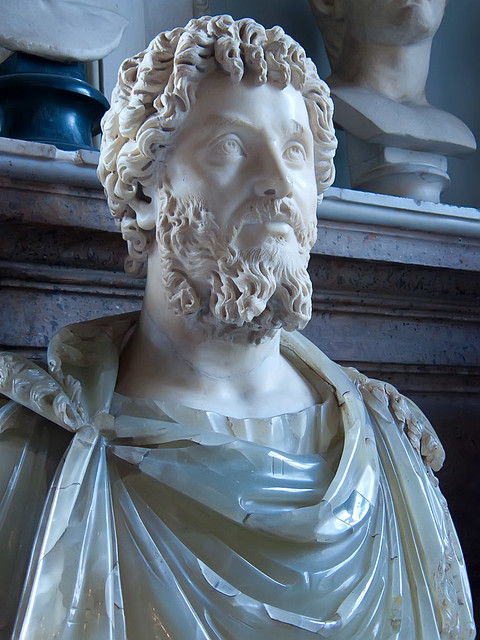
Bust of the Roman emperor Septimius Severus
photographed at the Capitoline Museum in
Rome, Italy
by  © 2009
"Caracalla's father, the Emperor Septimius Severus, had already started the rot," Weingarten exclaims,  "As the first of the Soldier Emperors, he came to power over the bodies of three emperors (all murdered in a single year!) and fought two bloody civil wars against rival generals to boot. He was, however, the last emperor, for a very long time, to die in bed. For the next 60 years, emperor after emperor - and there were many - fell to the assassin’s knife - and that is only to speak of the so-called legitimate emperors, who managed to fight off and kill their rivals - the losers then being called ‘usurpers’ or ‘pretenders’. [An old English jingle makes the point: Treason doth never prosper/ what’s the reason?/ For if it prosper/ none dare call it treason.] Caracalla’s murder, in turn,, did usher in a new age of instability. Legitimacy gave way to force and absolute despotism, in which the losers, their friends and supporters, were slaughtered and their property confiscated."
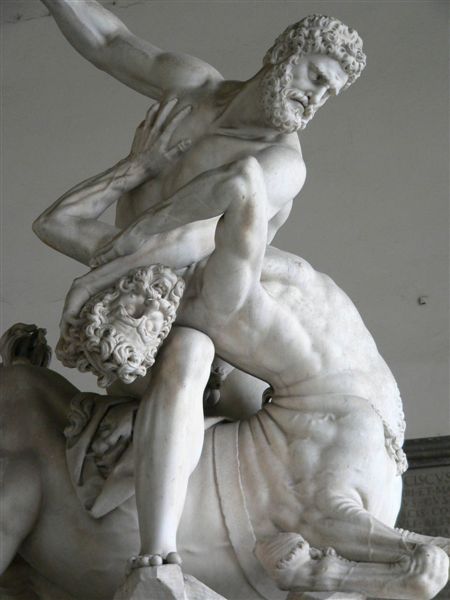
Hercules battling the centaur Nessus by
by Giovanni Bologna 1599 CE
photographed
at the Palazzo Vechio in Florence, Italy by
 © 2005

"In my opinion," she continues, "the true reason for Caracalla granting citizenship to all free men in the Empire, was his need to raise revenue: in return for citizenship, he taxed them. When even that was insufficient, he debased the currency...."

Another historian, Volker Carlton Bach of Denmark, took issue with the speculation that Constantine's rejection of the emperor's traditional descent from Hercules was a demonstration of rejection of pagan philosophy.

"I think this is based on a misunderstanding," Bach states, "The descent of the Herculian Emperors (not the Jovian ones) from Hercules was purely a notional, cultic (for want of a better word) concept. The closest we have today, I think, is the link between the popes and St Peter - not an arogation of genetic descent, but a claim of spiritual successorship and close association. The Romans knew that Maximian and his successors were not the great-great-great-repeat ad nauseam-grandsons of the heros Hercules. After all, they had real mothers and fathers, and in some cases even knew both with a degree of certainty. The descent claim from Claudius Gothicus, on the other hand, *is* a 'real' paternity claim, similar to the adoption of Antonine nomenclature by third-century emperors. So Constantine doesn't really replace one claim with another. The Herculian designation was unnecessary simply because with Constantine's victories, as it had been used to distinguish junior colleagues from senior (Jovian) ones. Constantine was *the* emperor, so that was that. Claudius Gothicus, on the other hand, was a very attractive ancestor to claim, a successful and legendary warrior and, unlike Aurelian or Diocletian, without anti-Christian baggage."

Any book that can generate this type of quality discussion is a worthy addition to any history enthusiast's collection. I notice it is one of a series of introductory-level texts exploring the key conflicts of classical antiquity. I look forward to reading others in this series.

Related articles
Enhanced by Zemanta