Showing posts with label ancient Rome. Show all posts

Sunday, February 27, 2011

Review: Roman Games by Bruce MacBain

Roman Games: A Plinius Secundus MysterySextus Ingentius Verpa, imperial informant to the vicious emperor Domitian, was a real piece of work, having clawed his way to imperial favor by turning in even the emperor's cousin, Clemens, for atheism.  Now, the disgusting thug lay tangled in his bedsheets in a pool of blood, gripping his "member virilus" and clutching his throat.

But, just as in life, Verpa's death sends terror through his household as troopers of the city prefect round up the household slaves and herd them into a small windowless chamber where they will await the foregone conclusion of the official investigation before being executed in a most hideous manner in the arena.

After all, Roman law was clear.  If any slave should murder his master, all slaves, considered complicit because the murder was not prevented, are deemed equally guilty.

But, this time, the outcome was not going to be as predetermined as in cases in Rome's past.  The city prefect has appointed Gaius Plinius Caecilius Secundus, temporary vice-prefect, to investigate, and the thriving young lawyer, known to history as Pliny the Younger, will not be content to simply go through the motions.
As the case begins to unravel, we find Pliny snared in not only a complicated murder investigation but an assassination plot woven about the imperial throne as well.

Mosaic of a Charioteer at the Palazzo Massimo
Photographed by Mary Harrsch
Bruce MacBain, with a PhD in ancient history, does an excellent job of conjuring daily life in Rome of the late first century CE.  I did not detect a single misstep in his descriptions of Roman housing and decor, Roman law, religion, social obligations, leisure pursuits or entertainments.  He even got the numbers and colors of chariot teams correct for the period,  the whites, blues, greens, reds, purples and golds.   Thankfully, I had just finished the Teaching Company course, The Visual Exploration of Rome: Antiquity's Greatest Empire by Dr. Steven Tuck in which Dr. Tuck explained that throughout most of the imperial period there were four official chariot team colors. But, Domitian introduced two more colors, the purples and the golds.  So, I was gratified when Dr. MacBain mentioned the purples and golds in his novel when Pliny attends the races one day!

Although I was only slightly familiar with the historical Pliny the Younger from my study of Pompeii and the Vesuvian disaster that claimed his uncle, Pliny the Elder, I found Pliny to be an interesting man in his own right and plan to read more of his letters as time permits.  From what I found in my research, Dr. MacBain's portrayal of Pliny closely follows his real persona as discovered in the study of his own writings, the Epistulae (Letters), a series of personal missives directed to his friends and associates that were published in Pliny's own lifetime.

Pliny the Younger's descriptions of the eruption
 of Vesuvius have been invaluable to modern volcanologists
From the Discovery Channel's ''Pompeii'', courtesy of Crew Creative, Ltd 
"We know more about Pliny as a person than we do about most figures from antiquity," MacBain obeserves, "because he was a great letter writer. Through his letters we see many facets of the man. He was a Roman senator and a lawyer with a successful, if not brilliant, career in the imperial administration. He was a landowner with a beautiful villa on the Italian coast. He was a literary dilettante. He was rather vain, rather fussy. At the same time, conscientious and honest. He was curious about the natural—and supernatural—world. He was a very social animal, he had hundreds of friends. His most endearing qualities are his love for his young wife, Calpurnia; his generosity—he endowed a scholarship fund for the boys and girls of his home town; and his humanity towards his slaves and freedmen in an age when that was not common."

Calpurnia was actually Pliny's third wife.  Childbirth was a hazardous undertaking in the 1st century CE and Pliny had already been widowed by it earlier in his life.  So, we can certainly understand his worry over his young wife's advanced pregnancy as the story progresses.

MacBain also introduces us to the flamboyant poet Martial.  This hairsute Spaniard is a pungent blend of crude comedy mixed with sudden, unexpected flashes of introspection.  Although he was known for his ribald epigrams he could also pen verses that encouraged reflection on what was really important in life.
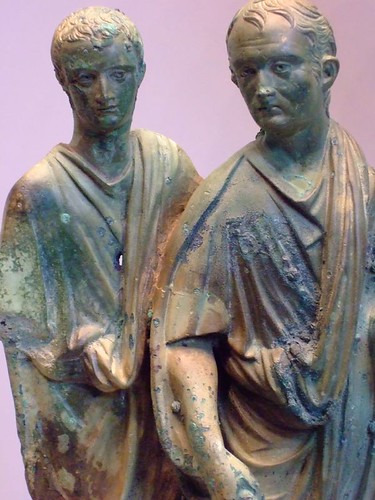
Bronze applique depicting two togate men.
Roman 50 - 75 CE. Photographed at the Getty Villa by Mary Harrsch
An example:

"This is that toga much celebrated in my little books, that toga so well known and loved by my readers. It was a present from Parthenius; a memorable present to his poet long ago; in it, while it was new, while it shone brilliantly with glistening wool, and while it was worthy the name of its giver, I walked proudly conspicuous as a Roman knight. Now it is grown old, and is scarce worth the acceptance of shivering poverty; and you may well call it snowy. What does not time in the course of years destroy? this toga is no longer Parthenius's; it is mine." - Martial, On a Toga Given Him by Parthenius, Book IX,  XLIX.  

We meet Parthenius, a portly and scheming chamberlain of Domitian who acted as gatekeeper to the emperor as the story progresses and learn that even he has joined the inner circle of conspirators plotting Domitian's death.  The chambelain was probably the recipient of many gestures offered to secure a position in the imperial court and someone who an aspiring poet would have had to flatter with verse if he sought to have a copy of his work reach the eyes of the emperor.  Parthenius may have reciprocated with the gift of a toga that could have been worn by the poet to disguise his rather common upbringing and tout his court favor.  But life takes a toll on togas as well as men and Martial confides at the end of the passage that now the toga is more worn and threadbare, it is much more suitable for the real man it now covers.

Martial actually was a friend of Pliny the Younger, who, like many young aristocrats, dabbled in poetry himself and enjoyed  socializing with literary celebrities.  I appreciate the inclusion of  this aspect of Pliny's nature in MacBain's portrayal of Pliny and the opportunity to gain insight into the life of one of Rome's celebrated grammarians living on the precarious edge of imperial patronage.
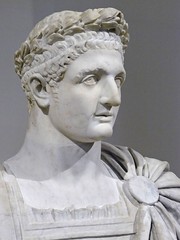
Bust of the Roman Emperor Domitian 1st century...Image by mharrsch via Flickr
Bust of Domitian 1st century CE

Of course, we also get to meet one of Rome's most sinister emperors, Domitian.  Our first encounter occurs when Pliny is invited to a strange dinner party where the guests are first ushered deep into the bowels of the palace and a bizarre charade takes place where an encounter with Hades himself is reenacted without the guests being forewarned, in an effort to elicit damning confessions from them.  This scene is very reminiscent of a similar audience with Domitian described by Steven Saylor in his novel "Empire".

Domitian's pleasure derived from tormenting Rome's social elite is chilling.  I know Professor Tuck related that he felt many of Domitian's more "transgressive" activities reflected the emperor's efforts to redefine Roman virtus but I can't help but assign a proclivity to sadism to Domitian's psychological profile.

At one point in the novel, Pliny watches as Domitian squashes flies in a prelude to a petulant diatribe against first, Pliny, then Roman society as a whole.  As Domitian veers wildly from condemnation to bestowing  favor upon his hapless visitors and demanding kisses, we can easily understand the fear that must have  permeated Domitian's inner circle.  We also gain sympathy for Domitian's wife, one of the co-conpirators, who is described as bruised so severely even heavy makeup cannot conceal her condition.
Understandably, Pliny  offers to resign his position but the prefect and emperor make it clear that is not an option.  So, he plows ahead, investigating as best he can,  at one point searching through piles of scrolls that comprise his uncle's Naturalis Historia for clues (a respectful nod to the prodigious scholarship of Pliny the Elder).

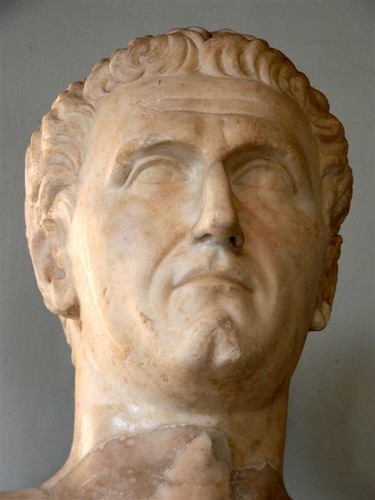
The emperor Nerva photographed at the
Capitoline Museum by Mary Harrsch
The plot takes many twists and turns as Pliny gets closer to the truth. Will Pliny as an upright officer of the court denounce the killer and expose the imperial treachery even though it may mean the deaths of family friends and some of the most conscientious people in Roman society?  Will the emperor's death ignite a civil war with the emperor's loyal legions in Germania who Pliny fears will swoop down on the eternal city  and wreak revenge on its citizens?  What will happen to Pliny under the rule of someone like Nerva, the conspirators' less than enthusiastic designate?

Nerva was Domitian's immediate successor and he is portrayed in the book much as he was thought to have been in life - a reluctant Caesar who other conspirators selected mainly because of his age, with the thought that he could be a placeholder for a short time until someone more suitable could be found.  But there was more to Nerva than the conspirators may have realized.  If we examine another passage from Martial, we see that the poet, experienced in assessing the motivations of others, lends insight into this "man who would be king":

"He who ventures to send verses to the eloquent Nerva, will present common perfumes to Cosmus, violets and privet to the inhabitant of Paestum, and Corsican honey to the bees of Hybla. Yet there is some attraction in even a humble muse; the cheap olive is relished even when costly daintiest are on the table. Be not surprised, however, that, conscious of the mediocrity of her poet, my Muse fears your judgment. Nero himself is said to have dreaded your criticism, when, in his youth, he read to you his sportive effusions." - Martial, To Nerva, Book IX, XXVI.
Martial, at least, has more than just a little trepidation about Nerva's accession and, as the novel concludes, Pliny soon discovers himself that the new emperor has an edge of ruthlessness about him that Pliny will be unable to deflect.

So we leave Pliny, sobered by his new reality, and must say goodbye to Martial as he leaves for his childhood home in Hispania.  Although Pliny has more adventures ahead of him, Martial will no longer share them and, historically, dies within a few years of his return to Spain.

I look forward to Pliny's next adventure as we fast forward ten years and Pliny embarks on a new career as governor of the province of Bithynia-Pontus in Asia Minor.  I see that his new side-kick will be that salacious gossip-monger Suetonius so I'm sure that will make for a wild ride!

Roman Games: A Plinius Secundus Mystery  Complete Letters (Oxford World's Classics)  Ashen Sky: The Letters of Pliny The Younger on the Eruption of Vesuvius Domitian: Tragic Tyrant 


Enhanced by Zemanta

Friday, February 25, 2011

Review: The Green Bronze Mirror by Lynne Ellison (Young Adult)

  The Green Bronze MirrorThis time travel tale by a 14-year-old author was sent to me quite some time ago and I read it but got so swamped with other committments, I never got around to writing my review of it.  My apologies to CnPosner Books who were kind enough to send me a review copy.

Karen is a young British girl, about the same age as the author, with a talent for art. One day she is swept back in time to the age of the Roman Empire under the reign of Nero when she finds an old bronze mirror on a deserted beach and gazes into its corroded surface.  She is discovered by a Roman patrol whose Centurion takes her for a runaway slave and places her temporarily in his household until inquiries can be made.

When no one claims the girl, she is sold to a slaver and placed aboard a ship destined for Rome.  There, she befriends other young slaves and wonders what will happen to her once they reach their destination.
Roman coin bank depicting a beggar girl. 25-50 CE.
Photographed at the Getty Villa by Mary Harrsch.

In Rome, she is purchased by a wealthy Roman family and is charged with the care of the family's children.  When the mistress of the house later discovers Karen's talent for art, she orders Karen to paint murals on the walls of the villa in addition to her child care duties.   Karen enjoys her work so doesn't seem to mind her role in ancient society and befriends some of the other household slaves, discovering one of them is a member of the new Christian cult.  She asks to attend some of their meetings and she is welcomed into the group.  She then falls in love with one of the other young Christian slaves named Kleon.

One day a fire erupts in the city and soon many of the buildings surrounding the villa where Karen lives are threatened by flames.  Karen, remembering her Roman history, is terrified because she knows the Christians will be blamed for the fire and brutally persecuted.

She warns her friends that they will be blamed for the conflagration but, as slaves, they fear severe punishment if they are caught trying to flee.  Finally, she convinces them to flee to the catacombs.  But an angry mob discovers the entrance to the catacombs and begins searching its dank recesses looking for the "arsonists".
Will Karen escape persecution and find her way back to Britain and her own time?

Reading this book, I was impressed with this young author's skilled handling of dialogue.  She also seemed to have a good grasp of Roman culture and seemed to know quite a bit about the layout of ancient Rome, too, as evidenced by references to particular gates of the ancient city.

Her primary shortcoming, as an author, was her naivete about the brutality of daily life for slaves and other members of the lower classes in Roman society.  Her heroine was actually considered a fully mature woman at that point in time and it would be quite a stretch to believe that she could be found by a group of Roman legionaries and deposited untouched into the care of her new master's household slaves.  Furthermore, she manages to remain chaste despite her sale to a slaver, a long sea voyage, and purchase by a Roman master, seemingly content with the attentions of his own wife.
Bronze Bust of a Gallo-Roman Youth 
wearing a hairstyle fashioned after the 
emperor Nero 60-70 CE.  Photographed
at the Getty Villa by Mary Harrsch.

But, I can vaguely remember being 14-years-old myself and innocent about gender relations at that age, so I can certainly understand this aspect of the story.

The "Ben-Hur" approach to ancient Christianity is also understandable since this book was written in 1966 by an imaginative young girl who was probably as enthralled with Charlton Heston's portrayal of the Judean prince at that time as I was.

She also unknowingly compressed historical events surrounding the Great Fire.  The Christians were not immediately blamed for the disaster.  They were eventually selected as probable perpetrators after the populace began voicing their suspicions that Nero himself started the fire to clear out the center of Rome for his new Golden House.

Still, I think young Lynne Ellison could have blossomed into a very good author with more experience.  Sadly, I understand this was her one and only published effort.

I would recommend to the publisher, however, that more care be taken with proofing future releases.  The copy I received, although a commercial release complete with cover and illustrations, was filled with typos and even missing words and phrases.  It was as if an old manuscript was simply scanned, OCRed and sent to press without any human intervention.  Even young authors deserve a publisher's respect for quality in the output of the final product.

The Green Bronze Mirror  A. D. 62: Pompeii  The Gladiators from Capua (Roman Mysteries) The Thieves of Ostia (The Roman Mysteries)   The Secrets of Vesuvius (The Roman Mysteries)                
Enhanced by Zemanta

Friday, November 13, 2009

Art as Plunder: The Ancient Origins of Debate about Cultural Property


This book examines the ancient origins of debate about art as cultural property. What happens to art in time of war? Who should own art, and what is its appropriate context? Should the victorious ever allow the defeated to keep their art? These questions were posed by Cicero during his prosecution of a Roman governor of Sicily, Gaius Verres, for extortion. Cicero's published speeches had a very long afterlife, affecting debates about collecting art in the 18th century and reactions to the looting of art by Napoleon. The focus of the book's analysis is theft of art in Greek Sicily, Verres' trial, Roman collectors of art, and the later impact if Cicero's arguments. The book concludes with the British decision after Waterloo to repatriate Napoleon's stolen art to Italy, and an epilogue on the current threats to art looted from archaeological contexts. Margaret M. Miles is an archaeologist and art historian, now Professor of Art History and Classics at the University of California, Irvine. She has held fellowships at the American School of Classical Studies in Athens, the Institute for Advanced Study in Princeton, and the American Academy in Rome. She has excavated at Corinth and Athens, and did architectural fieldwork at Rhamnous in Greece and at Selinunte and Agrigento in Sicily. Her earlier publications include a study of the Temple of Nemesis at Rhamnous (Hesperia, 1989) and a volume in the Agora excavation series on the City Eleusinion, the downtown Athenian branch of the Eleusinian Mysteries (The Athenian Agora, Vol. 31: The City Eleusinion, 1998).

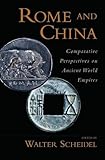
Rome and China: Comparative Perspectives on Ancient World Empires by Walter Scheidel


Two thousand years ago, up to one-half of the human species was contained within two political systems, the Roman empire in western Eurasia (centered on the Mediterranean Sea) and the Han empire in eastern Eurasia (centered on the great North China Plain). Both empires were broadly comparable in terms of size and population, and even largely coextensive in chronological terms (221 BCE to 220 CE for the Qin/Han empire, c. 200 BCE to 395 CE for the unified Roman empire). At the most basic level of resolution, the circumstances of their creation are not very different. In the East, the Shang and Western Zhou periods created a shared cultural framework for the Warring States, with the gradual consolidation of numerous small polities into a handful of large kingdoms which were finally united by the westernmost marcher state of Qin. In the Mediterranean, we can observe comparable political fragmentation and gradual expansion of a unifying civilization, Greek in this case, followed by the gradual formation of a handful of major warring states (the Hellenistic kingdoms in the east, Rome-Italy, Syracuse and Carthage in the west), and likewise eventual unification by the westernmost marcher state, the Roman-led Italian confederation. Subsequent destabilization occurred again in strikingly similar ways: both empires came to be divided into two halves, one that contained the original core but was more exposed to the main barbarian periphery (the west in the Roman case, the north in China), and a traditionalist half in the east (Rome) and south (China).
These processes of initial convergence and subsequent divergence in Eurasian state formation have never been the object of systematic comparative analysis. This volume, which brings together experts in the history of the ancient Mediterranean and early China, makes a first step in this direction, by presenting a series of comparative case studies on clearly defined aspects of state formation in early eastern and western Eurasia, focusing on the process of initial developmental convergence. It includes a general introduction that makes the case for a comparative approach; a broad sketch of the character of state formation in western and eastern Eurasia during the final millennium of antiquity; and six thematically connected case studies of particularly salient aspects of this process.

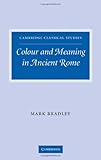
Colour and Meaning in Ancient Rome by Mark Bradley


The study of colour has become familiar territory in recent anthropology, linguistics, art history and archaeology. Classicists, however, have traditionally subordinated the study of colour to form. By drawing together evidence from contemporary philosophers, elegists, epic writers, historians and satirists, Mark Bradley reinstates colour as an essential informative unit for the classification and evaluation of the Roman world. He also demonstrates that the questions of what colour was and how it functioned - as well as how it could be misused and misunderstood - were topics of intellectual debate in early imperial Rome. Suggesting strategies for interpreting Roman expressions of colour in Latin texts, Dr Bradley offers new approaches to understanding the relationship between perception and knowledge in Roman elite thought. In doing so, he highlights the fundamental role that colour performed in the realms of communication and information, and its intellectual contribution to contemporary discussions of society, politics and morality.

Explores how ancient Romans categorised, organised and described colours, and outlines the principal differences and similarities between ancient and modern concepts of colour. By drawing together evidence from contemporary philosophers, elegists, epic writers, historians and satirists, Bradley explores the definition and function of colour in Rome during the early Empire.

The Essentials of Greek and Roman Law by Russ VerSteeg


Countless books detail the development of Roman law and explain the laws of the ancient Romans. Similarly, many scholars have traced the law of ancient Athens. Written for both students and educated lay readers, the chapters dealing with ancient Greece focus primarily on the law of ancient Athens in the 5th and 4th centuries B.C.E.

But material relating to other Greek colonies and city states also plays a significant role in the development of ancient Greek law. The Roman law chapters explore both law and legal institutions and emphasize the growth and expansion of legal principles. Roman law still serves as the foundation for the civil laws of many nations today. And given the importance of globalization, Roman law is likely to continue to influence the modern word for the foreseeable future.

Russ VerSteeg is a professor of law at the New England School of Law and a former teacher of classics.

The Deaths of Seneca by James Ker


The forced suicide of Seneca, former adviser to Nero, is one of the most tortured -- and most revisited -- death scenes from classical antiquity. After fruitlessly opening his veins and drinking hemlock, Seneca finally succumbed to death in a stifling steam bath, while his wife Paulina, who had attempted suicide as well, was bandaged up and revived by Nero's men. From the first century to the present day, writers and artists have retold this scene in order to rehearse and revise Seneca's image and writings, and to scrutinize the event of human death.

In The Deaths of Seneca, James Ker offers the first comprehensive cultural history of Seneca's death scene, situating it in the Roman imagination and tracing its many subsequent interpretations. Ker shows first how the earliest accounts of the death scene by Tacitus and others were shaped by conventions of Greco-Roman exitus-description and Julio-Claudian dynastic history. At the book's center is an exploration of Seneca's own prolific writings about death -- whether anticipating death in his letters, dramatizing it in the tragedies, or offering therapy for loss in the form of consolations -- which offered the primary lens through which Seneca's contemporaries would view the author's death. These ancient approaches set the stage for prolific receptions, and Ker traces how the death scene was retold in both literary and visual versions, from St. Jerome to Heiner Muller and from medieval illuminations to Peter Paul Rubens and Jacques-Louis David. Dozens of interpreters, engaging with prior versions and with Seneca's writings, forged new and sometimes controversial views on Seneca's legacy and, more broadly, on mortality and suicide. The Deaths of Seneca presents a new, historically inclusive, approach to reading this major Roman author.

Saturday, October 24, 2009

The Poison King: The Life and Legend of Mithradates, Rome's Deadliest Enemy


Machiavelli praised his military genius. European royalty sought out his secret elixir against poison. His life inspired Mozart's first opera, while for centuries poets and playwrights recited bloody, romantic tales of his victories, defeats, intrigues, concubines, and mysterious death. But until now no modern historian has recounted the full story of Mithradates, the ruthless king and visionary rebel who challenged the power of Rome in the first century BC. In this richly illustrated book--the first biography of Mithradates in fifty years--Adrienne Mayor combines a storyteller's gifts with the most recent archaeological and scientific discoveries to tell the tale of Mithradates as it has never been told before.

The Poison King describes a life brimming with spectacle and excitement. Claiming Alexander the Great and Darius of Persia as ancestors, Mithradates inherited a wealthy Black Sea kingdom at age fourteen after his mother poisoned his father. He fled into exile and returned in triumph to become a ruler of superb intelligence and fierce ambition. Hailed as a savior by his followers and feared as a second Hannibal by his enemies, he envisioned a grand Eastern empire to rival Rome. After massacring eighty thousand Roman citizens in 88 BC, he seized Greece and modern-day Turkey. Fighting some of the most spectacular battles in ancient history, he dragged Rome into a long round of wars and threatened to invade Italy itself. His uncanny ability to elude capture and surge back after devastating losses unnerved the Romans, while his mastery of poisons allowed him to foil assassination attempts and eliminate rivals.

The Poison King is a gripping account of one of Rome's most relentless but least understood foes.


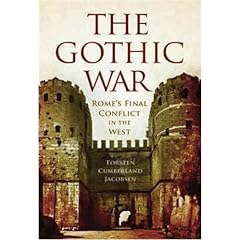
The Gothic War


A period of stability in the early sixth century AD gave the Eastern Roman emperor Justinian an opportunity to recapture parts of the Western Empire that had been lost to invading barbarians in the preceding centuries. It was an ambitious plan to attack such a vast territory with relatively few soldiers and resources. Yet Justinian's army succeeded in checking the Persians in the East and in retaking North Africa from the Vandals and Italy from the Ostrogoths, the strongest and most organized Barbarian tribe in the West. The climactic conflict over Italy between 535 and 554--the Gothic War--decided the political future of Europe, holding in its balance the possibility that the Roman Empire might rise again. While large portions of the original territory of the ancient Roman Empire were recaptured, the Eastern Empire was both unwilling and incapable of retaining much of its hard-won advances, and soon the empire once again retracted. As a result of the Gothic War, Italy was invaded by the Lombards, who began their important kingdom, the Franks began transforming Gaul into France, and without any major force remaining in North Africa, that territory was quickly overrun by the first wave of Muslim expansion in the ensuing century.

Written as a general overview of this critical period, The Gothic War opens with a history of the conflict with Persia and the great Roman general Belisarius's successful conquest of the Vandals in North Africa. After an account of the Ostrogothic tribe and their history, the campaigns of the long war for Italy are described in detail, including the three sieges of Rome, which turned the great city from a bustling metropolis into a desolate ruin. In addition to Belisarius, the Gothic War featured many of history's most colorful antagonists, including Rome's Narses the Eunuch, and the Goths' ruthless and brilliant tactician, Totila. Two appendices provide information about the armies of the Romans and Ostrogoths, including their organization, weapons, and tactics, all of which changed over the course of the war.