Showing posts with label ancient history. Show all posts

Tuesday, December 29, 2009

Blogcritic Bennet finds Goldworthy's latest, Slow Death of the Roman Superpower, a bit dry

The Fall of the West: The Death of the Roman SuperpowerI see London Reviewer Natalie Bennett didn't find Adrian Goldworthy's "The Fall of the West: The Slow Death of the Roman Superpower" a particularly interesting read.


"It might make a good board game, but it is hard to get interested in this fast-moving, if shortlived, cast of characters, about which we learn little. So while as a reference this is a handy book, it wouldn't be the best thing to take on a long train trip when seeking an engaging read." - Nancy Bennett, Blogcritics

I realize dates and political context are important but even with my passion for ancient history, I find it difficult to plow through such scholarly tomes from front to back.  Perhaps I'm just too used to doing research on the internet and targeting specific aspects of a culture or a historical figure's life to force myself to endure an unappetizing meal of bare facts without the more interesting human elements many scholars unfortunately tend to overlook in their effort to explain The Big Picture.

Still, somebody has to write the reference books so when we read historical fiction page turners by such authors as Conn Iggulden, we have somewhere to look to check which portions of the story are true and which ones benefited from the author's quite formidable imagination.

I recently finished Iggulden's riveting Genghis trilogy and was so intrigued with this multi-faceted conqueror and that period of history (1200s CE - a bit out of my usual ancient realm) that I've spent quite a bit of time researching some of the details in The Mongol's Secret History so I could be clear on which details of the story and the marvelous characterizations were based on fact.  I actually think I learn more and REMEMBER more this way than by simply reviewing a compendium of facts.

Genghis: Birth of an Empire The Fall of the Roman Empire: A New History of Rome and the Barbarians   Decline & Fall of the Roman Empire (Wordsworth Classics of World Literature)   The Fall Of The Roman Empire (Two-Disc Deluxe Edition) (The Miriam Collection)    I, Caesar - The Rise & Fall of the Roman Empire 

Friday, November 13, 2009

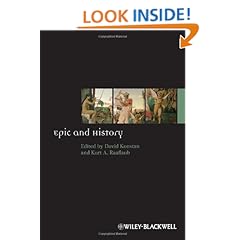
Epic and History by David Konstan and Kurt A. Raaflaub


With contributions from leading scholars, this is a unique cross-cultural comparison of historical epics across a wide range of cultures and time periods, which presents crucial insights into how history is treated in narrative poetry.
  • The first book to gain new insights into the topic of ‘epic and history’ through in-depth cross-cultural comparisons
  • Covers epic traditions across the globe and across a wide range of time periods
  • Brings together leading specialists in the field, and is edited by two internationally regarded scholars
  • An important reference for scholars and students interested in history and literature across a broad range of disciplines

Heroic epics have existed in many cultures, from antiquity to the modern day, offering an important means by which societies commemorate the past and transmit memories over time. Yet few attempts have been made to compare these epics systematically or to establish a typology of heroic epic. Nor is it always clear to what extent heroic epics reflect history, or what methodologies might be used to retrieve historical information from epics.


Addressing these issues, Epic and History invites comparison across a broad variety of cultures in which traditions of epic – oral and written – existed and continue to exist. It makes a unique and conscious effort to take full advantage of this cross-cultural comparison to enhance our understanding of this important topic, presenting crucial insights into how history is treated in narrative poetry.

Contributors are leading scholars on epic and heroic poetic traditions. They base their analyses on profound knowledge of the wide range of cultures discussed throughout the book, from the ancient Near East and South Asia, the Greco-Roman world, and medieval Europe – from Scandinavia to Spain – to today’s Egypt, Southern Africa, and Central America.

David Konstan is the John Rowe Workman Distinguished Professor of Classics and the Humanistic Tradition at Brown University; he is also a Professor in Comparative Literature, and a member of the Graduate Faculty of Theatre Arts and Performance Studies. He is the author of Roman Comedy (1983); Sexual Symmetry (1994); Greek Comedy and Ideology (1995); Friendship in the Classical World (1997); Pity Transformed (2001); The Emotions of the Ancient Greeks (2006); Terms for Eternity: Aiônios and aïdios in Classical and Christian Texts, (with Ilaria Ramelli, 2007); and A Life Worthy of the Gods: The Materialist Psychology of Epicurus (2008).

Kurt A. Raaflaub is David Herlihy University Professor, and Professor of Classics and History at Brown University. His numerous publications include The Discovery of Freedom in Ancient Greece(2004) and Origins of Democracy in Ancient Greece (2007, co-authored with Josiah Ober and Robert Wallace). He is also the editor of Social Struggles in Archaic Rome (Blackwell, 2005), andWar and Peace in the Ancient World (Blackwell, 2007), and co-editor of Democracy, Empire, and the Arts in Fifth-Century Athens (1998), War and Society in the Ancient and Medieval Worlds(1999), A Companion to Archaic Greece (Wiley-Blackwell, 2009), and Geography and Ethnography: Perspectives of the World in Premodern Societies (Wiley-Blackwell, 2010).

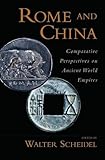
Rome and China: Comparative Perspectives on Ancient World Empires by Walter Scheidel


Two thousand years ago, up to one-half of the human species was contained within two political systems, the Roman empire in western Eurasia (centered on the Mediterranean Sea) and the Han empire in eastern Eurasia (centered on the great North China Plain). Both empires were broadly comparable in terms of size and population, and even largely coextensive in chronological terms (221 BCE to 220 CE for the Qin/Han empire, c. 200 BCE to 395 CE for the unified Roman empire). At the most basic level of resolution, the circumstances of their creation are not very different. In the East, the Shang and Western Zhou periods created a shared cultural framework for the Warring States, with the gradual consolidation of numerous small polities into a handful of large kingdoms which were finally united by the westernmost marcher state of Qin. In the Mediterranean, we can observe comparable political fragmentation and gradual expansion of a unifying civilization, Greek in this case, followed by the gradual formation of a handful of major warring states (the Hellenistic kingdoms in the east, Rome-Italy, Syracuse and Carthage in the west), and likewise eventual unification by the westernmost marcher state, the Roman-led Italian confederation. Subsequent destabilization occurred again in strikingly similar ways: both empires came to be divided into two halves, one that contained the original core but was more exposed to the main barbarian periphery (the west in the Roman case, the north in China), and a traditionalist half in the east (Rome) and south (China).
These processes of initial convergence and subsequent divergence in Eurasian state formation have never been the object of systematic comparative analysis. This volume, which brings together experts in the history of the ancient Mediterranean and early China, makes a first step in this direction, by presenting a series of comparative case studies on clearly defined aspects of state formation in early eastern and western Eurasia, focusing on the process of initial developmental convergence. It includes a general introduction that makes the case for a comparative approach; a broad sketch of the character of state formation in western and eastern Eurasia during the final millennium of antiquity; and six thematically connected case studies of particularly salient aspects of this process.

Colour and Meaning in Ancient Rome by Mark Bradley


The study of colour has become familiar territory in recent anthropology, linguistics, art history and archaeology. Classicists, however, have traditionally subordinated the study of colour to form. By drawing together evidence from contemporary philosophers, elegists, epic writers, historians and satirists, Mark Bradley reinstates colour as an essential informative unit for the classification and evaluation of the Roman world. He also demonstrates that the questions of what colour was and how it functioned - as well as how it could be misused and misunderstood - were topics of intellectual debate in early imperial Rome. Suggesting strategies for interpreting Roman expressions of colour in Latin texts, Dr Bradley offers new approaches to understanding the relationship between perception and knowledge in Roman elite thought. In doing so, he highlights the fundamental role that colour performed in the realms of communication and information, and its intellectual contribution to contemporary discussions of society, politics and morality.

Explores how ancient Romans categorised, organised and described colours, and outlines the principal differences and similarities between ancient and modern concepts of colour. By drawing together evidence from contemporary philosophers, elegists, epic writers, historians and satirists, Bradley explores the definition and function of colour in Rome during the early Empire.

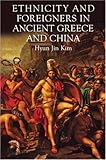
Ethnicity and Foreigners in Ancient Greece and China by Hyun Kim


Why did the Greeks claim to be superior to their neighbors and yet record, rightly or wrongly, that the founders of some of their most important cities were foreigners from the Near East? Can we find similar ethnocentric representations of outsiders in the literature of the other great literate civilization of the Ancient World, Early China? How do the Greek and Chinese representations of the foreigner differ?

These questions are examined in a comparative analysis of Archaic/Classical Greek and Early Chinese historical and ethnographic sources, in particular the 'Histories' of Herodotus and the 'Shiji' of Sima Qian. The author argues that Greece was an integral part of the wider Eastern Mediterranean and Near Eastern civilization and that this had a major impact on the ways in which the Greeks chose to represent foreigners in their literature. He also shows that the Ancient Chinese of the Han dynasty were as assertive as the Greeks in claiming their ethnic superiority over non-Chinese, but concludes that, although the two cultures shared the same breadth and variety of prejudices towards outsiders, they chose to emphasize different categories of differentiation.


Hyun Jin Kim took his DPhil at Oxford and is now University of Sydney Postdoctoral Research Fellow in the Department of Classics and Ancient History.

Roman Iberia: Economy, Society and Culture by Benedict Lowe


This is the first book to examine the economic impact of external cultures - the Phoenicians, Greeks and Romans - upon the Iberian peninsula throughout the first millennium BC. Benedict Lowe provides a synthesis of recent archaeological work to place Spain in the broader context of debates about Romanisation during the Republic and Early Imperial period. He adopts a chronological approach, focusing on the processes of integration and regionalism in the economy of the Iberian peninsula.

The book begins with an introduction to the kingdom of Tartessos and the impact of the Phoenician and Greek colonists upon the economy of the peninsula, setting the scene for Rome's conquest. Succeeding chapters explore the growing Roman presence, culminating in the 1st century AD.

Combining literary and archaeological evidence, Roman Iberia provides an in-depth analysis of the Romanisation of Iberia in economic terms: villas, urbanism, pottery and trade and the interaction of Roman and native populations.


Benedict Lowe is Associate Professor of History, Western Oregon University.

The Essentials of Greek and Roman Law by Russ VerSteeg


Countless books detail the development of Roman law and explain the laws of the ancient Romans. Similarly, many scholars have traced the law of ancient Athens. Written for both students and educated lay readers, the chapters dealing with ancient Greece focus primarily on the law of ancient Athens in the 5th and 4th centuries B.C.E.

But material relating to other Greek colonies and city states also plays a significant role in the development of ancient Greek law. The Roman law chapters explore both law and legal institutions and emphasize the growth and expansion of legal principles. Roman law still serves as the foundation for the civil laws of many nations today. And given the importance of globalization, Roman law is likely to continue to influence the modern word for the foreseeable future.

Russ VerSteeg is a professor of law at the New England School of Law and a former teacher of classics.

The Deaths of Seneca by James Ker


The forced suicide of Seneca, former adviser to Nero, is one of the most tortured -- and most revisited -- death scenes from classical antiquity. After fruitlessly opening his veins and drinking hemlock, Seneca finally succumbed to death in a stifling steam bath, while his wife Paulina, who had attempted suicide as well, was bandaged up and revived by Nero's men. From the first century to the present day, writers and artists have retold this scene in order to rehearse and revise Seneca's image and writings, and to scrutinize the event of human death.

In The Deaths of Seneca, James Ker offers the first comprehensive cultural history of Seneca's death scene, situating it in the Roman imagination and tracing its many subsequent interpretations. Ker shows first how the earliest accounts of the death scene by Tacitus and others were shaped by conventions of Greco-Roman exitus-description and Julio-Claudian dynastic history. At the book's center is an exploration of Seneca's own prolific writings about death -- whether anticipating death in his letters, dramatizing it in the tragedies, or offering therapy for loss in the form of consolations -- which offered the primary lens through which Seneca's contemporaries would view the author's death. These ancient approaches set the stage for prolific receptions, and Ker traces how the death scene was retold in both literary and visual versions, from St. Jerome to Heiner Muller and from medieval illuminations to Peter Paul Rubens and Jacques-Louis David. Dozens of interpreters, engaging with prior versions and with Seneca's writings, forged new and sometimes controversial views on Seneca's legacy and, more broadly, on mortality and suicide. The Deaths of Seneca presents a new, historically inclusive, approach to reading this major Roman author.

Sunday, May 03, 2009

Goldsworthy interview: How Rome Fell: Death of a Superpower


New Books in History interviewed author Adrian Goldsworthy about his new book, "How Rome Fell: Death of a Superpower. Goldsworthy essentially said that analysts have been so busy sifting through the minutia of Late Antiquity to formulate yet another theory (according to Goldsworthy there are already 210) that they have overlooked the obvious.

"The late Roman Empire was ill, but it was hardly on its death bed in the third and fourth centuries. Moreover, even at its weakest moments, the Empire was hugely more powerful than any of its competitors. In order to understand how the Romans managed to pull defeat out of the jaws of victory (or at least survival) Goldsworthy says we need to look at Roman politics, or what I would call Roman “political culture.” In Goldsworthy’s telling, the Roman political elite forgot what the empire was for, that is, to serve the interests of the Romans (the “Res publica”). Instead, up-and-coming Roman leaders were primarily interested in making it to the top and staying there. That meant staying alive, and since many failed do so for very long, long-term political instability ensued." - More: New Books In History

Goldsworthy expresses his opinion that a tendency for emperors to ignore the Senate and turn to the far more numerous equestrian order for bureaucratic and military leadership positions, especially after the assassination of the Emperor Caracalla, meant an increase in potential competitors for the job of emperor. This highly competitive environment, a sharp contrast from the dynastic successions of the earlier Empire, bred civil wars that eventually fatally weakened the empire from within.

He made an interesting point that if you examine the social structure and behaviors of the German "barbarians" in the 4th century CE, that you really don't see that much difference with the behaviors of their ancestors in the 1st century BCE. He said that the Germans, like their Persian counterparts in the East, were not successful against the Romans until Roman troops were drawn away into civil wars.

Goldsworthy also doesn't see much parallel between the decline of the Roman Empire and the modern trajectory of the United States. He points out that the context of the two civilizations is totally different.

The hour long podcast is well worth a listen!

Goldsworthy says his next book will be a followup to his biography of Julius Caesar - an examination of the lives and motivations of Antony and Cleopatra. He said it should be available by the end of the year. It will be interesting to compare his analysis with the personifications in Colleen McCullough's Antony and Cleopatra: A Novel (Masters of Rome)
that I liked very much!

Friday, April 03, 2009

Review: Of Merchants and Heroes by Paul Waters


The young Roman protagonist of classicst Paul Waters' first novel, "Of Merchants and Heroes", seeks to find his own identity in a society in the midst of redefining itself, as the traditionally conservative Roman culture begins to embrace, albeit uncertainly, Greek Hellenism at the end of the second Punic War. Born of a landed but impoverished family on a farm in the centuries old city of Praeneste, young Marcus' life takes a dramatic turn when he and his father, along with other travelers, are captured by pirates, led by a ruthless but charismatic rogue named Dicaearchus (Dicearchus, or Diceärch - d.196 BC), an Aetolain rogue (and real historical figure) employed by Philip V of Macedon to raid the Cyclades and Rhodian ships after the second Punic War.

Marcus, alone, escapes and flees to the house of his uncle, a prosperous merchant who has capitalized on the war with Hannibal. Forced to become his uncle's adopted son, Marcus accompanies his uncle to Tarentum where his uncle has obtained a contract to oversee properties seized from Tarentines who supported Hannibal in the recent war. There, he saves the life of the father of Titus Quinctius Flamininus, a man who would play a prominant role in the future of Greco-Roman relationships and command the allied forces of Rome and Greece in the defining battle of Cynoscephalae in 197 BCE.

Titus, like many young elite Romans of the period, had selectively embraced a number of Greek customs while living in Tarentum, a city originally founded by a group of exiled Spartans in the 8th century BCE. Since its founding, Tarentum had become a thriving trading center and bustling seaport where many nations of the ancient Mediterranean co-mingled, sharing ideas and lifestyles. At one of Titus' dinner parties, Marcus encounters his first hetaira, a lady he grows to respect as they encounter each other a number of times throughout the story. Pacifae personifies the skilled courtesan described by Lucian in his Dialogues of the Courtesans:

"In the first place, she dresses attractively and looks neat; she's gay with all the men, without being so ready to cackle as you are, but smiles in a sweet bewitching way; later on, she's very clever when they're together, never cheats a visitor or an escort, and never throws herself at the men. If ever she takes a fee for going out to dinner, she doesn't drink too much--that's ridiculous, and men hate women who do--she doesn't gorge herself--that's ill-bred, my dear--but picks up the food with her finger-tips, eating quietly and not stuffing both cheeks full, and, when she drinks, she doesn't gulp, but sips slowly from time to time....Also, she doesn't talk too much or make fun of any of the company, and has eyes only for her customer. These are the things that make her popular with the men."

But love does not bloom for the young man until he visits the gymnasium and meets Menexanos, a young Athenian athlete. Bisexuality was accepted openly in the ancient world although in Roman society any Roman male engaging in such relationships was expected to take the dominant role. Waters does not examine that aspect of the relationship but rather presents the relationship as a communion of souls who strive to serve their respective homelands and infuse their lives with meaning while cultivating courage and lending support the each other in their quest for achievement and honor. This approach most closely resembles the treatment of bisexual relationships in Mary Renault’s classic “The Last of the Wine”.

Both young men end up as combatants in the famous battle of Cynoscephalae – Menexanos as an Athenian hoplite and Marcus as a Roman tribune – in the climax of the novel.

The thing that struck me as particularly unique about this novel was the development of the character of King Philip V of Macedon. He is usually mentioned only in passing in many books focusing on this period, presumably because Hannibal is such a charismatic figure he steals the show, so to speak. But King Philip V is presented by Waters as quite a dashing, if a bit roguish, commander of note in his own right who mounted a serious threat to Roman dominance in the Aegean. True to his ancestors, he was a master of subterfuge and seemed to have a formidable grasp of both siege and naval warfare. He was an intelligent and perceptive leader who could have easily turned the tables on the Romans if the confrontation at Cynoscephalae had occurred on ground more suited to phalanx tactics than to maneuvers of small Roman maniple units. As it is, the battlefield apparently was not specifically selected by Flamininus, just a fortunate coincidence although I’m sure Flamininus was aware of the phalanx’s maneuvering vulnerabilities. It seemed to be more of a case of Fortuna smiling on the Romans that day rather than a victory resulting from a carefully sprung trap.

I enjoyed this novel immensely and highly recommend it. I think it ranks as one of the best “first” novels I have read and I look forward with anticipation to Waters next effort.

Note: This novel was recently released in the U.S. under the title "The Republic of Vengeance."

Wednesday, May 14, 2008

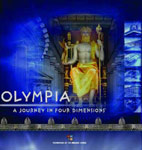
Olympia: A Journey to Four Dimensions


"The publication "Olympia. A Journey to Four Dimensions" is a "digital album" with three-dimensional reconstructions of the most important buildings of ancient Olympia, which are presented with emphasis on historical accuracy and construction details. For the first time the site of ancient Olympia is presented in a book, as it was in its heyday, exclusively through digital pictures.

The main part of the book consists of large coloured images of the various monuments of Olympia, as well as general perspectives of the site, the birthplace of the Olympic Games. Architectural monuments and areas that no longer exist in their original form come to life through the use of computers and of three-dimensional graphics programs.

The book has been created as part of the activities of the Foundation of the Hellenic World for the Olympic Games that were organized in our country in 2004. At the same time, a series of twelve postal cards has been published with select pictures from this book. The production of digital reconstructions was done exclusively by the 3D Reconstruction and Animation Department (http://3d.fhw.gr/) of the Foundation of the Hellenic World."

Olympia: A Journey to Four Dimensions is available in Greek or English.

Friday, May 09, 2008

The Afghan Campaign - A Review


by Mary Harrsch

Stephen Pressfield has garnered laurels for his ability to describe the utter brutality of ancient warfare and his descriptions of battles fought during the campaign of Alexander the Great in Afghanistan in his novel "The Afghan Campaign" are as wrenching as those depicted in Pressfield's "Gates of Fire".

Told from the perspective of a common soldier rather than from Alexander's viewpoint or the viewpoint of one of Alexander's commanders, "The Afghan Campaign" provides the reader the opportunity to experience the grinding existence of a man struggling to maintain some shred of integrity in a hostile and intractable world.
Alexander is most often glimpsed from a distance and we are not privy to his strategic debates or daily dispatches to help us understand the "big picture" he sees in his efforts to add the tribes of the Hindu Kush to his role of conquered nations. We must, through Matteius' eyes, simply endure the relentless wind, quagmires of mud, and bitterly cold snow and sleet, as we climb and descend the deadly precipices that score the Afghan countryside in search of a foe that materializes suddenly to engage in deadly tribal rituals, counting coup and scalping or mutilating their victims, then escapes back into the mountains where, unlike the Macedonians, they appear to thrive. We feel Mattteius' frustration rise to an excruciating level as his comrades are butchered in ambushes or slain by duplicitous camp followers.

As the war wears on, he participates in retaliatory strikes where entire villages are put to the sword and torched as efforts intensify to "win" an ultimately unwinnable war. Matteius' acceptance of these measures poignantly demonstrates the ultimate result of living amidst so much brutality - the loss of one's own humanity as both sides must cultivate ruthlessness to simply survive.

Tuesday, May 06, 2008

Farewell Britannia: A Family Saga Of Roman Britain: A Family Saga of Roman Britain


Brilliant young historian Simon Young has invented a multi-generational family, part Roman, part Celtic (invaders intermarrying with natives) to tell the dramatic story of 400 years of Roman rule in Britain. Vivid historical detail is balanced by a real feel for the psychological depth of the individual stories. The narrator is writing this 'family history' in 430 AD, realising the Romans will never return. He chooses 14 of the most interesting, but not always the most admirable, of his ancestors. The big events of Roman Britain are all here: scouting for Caesar's expedition in 55 BC; the Roman invasion in 43 AD; Boudicca's revolt and the massacre of 70,000 Romans; the Pict attacks on Hadrian's Wall; the great Barbarian Conspiracy of 367; and the sudden cataclysmic departure of the legions in 410. But there are plenty of non-military episodes: spying on the Druids; a centurion dreaming of retirement with a young slave he has bought; an ambitious wife on the northern frontier; a bad poet in Londinium; infanticide in Surrey; a young Christian girl facing martyrdom in a British amphitheatre.

Saturday, February 09, 2008

A Greek Army on the March: Soldiers and Survival in Xenophon's Anabasis


"Professor [John W.I.] Lee provides a social and cultural history of the Cyreans, the classical Greek mercenary soldiers depicted in Xenophon's Anabasis. While the Cyrean army has often been thought of as a single political community, Lee reveals that in fact the soldiers' lives were shaped largely by their participation in a set of smaller social communities: the formal unit organization of the lochos ('company') and the informal comradeship of the suskenia ('mess group'). Drawing on a wide array of ancient literary and archaeological evidence, along with comparative perspectives from military sociology and modern war studies, he examines the full range of the Cyreans' experience, including the environmental conditions of their campaign, ethnic and socio-economic relations amongst the soldiers, equipment and transport, marching and camping, eating and drinking, sanitation, and medical care. He also accords detailed attention to the non-combatants who accompanied the army. Anyone interested in ancient Greek warfare or in Xenophon's Anabasis will want to read this book."

Scheduled for release February 29, 2008

Friday, February 01, 2008

Rome and Jerusalem: The Clash of Ancient Civilizations by Martin Goodman


"As the People's Front of Judea concluded after asking "What have the Romans ever done for us?", the city of Jerusalem blossomed under the Roman Empire, benefiting from strong trade links and centuries of peace and religious tolerance.

Such a happy coexistence was not to last however, with the fabled Temple of Jerusalem completely destroyed in 70AD by the future Emperor Titus and the Jewish people subjected to increased taxation and discrimination, culminating in the renaming of Judea to Palestina in a final push for political and religious hegemony.

Rome and Jerusalem therefore asks the question whether such a deterioration of relations between the two great cities was inevitable, or even deliberate, or whether it was an unintended consequence of political intrigues.

As such, the book not only addresses the issues of Roman imperialism and the place of religion within the state but also touches upon the origins of 2,000 years of Western anti-Semitism..."

"...Goodman's great skill lies in his vivid portrayal of the vanities and ambitions of the leaders of both sides and, as such, his overriding argument that the calamitous deterioration of relations between the two cities was almost a tragic accident caused by a series of decisions taken by Emperors interested solely domestic politics and glory, becomes highly plausible.

However, Rome and Jerusalem is not simply another 'Great Man' account of historical shifts, but rather the author cites contemporary accounts from observers such as Josephus and Pliny the Elder to give an equally vivid account of day-to-day life among the ordinary citizens of the two cities. Thus, readers benefit from a fuller context to the clash of the two cities, from daily religious observations to the differing trade and cultural priorities of the pair. "

Monday, January 21, 2008

The Palace of Illusions by Chitra Banerjee Divakaruni reimagines epic of ancient India


"A reimagining of the world-famous Indian epic, the Mahabharat—told from the point of view of the wife of an amazing man.

Relevant to today’s war-torn world, The Palace of Illusions takes us back to a time that is half history, half myth, and wholly magical. Narrated by Panchaali, the wife of the legendary Pandavas brothers in the Mahabharat, the novel gives us a new interpretation of this ancient tale.

The novel traces the princess Panchaali's life, beginning with her birth in fire and following her spirited balancing act as a woman with five husbands who have been cheated out of their father’s kingdom. Panchaali is swept into their quest to reclaim their birthright, remaining at their side through years of exile and a terrible civil war involving all the important kings of India. Meanwhile, we never lose sight of her strategic duels with her mother-in-law, her complicated friendship with the enigmatic Krishna, or her secret attraction to the mysterious man who is her husbands' most dangerous enemy. Panchaali is a fiery female redefining for us a world of warriors, gods, and the ever-manipulating hands of fate."

Scheduled for a February 2008 release.

Sunday, January 13, 2008

Bulgarian author shares love of her country and its ancient history in new time travel novel


I'm so excited to see that a woman from Bulgaria with a love of her country's ancient history has written a time travel novel that whisks readers back in time to 5th century BCE Thrace. I've been fascinated by all of the reports of such beautiful artifacts that have been peppering the news these past few years and have yearned to learn more about the history of ancient Thrace Now I can do this in a book that also gives me a time travel adventure as well.

Thracian Princess by Bistra Johnson, (nee Tangarova), explores the world of Thrace when its tribes were unified by the Odrysians and ruled by their leader Teres in the 5th century BCE.

"The 144-page book itself tells the story of Veronica, a young English woman whose parents bought a house in Stara Zagora and moved to Bulgaria. In somewhat of a period of transition herself, she goes to visit them, meets a handsome neighbour (an architect, at that) and starts to learn about the country.

Then, the reader is as surprised as is Veronica – suddenly she is in ancient Thrace (called Trakiya in Bulgarian), and the beloved new wife of the king.

Through this experience, the reader, like Veronica, learns first-hand about a world that is probably unknown to most.

Bistra says that her facts came from a variety of sources and lots of research. A comprehensive glossary at the back substantiates and further explains many of the characters and terms. For example, the town where the novel is set has been known under eight names: Beroe (meaning “iron”, a Thracian settlement), Augusta Trajana (Roman era), Beroia/Vereia, Irinopolis (in honour of Empress Irina, in the Byzantine era), Boruy (during the First Bulgarian Kingdom), Eskizagra (Turkish for “behind the mountain”), Zheleznik (Slavic for “iron”), and now, finally, Stara Zagora (meaning “the old one behind the mountain”)."

Thracian Princess is available from Lulu.com in both English and Bulgarian.

Tuesday, December 25, 2007

Strassler's The Landmark Herodotus released by Pantheon Press


Robert Strassler, the 70-year-old president of Riverside Capital Management Corp., a private investment firm, is a Harvard graduate who describes himself as a historian of the ancient Mediterranean. Back in 1996, he edited "The Landmark Thucydides: A Comprehensive Guide to The Peloponnesian War," that was published by CBS Corp.'s Free Press. This book received excellent reviews and sold over 24,000 copies. It has taken 10 years for a sequel "The Landmark Herodotus" is now available from Pantheon with 20,000 copies in print.

When Wall Street Journal columnist, Jeffrey Trachtenberg asked Strassler why it took so long to write this sequel, Strassler says, "Thucydides is more narrowly focused. He was interested only in military and political history. Herodotus is interested in everything. He wants to know what people wear, what gods they worship, what crops they grow. I needed 11 appendices for Thucydides to provide context, but we have 21 for Herodotus, and we could have done another five to 10."

When asked about the reliability of Herodotus' chronicles, Strassler replies, "There are a lot of questions. He does tend to write about fables, things that aren't real. His job was to tell you what he heard. He's critical, but there are anecdotes where you don't know if he's pulling your leg, or his leg is being pulled. For example, he said he saw a sign on one of the Pyramids. He asked his Egyptian guide about it and says he was told that the sign listed the amount of garlic, leeks and onions consumed by the workmen over the 20 years it took to build the pyramid. Do you think he believed it? But he put it in his book. You can't always be sure. And he wasn't an eyewitness to everything. But this book has survived for 2,500 years, and it offers a huge panorama of his world."

If you wish to learn even more about Herodotus, I would highly recommend an audio course offered through the Teaching Company, Herodotus: Father of History presented by Professor Elizabeth Vandiver of Whitman College.

Friday, July 27, 2007

Popular Morality in the Early Roman Empire by Teresa Morgan


Morality is one of the fundamental structures of any society, enabling complex groups to form, negotiate their internal differences and persist through time. In the first book-length study of Roman popular morality, Dr Morgan argues that we can recover much of the moral thinking of people across the Empire. Her study draws on proverbs, fables, exemplary stories and gnomic quotations, to explore how morality worked as a system for Roman society as a whole and in individual lives. She examines the range of ideas and practices and their relative importance, as well as questions of authority and the relationship with high philosophy and the ethical vocabulary of documents and inscriptions. The Roman Empire incorporated numerous overlapping groups, whose ideas varied according to social status, geography, gender and many other factors. Nevertheless it could and did hold together as an ethical community, which was a significant factor in its socio-political success.

About the Author
Teresa Morgan is University Lecturer in Ancient History at Oxford and a Fellow of Oriel College. She is the author of Literate Education in the Hellenistic and Roman Worlds (1998).